The mother's cognitive decline and loss of independence
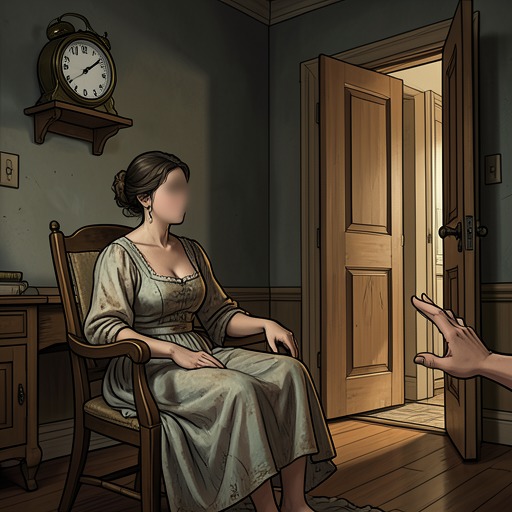
ErasureAgnes Ellison’s cognitive decline and loss of independence reshape family life around the unstable boundary between recognition and absence. Her condition does not unfold as a simple, uninterrupted vanishing: moments of confusion and danger coexist with flashes of familiarity, musical pleasure, and painful self-awareness. Through Thelonious Ellison’s close attention to her changing abilities, the narrative makes caregiving a daily negotiation among medical uncertainty, physical safety, and the knowledge that his mother remains a person even when she cannot consistently recognize him.
Identity and Medical Uncertainty
The account initially resists an easy diagnostic explanation. When Thelonious Ellison takes Agnes to a doctor, an X-ray finds no lung infection; a CAT scan shows no stroke and no visible brain shrinkage, and testing finds no vitamin B-12 deficiency. The doctor does identify tangled nerve fibers, but the scene offers no simple answer that can make her changes manageable. During the appointment, he has the same conversation with Agnes twice. She notices the repetition and asks, “Why are we going over this again?” Her response registers both a present awareness of what is happening and the limits of what the examination can explain.
The uncertainty matters because the family must respond to the effects of her decline without a clear medical resolution. The narrative shows cognitive changes through particular incidents: disorientation, altered judgment, failing recognition, and increasing dependence on others. It does not treat one medical observation as a complete account of Agnes’s condition. Instead, the accumulating evidence comes from home, visits, conversations, and the practical work of keeping her safe.
Disorientation and Immediate Risks
One stark domestic episode makes the danger concrete. Agnes has a gun in her shaking hands; Thelonious approaches carefully, pushes its muzzle away, and takes it from her. He tells her that he will handle the man and sends her to her bedroom for a nap. After watching her turn the corner, he checks the pistol and finds it loaded. The scene shows how a familiar household can become unsafe when judgment and orientation are compromised. Care requires not only reassurance but also attention to objects that can cause immediate harm.
Later, the risk takes a quieter but no less alarming form. Lorraine finds Agnes standing in a light-blue skiff on the still pond, apparently without excitement or awareness of the situation. Thelonious knows that his mother hates water and remembers how difficult it once was to persuade her into a boat. He swims toward her in cold water; when he reaches for the boat, she strikes his hand with an oar. He circles until he can see her eyes, but recognizes that the familiar face does not mean she understands who he is. Rather than approach again, he takes hold of the floating tie rope and repeatedly tells her, “It’s okay, Mother.” Then he addresses her formally as Mrs. Ellison and tells her, “there’s no standing allowed in the boat.” She sits, and his movements in the water immediately relax. The change of address succeeds where appeals based on their intimacy have not: the scene records a practical adjustment, not a restoration of recognition.
Care, Dependence, and Family Life
Agnes’s physical condition does not decline in step with her cognition. After she is placed in care, Thelonious visits every day for the first three weeks. Staff keep close watch, and he is confident that she is safe; meanwhile, she is more often mentally absent, yet her body becomes healthier. She gains weight and her hand strength improves, even as the doctor warns that this physical improvement will not last. The contrast unsettles any expectation that outward health can stand as a reliable measure of how she is doing.
Her loss of independence becomes particularly visible in intimate care. Her incontinence worsens, and although she appears physically strong enough to move herself, she chooses not to. During one visit, a nurse and an orderly change her soiled bedding and clean her while she lies uncovered from the waist down. Thelonious turns away, but still sees Agnes’s head roll toward him and her vacant eyes point in his direction. The scene’s force comes from the distance between the woman he remembers and the bodily dependence he witnesses—not from treating that dependence as an abstraction. He recalls her description of seeing colors while listening to Mahler: “Ashen greens giving way to reds and ochre while the sky darkens and the night feels cool.” The remembered precision of her musical perception makes the present loss of communication more painful.
Recognition, Preference, and Remaining Selfhood
The decline is variable, and the narrative repeatedly distinguishes a brief moment of recognition from a lasting recovery. After a night spent watching over Agnes, Thelonious fears that he will wake to find her bed empty and her body in the creek or at the bottom of the stairs. When she wakes, she takes him in for a few seconds and says, “Good morning, Monksie.” The greeting is small but unmistakable: recognition still occurs, though it cannot be assumed or relied upon.
At the care home, Thelonious continues to encounter Agnes in and out of herself. When she is present, they listen to music and talk about going into the city to hear something at the Kennedy. She may then drift peacefully to sleep. These visits provide moments of shared pleasure, but they do not undo the wider pattern of decline. Thelonious sometimes cries in the car afterward, carrying the sadness of those encounters beyond the institution.
A later lucid interval gives Agnes language for her own changing experience. She tells Thelonious, “The hard part is seeing myself, what I’ve become. I see for a couple of seconds and then I don’t know where I am.” She asks him to come on Thursday, predicting that she will have a good day. The nurse explains that old friends have visited, but Agnes stared past them toward the window; one visitor had come before and received the same response. The contrast is not simply between family and strangers: Agnes can sometimes know Thelonious, while familiar visitors may remain beyond her recognition. The nurse’s own account makes the limits of recognition relational, too: Agnes knows the nurse much of the time, but says the nurse means nothing to her and is “just furniture.”
The Final Visits and the Meaning of Care
On the Thursday Agnes predicted, she smiles at Thelonious, asks for something nice, and chooses Ravel, describing the music as “so dancey.” With her eyes closed, she reflects on Ben Ellison. She suspects that he was sometimes bored with or annoyed by her, though he never said so; she recalls that he denied being wearied when she once asked him. She also insists that she knows he loved her and remembers that they had good times. The exchange reveals a continuing capacity to interpret a relationship and revisit its uncertainties, even amid severe cognitive loss.
Agnes ends the reflection by recalling a promise she made to herself not to grow old and smell of mentholated spirits. Thelonious answers, “I can’t smell it, Mother.” His reply does not correct or dismiss her perception; it offers reassurance within a moment of closeness. Across the episodes, care consists of such adjustments: removing a loaded pistol, finding another way to guide her into sitting, visiting daily, listening to music, and responding to a lucid fear without claiming that it will last. The narrative neither equates memory loss with the disappearance of Agnes’s personhood nor pretends that affection can restore her independence. It keeps both truths in view: her needs become more demanding, and moments of preference, insight, humor, and connection remain consequential.