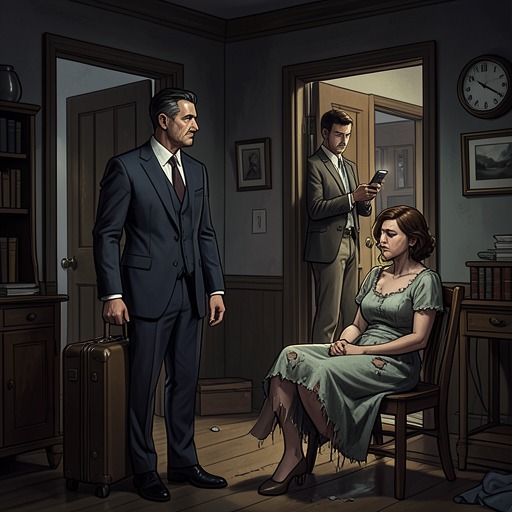
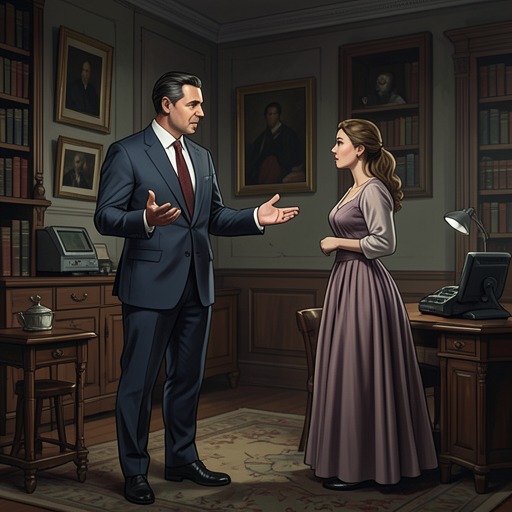
The identity split between Thelonious Ellison and Stagg R. Leigh
ErasureThe identity split between Thelonious Ellison and Stagg R. Leigh turns a pen name into a rival public self. Thelonious’s attempt to keep his authorship secret becomes increasingly difficult as Fuck is advanced for release, submitted for an award, and celebrated in public. The division is at once practical—a way to separate the writer from a marketable persona—and existential: as Stagg acquires an audience, Thelonious begins to wonder whether the character has become independent of him, and whether recovering his own identity will require giving up the self he has made.
Concealment and the Award
The split sharpens when Thelonious learns that Fuck will be released earlier than expected because of the interest in it. The news reaches him through his editor, who contacts his agent; Thelonious, meanwhile, is still expecting to see the book in March. In January, a padded envelope addressed to Thelonius Ellison arrives with a bound galley and a request that the novel be considered for The Book Award. The book’s movement through the publishing world has brought the secret directly to its author under his own name.
Thelonious frames the submission as a dilemma. He refuses to acknowledge that he, Thelonious Ellison, is also Stagg R. Leigh, yet admitting this would expose the concealed authorship. He also cannot disqualify himself without betraying the secret. His chosen response is to ignore the submission, reasoning that the novel is not a plausible award winner. The solution depends on the distance between the identities: he treats the book as though it belongs to someone else, although the problem exists precisely because it does not.
That separation is tested again at the National Book Association committee meeting in New York. Thelonious travels there under the arrangement made by the association’s staff, sitting among the judges while remaining silent and listening closely as they discuss the books. Ailene Hoover eventually brings up Fuck. Her question about whether the others have read it makes the novel, which Thelonious has tried to keep at a distance, present within the very process that could publicly validate Stagg. The scene places him in two incompatible positions at once: a committee participant and the concealed author of a book under consideration.
Performing Stagg in Public
The journey to New York makes the division feel less like a clean separation than a performance carried by one person. Thelonious imagines Thelonious, Monk, and Stagg Leigh making the trip together on the same flight and, pointedly, in the same seat. He considers the possibility that the charade could get out of hand and become an actual condition of divided personalities, but tells himself that he is acting and that the work is well paid. At the hotel, he arrives as himself, as the son his mother sees as Monksie, and as the artist in his own eyes. These are not separate travelers; they are positions he occupies and tries to keep distinct.
Before Stagg appears publicly on Kenya Dunston’s program, Thelonious asks Yul whether he remains the only person who knows the secret. Yul says that no one in the office knows, except Isabela, the accountant, who has not put the pieces together. Thelonious resists Yul’s suggestion that the exposure might eventually seem amusing or even help sell his other books. He insists that nobody will ever know he wrote the novel. In response, Yul tells him to get into character. Thelonious puts on Stagg Leigh’s dark glasses, making the disguise both a practical means of concealment and a visible act of becoming.
The television appearance makes the concealment public in a new form. Stagg is presented to the audience as the author of a forthcoming first novel that is expected to be a bestseller and whose film rights have already been sold. Because the guest will appear only behind a screen, the audience welcomes a silhouette rather than an identifiable face. The public response gives Stagg a life in the symbolic space of publicity even while Thelonious’s body remains hidden. The screen protects the secret, but it also supplies the audience with an image of the separate author it has been invited to admire.
Authorship and Agency
Thelonious’s questions after the appearance expose how unstable the arrangement has become. He wonders whether erasing his own presence has asserted Stagg’s individuality, or whether the book itself has given Stagg life. The audience is responding to the figure presented behind the screen, and Thelonious imagines what might happen if he can no longer keep holding his breath. He even asks himself whether Stagg would have to be killed to silence him. The thought that Stagg might possess agency is itself part of the crisis: Thelonious is considering his creation as an independent force while knowing that he made it.
This contradiction is not resolved into a firm diagnosis or a simple discovery of a hidden, authentic self. Instead, the narration holds the questions open. Thelonious recognizes that he can ask whether Stagg has agency, then immediately regards the thought as meaning nothing and everything. The oscillation captures the split’s double character: Stagg is a constructed identity, but the public response to the identity gives the construction real consequences. The persona does not need to exist as another person in order to exert pressure on its maker.
The consequences are also formal. Thelonious describes himself as having reconfigured and then disintegrated himself, leaving two bodies of work and two bodies, with no boundaries but walls everywhere. The phrasing joins literary production to bodily identity without making the two neatly equivalent. His work has been divided between his established authorship and the novel published under Stagg’s name; the image of walls suggests that secrecy has not produced a stable boundary, but a proliferation of barriers. The mirror image intensifies the paradox: seeing himself with nothing to hide does not bring reassurance, but prompts him to turn away. The absence of a concealment to remove becomes another reason the self is difficult to face.
Crisis and Significance
Thelonious’s proposed solution becomes more severe as he considers the award. He imagines going out around 14th Street and T in Washington and finding a person who would, by every measure, be Stagg Leigh. He also knows there is no such separate person, even as he feels that there is one, because Stagg is himself. The fantasy of locating and eliminating an external rival collapses into the recognition that he created the figure he would have to confront. His comparison of himself to a god contemplating a creation he cannot accept makes authorship seem less like control than responsibility for an outcome that has escaped its maker’s intentions.
He resolves that he cannot allow the committee to select Fuck as the nation’s most prestigious award winner. In his own formulation, defeating Stagg is necessary to save his own identity: he wants to silence the creation and have the world acknowledge that Stagg never existed. Yet this plan depends on the same public recognition that sustains the split. The book’s success has made Stagg visible, and Thelonious’s attempt to erase him imagines an audience whose judgment would make that erasure complete.
The novel’s commercial rise intensifies the conflict rather than settling it. By the middle of January, Fuck is number one on the New York Times bestseller list and has been selected by two additional book clubs. These developments make the boundary between author and pseudonym harder to maintain: Stagg’s reputation is no longer an abstract disguise but a public success attached to a work Thelonious wrote. His recurring movement between concealment and exposure, denial and recognition, makes the identity split a crisis of authorship as well as selfhood. The more effectively Stagg exists in the world, the less easily Thelonious can treat him as someone who does not.