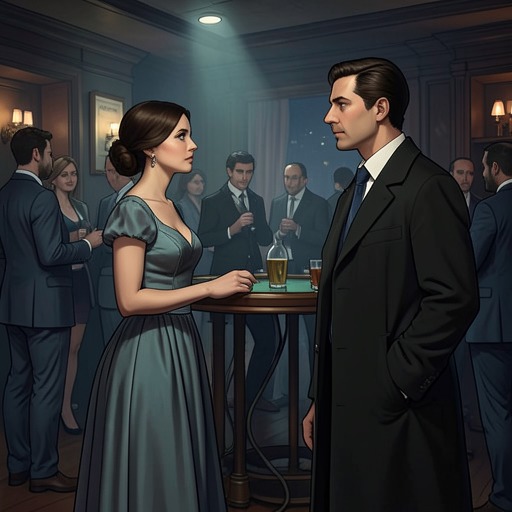
Fabian rejects Moll’s offer and leaves Berlin for home
FabianFabian rejects Moll’s offer and leaves Berlin for home in a sequence that turns departure into a refusal of escape. Bereaved, unemployed, and convinced that Berlin has nothing left to hold him, he boards a train; when Irene Moll appears in the corridor and proposes a life of travel and money, he repeatedly chooses instead to go to his mother. The journey ends not in renewal but in grief: at the family soap shop, he tells his mother that Labude has shot himself and weeps alone in the back room.
Departure from Berlin
In the aftermath of Labude’s death, Fabian decides he cannot stay in the city. He does not want to be present when his friend is laid to rest, and the thought of seeing Cornelia in a passing car briefly stops his heart before he recognizes that the woman is not her. He concludes that no ten horses could keep him in Berlin. The decision is not a planned return to a settled life so much as a breaking away from a place where his work has been lost, his closest friend is dead, and his relationship with Cornelia has ended.
Fabian goes to the station without returning to Frau Hohlfeld’s room, leaving everything there as it was. He also abandons any intention of visiting Zacharias, whom he regards as vain and dishonest. With the express train due in an hour, he buys a ticket and newspapers and waits. Once he has seen Cornelia’s photograph in a newspaper, he carefully cuts out the pictures, puts the clippings in his notebook, and throws the papers away. Berlin’s remaining attachments seem severed; he wants home, his native town, and his mother. When other passengers spread out at his table, he gets up, passes through the barrier, and boards the train.
The encounter with Moll
During the journey, Fabian watches fields, meadows, telegraph poles, children, a horse and foal, and then a dark fir forest pass by. The landscape seems to move around him, but the other passengers remain absorbed in themselves. In the corridor, he discovers Irene Moll smoking and smiling at him. She remarks that the two of them keep chasing one another and asks where he is going. He answers that he is going home; when she demands the courtesy of being asked about her own destination, he asks where she intends to go.
Moll explains that she is running away because one of the lodgers at her establishment has informed on her. She learned of the danger that morning from a police officer whose monthly salary she had doubled. She asks Fabian to come with her to Budapest. When he refuses, she raises the stakes: she has a hundred thousand marks, so they need not stop at Budapest. They could travel through Prague to Paris and stay at the Claridge, or rent a small villa at Fontainebleau. Fabian still says no and repeats that he is going home.
Moll tries another appeal, mentioning the jewelry she has with her and proposing that, when they run out of money, they blackmail the wealthy older women who had slept at her establishment. She claims to know compromising details, adding that peep-holes have their uses, and asks whether he would prefer Italy or Bellagio. The offer joins travel and luxury to the exploitation of other people. Fabian declines again: he is going to his mother.
A refusal of money and escape
Moll’s proposal becomes personal. She calls him a fool and asks what he has against her, whether he finds her too sophisticated, and whether he would rather have a silly goose. She says she is tired of taking up with the first man available, that Fabian appeals to her, and that their repeated encounters cannot be coincidence. Taking his hand, she strokes his fingers and asks him to come with her. Her appeal mixes attraction, insistence, and a claim of fate; Fabian does not answer it by entering into an argument about their relationship. He simply refuses and wishes her a good journey.
As he turns back toward his compartment, Moll holds him briefly and says it is a pity, perhaps there will be another time. She opens her handbag and offers him banknotes. Fabian closes his hand into a fist, shakes his head, and goes inside. The gesture makes the refusal concrete: he rejects not only the proposed destinations and the prospect of a relationship, but also the money that might have made the journey possible. Moll stays outside the compartment door for a while, watching him through the window as the train passes through a village.
Arrival and grief
Fabian reaches his destination around six in the evening. He leaves the station and sees the Dreikönigskirche; the familiar town comes back through particular landmarks, among them the old viaduct, a freshly painted house where the teacher Schanze once lived, and a new butcher’s shop in the corner house associated with the midwife Schröder. The other houses remain in their old gray row. Although the street and buildings are familiar from childhood, the people emerging from the houses seem foreign to him.
At the house where he was born, Fabian stops before a shop sign reading “Seifengeschäft.” A window notice advertises reduced prices for fine soaps: the house-brand lavender soap is twenty instead of twenty-two pfennigs, and Torpedoseife is twenty-five instead of twenty-eight. Inside, his mother serves two women. She sets a packet of washing powder on the counter, cuts a bar of hard soap in half, then measures soft soap from a barrel with a wooden spoon and wraps it in paper. Fabian recognizes the smell of soap from the street before he opens the door.
The bell rings, and his mother looks up, startled, her hands falling still. Fabian goes to her and, with a trembling voice, tells her that Labude has shot himself. Tears come suddenly. He opens the door to the back room, closes it, sits in the armchair by the window, looks out into the yard, then slowly lays his head on the windowsill and weeps.
The return’s significance
The journey gives Fabian a destination but not a resolution. He leaves Berlin because loss has made the city uninhabitable to him, yet the homecoming does not erase that loss: his first words to his mother carry the news of Labude’s death. The contrast between Moll’s vivid itinerary—Budapest, Paris, Fontainebleau, Italy—and Fabian’s repeated, plain declaration that he is going home gives the scene its shape. He refuses the money, the proposed escape, and Moll’s suggestion that their recurring encounters amount to fate.
The return also moves from public transit to intimate grief. In Berlin, Fabian waits among newspapers, passengers, and the rush of the station; on the train he watches the landscape pass, then encounters Moll in the corridor. At home, the narration dwells on the ordinary work of the soap shop: weighing, cutting, wrapping, and serving. Against those practical routines, the news of Labude’s suicide breaks into the room, and Fabian’s composure gives way. He has reached his mother, but the homecoming offers no triumph or cure—only a place to speak the loss and weep.