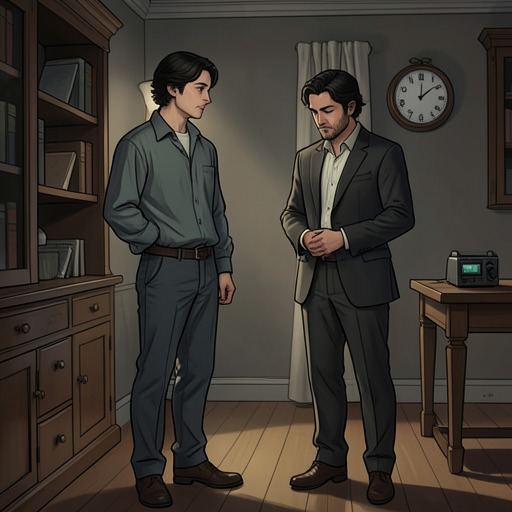
Labude discovers Leda’s infidelity and breaks up with her
FabianLabude discovers Leda’s infidelity and breaks up with her in a sequence that moves from long-distance estrangement, through deliberate surveillance, to a painful confrontation and a declared final separation. The episode breaks his expectation that he and Leda would marry after his habilitation, while leaving him to reckon with the possibility that the five years he invested in the relationship rested on a false understanding of it.
Distance and Suspicion
Labude explains that he and Leda, who lived in Hamburg while he was in Berlin, spent only two days and a night together each month. Repeated for years, these brief visits had become a cycle: a kiss at the station, a conversation, a night together, and another parting. In his view, the arrangement had steadily undermined intimacy. They no longer knew one another’s worries or acquaintances, or how and why the other had changed; letters could not repair the distance. He describes their scheduled sexual encounters as governed by the calendar and the clock, and concludes that love had succumbed to geography.
His suspicion had grown over the preceding months. He believed Leda had changed and begun to act a part: the affectionate greeting, tender conversation, and passion in bed seemed to him like theatrical performances. He had repeatedly asked her by letter for explanations, but she avoided giving them. Labude says that before each visit he had begun to feel afraid, and that even when Leda held him, her face seemed to him like a mask. His account presents the discovery not as a sudden beginning of distrust, but as the point at which an already accumulating estrangement becomes impossible for him to ignore.
Waiting Outside Leda’s House
On the night Labude and his companions founded the student initiative group, he left early and went to the house where Leda lived, intending to watch her secretly. He found the windows dark and waited across the street on a bench. The setting gave him a long, exposed vigil: opposite the house lay flower beds, meadows, paths, and shrubbery, with the Outer Alster beyond. From midnight until three in the morning, he smoked cigarette after cigarette, mistook passersby for Leda, and imagined the confrontation he might have with her.
Shortly after three, a taxi stopped at the house. A tall, slim man got out and paid the driver; a woman followed, unlocked the door, let the man inside, and shut it behind them. Labude saw the light come on in Leda’s windows, then watched shadows move behind the curtains. The living room went dark and the bedroom lit up. Sometimes he heard Leda laugh; at other moments the house and street were silent except for the sound of his own heartbeat. In the morning, after rain had fallen and stopped, the man left at seven, whistling. Leda appeared on the balcony in a Japanese dressing gown and waved to him; he waved back and blew her a kiss before walking away. Labude watched her close the balcony door.
The Confrontation and Breakup
The following day Labude telephoned Leda. She sounded pleased that he was visiting again and asked why he had not written; she invited him to come at five. He spent the intervening time walking through the harbor district. At her home, she had prepared tea and cake and greeted him affectionately. After tea and ordinary conversation, she began to undress and lay down on the couch. Labude asked how she would feel about ending their relationship.
Leda was surprised. She reminded him that they had agreed to marry once he had completed his habilitation, and asked whether he no longer loved her. Labude said that love was not the immediate question: the growing estrangement, for which he held her responsible, made a separation advisable. Leda acknowledged how hard it was to bridge the distance between Hamburg and Berlin, including their sexual difficulties. She argued that marriage would change matters. She also disclosed that she had undergone a medical procedure weeks earlier, explaining that she wanted to bear their children as his wife rather than before marriage and had not told him because she did not want to worry him.
Labude asked who the aborted child’s father had been. He then asked who the man was who had slept at her house that night. Leda denied his suspicion, calling him jealous and saying he was seeing things. Labude slapped her and left. She ran after him down the stairs and stood naked in her moving dressing gown at the doorway, calling for him to stay. He ran away and took the train. The contrast between their intimacy at the meeting and his abrupt departure gives the breakup its decisive action: the couple’s supposed future is displaced by a confrontation neither can turn back into the routine visit that preceded it.
Aftermath and Retrospective Meaning
Back in Berlin, Labude recounts the episode to Fabian. At the memory of seeing Leda with the other man, he strikes his fist on the desk and cries out in anger, then resumes his account in a controlled voice. Fabian puts his hands on Labude’s shoulders and asks why he had not told him the previous day. Labude says he will get over it, but also says that being lied to has marked the experience. When Fabian observes that he is still ill and still loves Leda, Labude agrees.
He nevertheless declares the case finished: he has spent five years living under a false premise, and that is enough. He says he understood the preceding years only after the breakup, when Leda lay beside him and lied calmly; in five minutes, he felt that the past had become legible. His conclusion is more absolute than the evidence of his continuing love: he believes Leda never loved him, even as he acknowledges that he remains attached to her. The episode thus closes the relationship as a practical commitment while leaving its emotional consequences unresolved. Labude immediately turns toward what comes next, telling Fabian that he has things to make up for and that they have been invited to Ruth Reiter’s studio.