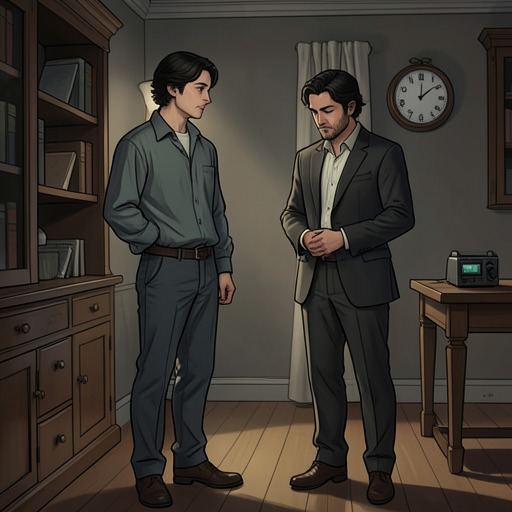
Stephan Labude and Leda’s relationship
FabianStephan Labude and Leda’s relationship is a five-year long-distance affair whose intimate rituals have become a calendar-bound substitute for shared life. Labude’s discovery that Leda has concealed another lover turns their accumulated distance into a decisive break: after watching her with the man, he confronts her, strikes her, and leaves, later concluding that she never loved him.
A Relationship Organized by Distance
Labude describes a pattern in which he and Leda are together for only two days and one night each month, while she lives in Hamburg and he in Berlin. The arrangement does not merely limit their time together; it prevents them from knowing one another’s changing circumstances. They do not share each other’s worries or acquaintances, and Labude says that letters cannot repair what distance obscures. Each visit repeats the same compressed sequence: a greeting at the station, a conversation about news, a night together, and another separation. Their emotional and sexual lives are made to fit the timetable, until intimacy itself feels scheduled rather than freely lived.
The relationship’s geography becomes Labude’s explanation for its deterioration. He calls the arrangement an inevitability, not simply a failure of the partners’ qualities: people who live apart for years cease to see how the other changes or why. His account joins emotional estrangement to sexual frustration. At their meetings, affection and sex occur within a narrow window, as if desire must be completed on schedule. The distance is therefore both literal and relational: the journeys between Berlin and Hamburg expose how little of each other’s ordinary lives they can reach.
Suspicion and the Vigil
Labude says he had grown suspicious months earlier. In his view, Leda’s behavior had begun to seem performed: the station greeting, tenderness in conversation, and passion in bed all appeared to him like theater. He had previously hinted to Fabian that she had changed, but her repeated avoidance of explanations left him without confirmation. He says he had come to dread their meetings, and that when Leda held him with closed eyes, he sometimes wanted to tear away the mask he believed she was wearing. His suspicion thus precedes the discovery, but the evidence arrives through observation rather than through a confession.
On the night the student initiative group is founded, Labude leaves the gathering early and goes to the house where Leda lives. The windows are dark, but he cannot make himself leave. Across the broad street, on a bench opposite the house, he smokes and waits from midnight until three in the morning. The street’s other side opens onto flower beds, lawns, paths, bushes, and the Outer Alster; amid this quiet setting, each passerby briefly seems to him to be Leda. Shortly after three, a taxi stops at the house. A tall, slender man gets out, pays the driver, and is followed inside by a woman who unlocks the door and holds it for him. The taxi returns to the city.
Labude identifies the woman as Leda when the lights come on behind her windows. From his place across the street, he watches two shadows move behind the curtains. The living room goes dark, then the bedroom lights up; the balcony door stands partly open. He hears Leda laugh, a sound he knows, and at other moments hears only his own heartbeat. The watch is a stark contrast to their monthly visits: instead of the intimacy they have arranged by mutual appointment, Labude sees a private night from outside, unable to enter or speak, while the successive changes of light make his suspicion more concrete.
Confrontation and Separation
The next day, Labude telephones Leda. She sounds pleased that he is visiting and asks him to come at five. He runs through the harbor district until it is time, then arrives to find tea and cake prepared and Leda greeting him tenderly. After drinking tea and talking about indifferent matters, she automatically begins to undress, wraps herself in a kimono, and lies on the couch. Labude then asks what she would think about ending their relationship. The familiar choreography of a visit has continued, but he refuses to let it pass as proof that their bond is intact.
Leda responds that they have always intended to marry once Labude completes his habilitation. She asks whether he no longer loves her. He tells her that the question is not his love but the estrangement he believes she has caused. Leda partly acknowledges the difficulty of bridging the distance between Hamburg and Berlin, and the sexual conflicts it creates: when she wants him, he is absent; when he is present, she says, love has to be dealt with like a midday meal, whether either is hungry or not. She argues that marriage would change matters. She also tells him that she had undergone a medical procedure weeks earlier, explaining that she wanted to have their children as his wife and had kept the procedure from him so as not to worry him. Labude’s account presents this disclosure alongside the secrecy and distrust already shaping the encounter; he asks about the child whose termination she says had been reversed, then about the man he saw at her home.
Leda denies that the man was there and calls Labude jealous, saying he sees ghosts. Labude slaps her and leaves. She runs after him down the stairs and reaches the doorway naked beneath her loose kimono, calling for him to stay. He runs away and takes the train. The abrupt departure replaces the relationship’s accustomed cycle of meeting and separation with a break that Labude treats as final: the visit does not end in another month of waiting for the next appointment.
Aftermath and Meaning
Labude later tells Fabian that he has spent five years living under a false assumption. The worst realization, as he describes it, is not only that Leda lied during their final confrontation but that she never loved him at all. In retrospect, her lie beside him makes the preceding years seem newly legible to him; he says that the account of their past suddenly adds up only after he has ended the relationship. He pushes Fabian toward the door and announces that the matter is finished, giving the separation the force of a decision rather than an invitation to negotiate.
The relationship’s ending also alters how Labude speaks about love and responsibility. Elsewhere, Ruth Reiter describes herself as having been left by two men after giving herself to them, and Fabian answers that young men have too little time for love and face a trap in either accepting or refusing responsibility for a woman’s future. This exchange does not establish the circumstances of Leda’s other relationship, but it places Labude and Leda’s failed intimacy within a wider conversation about attachment, economic insecurity, and the costs of commitment. Their affair makes that contradiction concrete: they had planned marriage after Labude’s academic qualification, yet their present life together had already narrowed to infrequent visits, concealed changes, and sex governed by the clock.
At Haupt’s, a dance hall where Labude and Fabian sit apart from the spectacle, two dozen street girls descend from the gallery each evening in colorful bathing suits; the arrangement grants them entry and a free drink, while customers crowd toward them. The scene does not reveal anything about Leda’s conduct, but it establishes the commercialized and theatrical sexual environment through which the novel sets its intimate relationships. Labude’s description of his own visits to Leda as theater carries a different, personal charge: what he had taken for tenderness and passion now appears to him as performance. Later, in a vision of a grotesque exhibition, Leda is not identified among the people Fabian recognizes, so that scene supplies no further evidence about her or the affair. What the relationship itself leaves behind is more sharply bounded: five years of repeated separation end not in marriage or reconciliation, but in Labude’s conviction that the love he had trusted was never mutual.