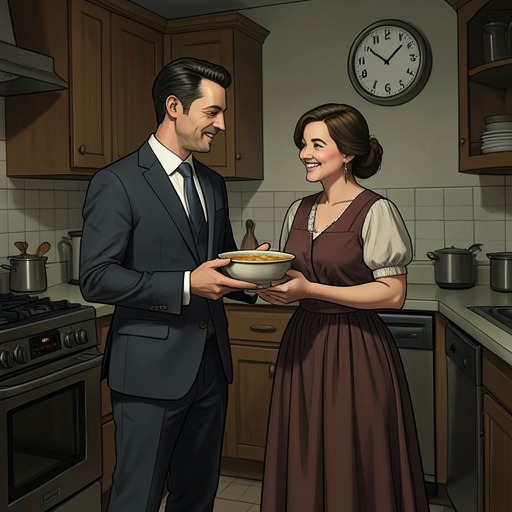
Jakob Fabian—Fabian’s mother
FabianJakob Fabian—Fabian’s mother is a relationship shaped by quiet care and concealment. She has labored and saved for her son, and he responds with affection, practical generosity, and a protective lie about his circumstances. Their bond is most visible in modest gestures: laughing together at a film, saying goodnight across a dark room, exchanging money without telling each other, and finally sharing the news of Stephan Labude’s death in tears.
Identity and Background
Fabian’s mother is a working woman whose life has been marked by illness, effort, and thrift. When she visits her son, she reflects that if she had been as healthy earlier, he would have had a better life. Fabian answers that things had not been so bad and, more decisively, that the past is over. His reply does not erase her regret; it refuses to make their shared history a charge she must continue to carry.
Her practical habits persist even in moments of leave-taking. Before departing, she makes sure that a coat loop has been sewn back on and that the room has been put in order. She worries that a suitcase may be stolen if left unattended, and Fabian, in turn, becomes the more watchful of the two, keeping an eye on the luggage rack through the train window. Their care runs both ways, though it takes different forms: she attends to belongings and food, while he watches over her and tries to ease her burdens.
Shared Time and Everyday Intimacy
During her visit, Fabian takes her to a talking picture. The film is a foolish theatrical comedy, extravagantly luxurious and staged in a world of improbable opulence. The movie itself is less important than the mother’s repeated laughter: her amusement makes Fabian happy enough to laugh with her. For a little while, shared pleasure interrupts the hardships each carries.
At home, the question of who should sleep in the bed and who on the sofa becomes a small contest of consideration, which Fabian wins. Before settling down, he tells her that a young woman lives next door and that he is her friend, then goes to check on her. The woman is already asleep; Fabian returns and takes the sofa. His mother observes that such an arrangement would not have been possible in the past. The exchange registers how the present differs from an earlier, more constrained life without spelling out every cause of that change.
Just before falling asleep, Fabian gets up again and crosses the dark room. Bending over his mother’s bed, he gives her the familiar bedtime farewell he used in childhood. She answers and opens her eyes, though he cannot see her in the darkness; he finds his way back to the sofa by touch. The scene makes their affection physical and unceremonious: a son’s old ritual survives even when neither can fully see the other.
Protection, Work, and Departure
The next morning, his mother urges Fabian to get to work and says that she will meet him outside the office that afternoon before he takes her to the station. She also admits that she could no longer bear staying where she had been, but tries to reassure him that she is feeling better. Her advice is practical and tender: he should sleep more and not take life so heavily, since doing so will not make it easier.
Fabian leaves quickly, waving and laughing until the house is out of sight. Once alone, however, he slows and stops. His brisk departure has been a performance: he has no work to go to, because he has been dismissed, and he does not want his mother to know. He plans to maintain the appearance of employment when she meets him later. The deception grows out of his awareness of what she has already sacrificed for him. The suit he wears is the only one he has bought for himself in thirty-two years, while she has spent her life working and saving. He cannot bear to add the truth of his dismissal to the burdens she carries, so he lets her believe in an ordinary working day.
At the station, she urges him to come home if things do not improve in the city. She imagines welcoming him with his favorite dishes, one each day, and a visit to Tante Martha’s garden; she also mentions how little business there is at the shop. Fabian promises to come as soon as he can. Their farewell is composed of ordinary assurances, but the possibility of his return gives those details—food, garden, family home—the weight of an offered refuge.
The Twenty-Mark Exchange
Before boarding, Fabian buys his mother a ham roll, a packet of biscuits, and two oranges. She calls him careless with money, and he laughs. Then he slips a twenty-mark note into her handbag without her noticing. Her concern about thrift meets his quiet effort to give something back, even though he has not told her how precarious his own position has become.
After the train leaves, Fabian finds flowers and a letter on the table. A twenty-mark note falls out, accompanied by a note from his mother. She has returned the money in her own way, adding instructions to eat the schnitzel first and explaining that the sausage will keep for several days in its wrapping paper. The exchange reveals a shared language of care in which money, provisions, and advice do the work that direct declarations might not.
The two notes leave each with the same amount of money as before, so the arithmetic comes to zero. The moral meaning does not. Their gifts cannot be canceled out simply because the balance is unchanged: each has acted from generosity, and each has tried to make the other’s life easier without demanding recognition. The scene condenses the relationship’s central pattern—mutual devotion expressed through material acts, accompanied by a protective silence about need.
Grief and the Return Home
Later, Fabian comes back to the neighborhood where he was born. The street and buildings are familiar, but the people emerging from them seem strange to him. At the soap shop, his mother is behind the counter, serving customers: weighing soft soap, cutting a bar of soap, and wrapping goods. He enters, and the shop bell rings. She looks up and lets her hands fall in surprise.
Fabian tells her that Stephan Labude has shot himself. His voice trembles, and he begins to cry. He goes into the back room, sits in the armchair by the window, looks out into the courtyard, and finally lowers his head to the windowsill. The news is given not in a composed conversation but in a collapse of speech and posture. His mother’s shop—the place of her daily labor and the home he once knew—becomes the setting where he can no longer keep grief at a distance.
The return brings the relationship’s recurring elements into sharp focus. Fabian has tried to spare his mother by hiding his unemployment; now, faced with his friend’s death, he does not hide his tears. Their bond is not a solution to loss or hardship, but it remains a place where tenderness can be enacted without calculation: in food packed for a journey, a note tucked into a handbag, an old goodnight spoken in darkness, and the son’s grief finally released before his mother.