Wedding
FabianWedding is the Berlin district where political conflict becomes a physical confrontation between workers and police. At Weddingplatz, Fabian witnesses a police cordon advance against approaching workers, then leaves as the clash is driven back through the streets—a scene that makes the district a focal point for the novel’s depiction of Weimar-era unrest and the distance between violence and ordinary life.
Setting and Street Conflict
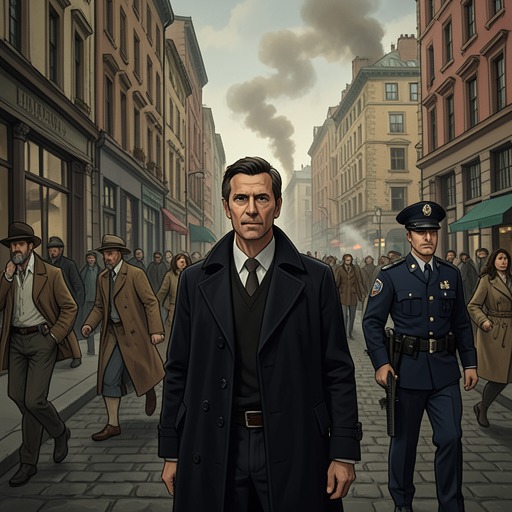
As workers approached along Reinickendorfer Straße, mounted police waited behind a barrier for orders to attack. A line of uniformed police faced the approaching crowd, while uniformed workers waited for the civilian workers to arrive. Their songs grew louder; then the police advanced in measured steps, with one metre between each man. The noise swelled until shouts replaced the singing and an encounter seemed imminent.
The collision followed within a minute. Police struck the crowd, and mounted officers rode into the opening. A shot rang out and windows shattered. As people tried to press forward, a second police line blocked the route to Reinickendorfer Straße and moved across Weddingplatz to clear it. Stones flew; a police sergeant was stabbed. Officers raised their batons and broke into a run, while reinforcements arrived on three trucks. Workers fled, regrouping at the edges of the square and in the adjoining streets.
Fabian’s Passage and Aftermath
Fabian pushes through the living wall of people and continues on his way. Three streets later, the uproar has receded enough for the surroundings to seem peaceful and orderly. A woman calls after him to ask whether there is fighting at Wedding. He answers that the people are measuring one another, a dry remark that reduces a violent confrontation to an exchange of force. Another woman fears that Franz has gone back into the fighting and calls for him to come home.
The abrupt transition from a square being cleared by police to apparent quiet a few streets away makes the violence feel both immediate and strangely compartmentalized. Fabian witnesses the conflict but does not join it; his movement out of the crowd parallels the way the noise itself travels away, leaving the street to resume its ordinary appearance.
Political Context and Significance
Wedding’s street fighting echoes an earlier episode in which Fabian and Stephan Labude encounter an armed man near the Märkischer Museum. The wounded man says that a dispute began in a tavern after someone drew a swastika on a tablecloth and invoked the International; a pursuer then shot him. Fabian takes the weapon and tells the opposing men that political disagreement will not be resolved by shooting one another. The scene at Wedding enlarges that localized confrontation into a mass encounter involving workers and police, with horses, barriers, batons, stones, and reinforcements shaping its course.
Together, the episodes connect political speech and symbols to bodily danger without presenting street violence as a resolution of the social conflict. At Wedding, opposing groups are placed face to face, but Fabian’s brief, sardonic comment and departure offer no reconciliation. The district’s significance lies in that unresolved collision: organized force clears the square, apparent order returns nearby, and the underlying antagonism remains.