Deutschland, Deutschland über alles
Fatherland“Deutschland, Deutschland über alles” is the opening line sung by the people in a German canteen after a broadcast announces an invitation for the American president to meet the Führer in Berlin. The scene makes the lyric a sound of collective political acclamation, set against Xavier March’s silent participation: his lips move with the crowd, but he produces no sound.
The anthem in the broadcast scene
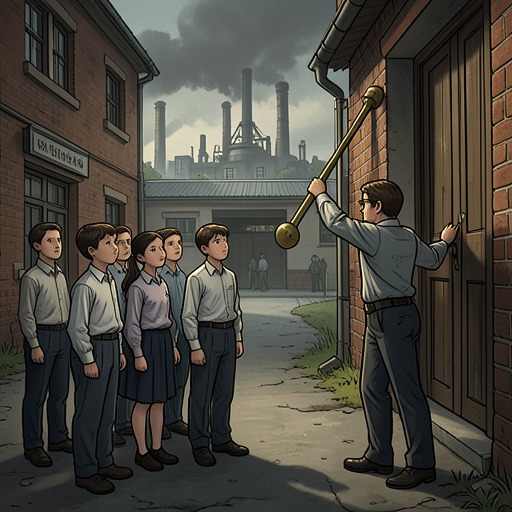
The television picture fades to black, and a drumroll announces the national anthem. Men and women in the canteen begin singing. March imagines the same response across Germany—in shipyards, steelworks, offices, and schools—as individual voices merge into a single, resounding expression of approval.
The words that follow are the anthem’s opening lines: “Deutschland, Deutschland über Alles!” and “Über Alles in der Welt!” In this scene, they are not presented as a private reflection but as a public ritual, carried by a crowd whose voices seem to unite the country.
March’s silence and the lyric’s significance
March moves his lips in conformity with those around him, yet no sound emerges. The gesture places him physically within the collective performance while marking his distance from it. The anthem therefore carries two contrasting meanings in the scene: it is the crowd’s audible affirmation, and, for March, a performance he can imitate without joining in vocally.
That contrast follows a broadcast announcing a planned meeting between the American president and the Führer, an event the authorities frame as an effort to promote understanding. The anthem’s expansive claim of national primacy thus accompanies an official appeal for international understanding. The text does not resolve that tension; it lets the public ceremony and March’s silence stand beside the language of diplomacy.