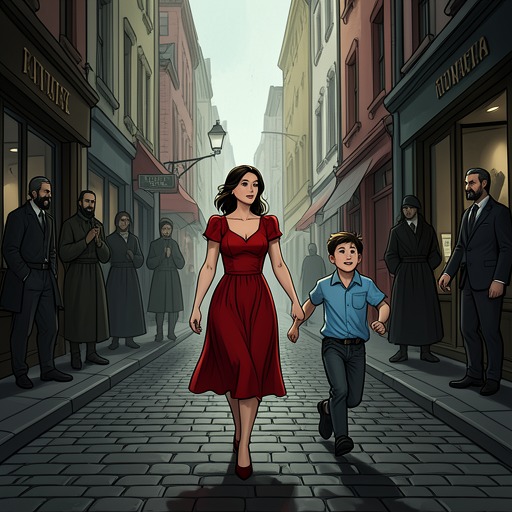
Ava’s Longing for an Ordinary Life
FirebugAva’s Longing for an Ordinary Life is the everyday life Ava can imagine but cannot safely inhabit. Her wish is not simply to escape danger: it is to choose how she spends her time, go to school, date without deception, and worry about the kinds of things other teenagers take for granted. Those modest scenes acquire force because her actual life is organized around a blood pact, compulsory violence, and the need to remain hidden.
Ordinary Life as a Measure
Ava measures the distance between herself and other teenagers through concrete, deliberately ordinary possibilities. She imagines a summer job scooping ice cream or washing dishes, complete with a low-paid paycheck and an unattractive polyester uniform. Even those small indignities look like a freedom she would welcome: such work would be chosen, temporary, and recognizable as teenage life, rather than another extension of supernatural obligations. Her complaint is sharpened by the contrast with her work for the Coterie, where the question is not what job she wants but whether she will obey.
School provides an equally vivid measure of what she lacks. Ava is homeschooled and pictures the ordinary high-school rituals she cannot experience: keeping photographs of a boyfriend in her locker, holding hands in the hallway, asking him to the Sadie Hawkins dance, and then skipping the dance to go to a movie. She even wants the comic spectacle of classmates pretending to vomit at a locker covered in couple pictures. The detail matters because she is not asking for an idealized life without embarrassment. She wants the clichés, awkwardness, and social performance that would let her share the same world as her peers.
Her complaints about prom dresses and SATs make the contrast still sharper. Those conventional adolescent worries are remote from the calculations Ava actually faces. Instead of simply considering school and romance, she has to weigh the ethics of being an assassin against human life and basic freedom. The ordinary is therefore both a set of desired experiences and a standard by which the abnormality of her circumstances becomes unmistakable.
Work, Coercion, and Moral Choice
Ava’s employment for the Coterie exposes how little choice lies behind the appearance of a job. She can hunt targets for the organization or be treated as violating her blood pact; in her account, that violation means an enforcer comes to kill her. The pact binds her until her death or Venus’s, although Venus formally retains the option to release her. Ava regards that clause as no real promise of freedom: Venus is unlikely to give up a possession she values, and the provision could instead allow her to trade Ava to someone else. Lock and Ezra have a different arrangement, with service ending at twenty-five, but Ava notes that none of them can simply leave without the Coterie’s enforcers pursuing them.
This coercion turns the wish for a mindless job into a question of agency. Ava describes herself as a weapon sent to end a target’s existence, not merely to warn or punish. During a hunt for an ice elemental, she can recognize that the target has endangered people by freezing them while creating a nest, yet she also understands that Venus’s immediate concern is his intrusion on Coterie territory. Ava is the one who cares about the human victims. She believes every creature has a right to survive, while also recognizing that the elemental could have built his nest elsewhere. The ordinary life she longs for would not erase difficult choices, but it would not make her livelihood depend on carrying out someone else’s lethal orders.
Romance Under Secrecy
Ava’s relationship with Ryan gives her a possible version of teenage normalcy, but its surface rituals cannot overcome the secrecy beneath them. They go on dates, hold hands, and kiss; she has little previous experience of having a boyfriend, so the relationship itself is unfamiliar. Yet she does not consider Ryan a friend in the fuller sense of someone with whom she can relax at home and share an unguarded life. She is concealing the truth about herself and repeatedly cancels dates with the excuse that her grandmother is sick when she is actually doing Venus’s work. The romance thus becomes another performance maintained alongside her Coterie obligations.
That conflict shapes her response when Ryan proposes a weekend in Boston for a foreign horror-film marathon. Ava’s first reaction is resistance, because Boston is the Coterie’s center and Venus is based there, near the Inferno. She cannot reject the invitation with the alarm she feels without making Ryan suspicious; instead, she asks for more information and works out that the theater may be away from the places she associates with Venus. Her effort to assess the outing as a normal girlfriend would is inseparable from a calculation about territory and exposure. Even a movie date requires her to decide how close she can safely come to the life she wants.
Cade and the Unreachable Cliché
A conversation with Cade makes Ava’s longing more intimate than her wish to resemble other girls. Cade is not simply a guardian forbidding her a date. He trusts her, has always been honest with her, and does not object to Ryan for the conventional reasons a parent might. He has even accepted Lock and Ezra staying over, despite other parents’ likely objections. His concern is the danger of Ava being discovered by Venus, not a suspicion that Ava cannot make decisions about romance.
Ava nevertheless tries to explain what safety alone cannot supply. She wants the school hallway, the locker, the dance, and the movies—not because she believes those things would make her life perfect, but because she has never been allowed to know what they would be like. Cade answers by imagining that she would reject the conventional high-school script: she would mock the boyfriend-covered lockers, object to surrendering her identity to a relationship, and favor coffee with a college student who writes bad poetry. Ava recognizes how closely he knows her, yet insists that she might still want the cliché once. Their exchange makes the desire more complicated than simple conformity: she can see the irony in the imagined routine and still grieve that she cannot choose it.
Cade’s response does not solve the danger or grant Ava an ordinary adolescence. He tells her that she is special to him not because of her abilities but because she is his daughter, and that he will not lose her so she can feel like everyone else. The reassurance affirms their family bond while leaving the underlying restriction in place. Ava’s longing persists precisely because love and trust cannot provide the school life, privacy, or freedom that the Coterie’s threat has taken off the table.
Narrative Significance
The concept links Ava’s large-scale struggle against the Coterie to the intimate texture of adolescence. Her imagined uniform, locker photographs, and movie dates are not distractions from the supernatural conflict; they show what that conflict costs her in daily terms. Likewise, the contrast between her forced work and ordinary teenage employment makes the difference between having responsibilities and being owned sharply visible. The ordinary life she wants remains specific, imperfect, and beyond her reach, giving her resistance a human scale without pretending that a heartfelt wish can dissolve the danger around her.