Blood pact
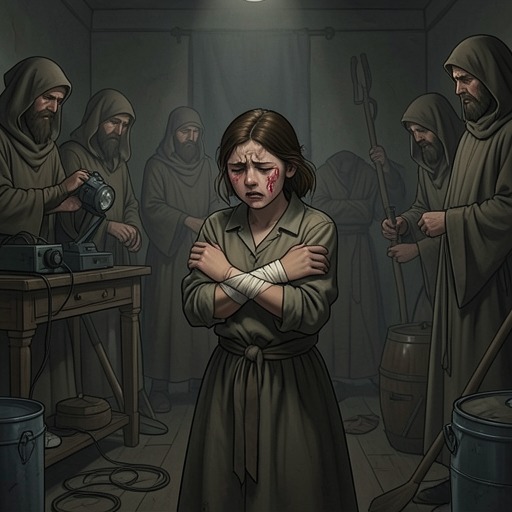
FirebugThe Blood pact is both a membership rite and an instrument of coercion. Its ceremony turns a recruit into one of the Coterie’s Elite, and its magical seal makes service effectively lifelong: for those who resist, the contract permits release only through the recruit’s death or Venus’s. Ava’s forced initiation shows how the pact is written onto the body and made to govern not just affiliation, but the limits of what she can do.
Ceremony and Binding
Ava was barely thirteen when she was taken to the Coterie’s ceremony. Her legal guardian, Cade, could not attend because he was not part of the organization. Two warded men held her in a dark hallway and dragged her into a candlelit room, where thirty crimson-robed figures stood around Venus. The staging made the rite a public passage into a new status, but Ava had not chosen to enter it.
A red-robed woman marked Ava’s forehead, palms, and feet with oil, then touched the oil to her lips. She blew ash from a brass bowl onto the marks; they sprang to life with burning pain, and Ava fell to her knees. The woman was a blood witch, and the warding she placed on Ava was not permanent, but it formed part of the ritual that prepared her for the pact.
Venus cut Ava’s hand with a silver knife and put Venus’s platinum talisman into the wound, rune-side up, so that the charm disappeared into blood and ash. She declared the Coterie Ava’s family and demanded that Ava’s life, thoughts, speech, and movements serve it. Blood from the wound was collected in a glass vial, while Ava’s name was signed on parchment in ink made from ash and blood. The signature was largely formal: the magic lay in the ceremony itself. When the cowls came down and Ava was allowed to see the participants’ faces, the rite had made her Elite, with no way back.
Terms and Enforcement
The pact fixes a sharp distinction between the Coterie’s two principal ranks. Associates perform work in its nightclubs and businesses, hoping for a share of its power, but remain outside the trusted inner circle. The Elite are made through the blood-pact ceremony: not simply employees or affiliates, but members shaped by Venus’s authority and bound to the organization until death. The rite therefore functions as a threshold into a status that cannot ordinarily be relinquished.
For Ava, the contract turns assignments into compulsion. Hunting targets is presented as a choice only in form: refusal makes her a violator of the pact, and the Coterie sends someone to kill her. The legal document was constructed by Coterie lawyers, signed in her blood, and sealed by a blood witch; the ceremony supplies the magic that makes the written agreement effective. Its stated exits are Venus’s death or Ava’s, while Venus’s theoretical power to release her offers little practical hope. Ava believes the pact also prevents her from acting against Venus, even when the platinum talisman hanging at Venus’s throat is within reach.
Lock and Ezra’s status as tithes exposes how differently the same organization binds its people. Their pacts require several years of service and end when they turn twenty-five; in return, Venus leaves their families alone. Ava’s agreement has no comparable term, and its clauses reflect how much more valuable Venus considers her as a firebug. The pact thus operates not as a single, uniform membership rule, but as a system of unequal obligations calibrated to the Coterie’s use for each person.
Coercion, Reproduction, and Resistance
The pact’s reach extends beyond the work Ava is ordered to perform: it secures the Coterie’s claim over her future and makes family a lever of enforcement. Venus frames joining as a choice, but the alternative is a threat to destroy everyone Ava loves and raze her town. The bargain’s coercion is therefore not confined to the moment of signing. It reaches outward to Cade and other people whose safety Venus can place at risk, making Ava’s continued compliance a condition of their survival.
That threat echoes the reason Ava’s mother fled the Coterie. Because both parents carried the recessive firebug gene, Venus could have treated them as breeding stock and used their children to build a force of living weapons. Ava’s mother left before the organization could claim her daughter or force Ava’s father into that role. The family’s years on the run were thus an attempt to prevent the same system of control that the pact later imposed on Ava from extending into another generation.
When Ava’s disobedience makes her less useful as a field operative, Owen reveals the Coterie’s next claim on her body: confinement and forced reproduction. He explains that the organization had postponed this plan while she remained valuable in the field, but now intends to make her bear children. The threat transforms the pact’s promise of lifelong service into something more invasive than labor. It shows that the organization regards Ava’s firebug identity and reproductive capacity as resources it can allocate, rather than parts of a person entitled to choose her own future.
Ava nevertheless resists within the narrow room the pact leaves her. She refuses Venus’s order to kill Duncan and openly defies Owen, even though she knows the contract can be enforced against her. After Venus strikes her, Ava sees the talisman and remembers that the pact forbids her from reaching for it. Its physical nearness makes the restriction legible: she can see the object that embodies Venus’s authority, yet cannot simply seize it. The pact’s control is not absolute in the sense that it erases Ava’s will; it makes resistance dangerous, binding her choices to the possible deaths of herself and those she protects.
The blood pact therefore operates simultaneously as a ritual of incorporation, a set of unequal service obligations, and a mechanism for controlling bodies and relationships. Its ceremony gives the Coterie’s claim a magical seal, while threats against loved ones and the prospect of forced breeding reveal what that claim is meant to secure. Ava’s defiance does not undo the binding, but it exposes the distance between the organization’s language of family and the coercion that makes its authority endure.
Collateral Kinship and Political Reach
The pact’s consequences extend beyond the person who signs it because the Coterie can make loved ones part of the price of resistance. Lock became a tithe to spare his mother, Angela, and the other Dryads from Venus’s demands. His service therefore functioned as protection purchased through his own obligation: the pact’s system of unequal terms could draw one person into the organization in order to shield a wider community.
That same leverage shaped the struggle over who would lead the Coterie. Duncan did not want power for himself, but he did not want Venus to retain it; he believed she would eventually kill Cade to spur or punish Ava. His decision arose from his attachment to Cade, whom he regarded as his family despite having no children of his own. The pact thus belongs not only to the organization’s formal hierarchy but to a web of chosen kinship: its threats reach people who never swore allegiance, while their safety helps determine who resists, who serves, and who is willing to contest Venus’s rule.