Chosen family
FirebugChosen family is a pattern of kinship made through care and loyalty rather than guaranteed by blood or official labels. For Ava, it is not an abstract ideal: it is the home Cade makes for her, Duncan’s steady presence, and the friends who refuse to leave her to face danger alone. The novel tests these bonds against bereavement, flight, estrangement, and the Coterie’s attempt to treat people as resources; again and again, family is defined by who stays and what they do for one another.
Kinship Beyond Labels
Cade is Ava’s guardian, but the significance of his place in her life exceeds that formal description. They are not related, yet Ava understands them as family, and the state’s label does not alter the bond she describes. Cade had been Lilia’s childhood sweetheart and remained the person she loved; Ava remembers the depth of that attachment as the foundation of a family formed by devotion rather than a simple accounting of blood. His guardianship is also active: he takes the parental role seriously and turns ordinary work, including maple-syrup making, into opportunities to teach and train Ava as a firebug.
Ava’s childhood gives this chosen home a history of both interruption and return. She and Lilia were repeatedly on the run, but Lilia sometimes came back to Currant despite the danger. When Ava was five, a holiday visit left them snowed in for a week. Lilia seemed happy, Ava was spoiled with books, candy, and homemade cider, and Cade showed her how to make decorations for a Christmas tree he furnished with popcorn chains and paper snowflakes. Duncan arrived with a present, and Ava’s delight in the carved animals inside it turned the visit into one of her defining memories of magic and belonging.
The animals were more than a gift. Duncan brought the carved pony, dog, cat, and tiny bird to life with a tap, making them parade through the house to Ava’s clapping before they froze again. When the family had to leave at the week’s end, Ava tried not to cry, knowing her sadness would make Lilia sadder. Cade kept the figures for her; they still sat on a shelf in her room. Ava could ask Duncan to animate them again, but feared that seeing the performance twice would diminish its magic. The preserved carvings hold the family’s temporary homecoming in material form: a reminder that care can keep a fragile memory present even after the people have to go.
A Home Sustained by Small Acts
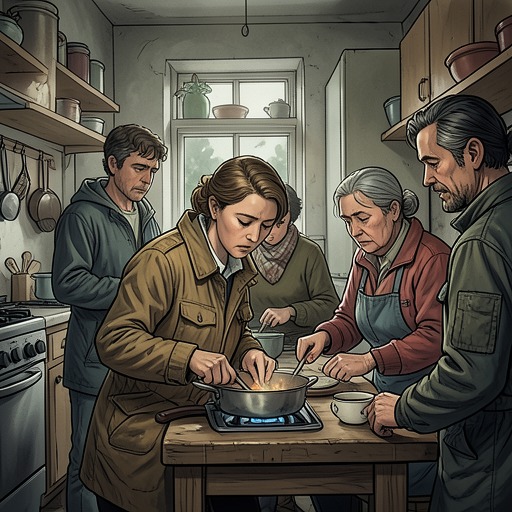
Chosen kinship in Ava’s life is maintained through repeated, ordinary exchanges. Duncan regularly brings what he has: fish after fishing, jam he has made, and sometimes eggs from his chickens. He is one of the few people who appears in Cade and Ava’s kitchen, a household made socially isolated by the danger attached to Ava’s existence. His visits are not grand declarations; their meaning accumulates through food, company, and the knowledge that he will return.
The exchange runs both ways. During maple-syrup season, some of Cade’s syrup goes to Duncan in return for smelt and other food from the water. This practical reciprocity joins their households without turning affection into a formal bargain. The kitchen, the meals, and the work of making or growing food give family life a daily shape. Duncan’s gifts are part of the same pattern as Cade’s teaching and shelter: each person contributes what he can, and care becomes visible in what is shared.
Ava’s attachment to Duncan is explicit. She thinks of him as the closest thing she will have to a grandfather and says she holds on fiercely to family. She never knew her father, has lost Lilia, and does not want to lose anyone else; even apart from her own feelings, Cade’s love for Duncan matters to her. Their bond also reaches back to Cade’s adolescence. When Cade left his parents’ home at sixteen and tried living in his car, Duncan found him camping in the woods and took him in until he could establish a place of his own. Duncan’s care for Ava therefore continues a history of care for Cade.
Loss, Refuge, and Protection
The family’s closeness is shaped by repeated loss and the need to escape the Coterie. Lilia had fled because the organization might claim Ava as a firebug to use as a weapon, or exploit her as leverage if she were human. She also feared what it could do to Ava’s father. In this history, the decision to keep the family together is inseparable from the decision to keep it beyond the Coterie’s reach. Their life on the run is not a romantic freedom from ordinary ties; it is the cost of protecting those ties from coercion.
After Lilia’s death, Ava arrived at Cade’s door soaked, exhausted, hungry, and overwhelmed by grief. She collapsed into him and was able to stop managing herself long enough to cry. Cade wrapped her in blankets, found dry clothes, and brought her warm food. He only faltered when he saw Lilia’s small silver heart-and-star necklace, but even his own grief did not interrupt his care for Ava. The scene makes the distinction between a label and a relationship concrete: Cade is her guardian, yet in the moment of loss he acts as the parent and home she needs.
Ava and Duncan also communicate through protective acts that do not require explanation. When Ava leaves after Venus summons her, she kisses Cade and Duncan goodbye. Between her and Duncan passes a silent request that he look after Cade, and his answering assurance is equally unspoken. Neither needs to ask whether the promise is for her return or for the possibility that she will not come back. The uncertainty is left unresolved, but the exchange shows how thoroughly they understand their shared responsibility.
That responsibility governs difficult choices as well. Duncan does not want to lead the Coterie, but he also does not want Venus to lead it; he explains that he acted because he feared Venus would eventually kill Cade to punish or pressure Ava. He has no children of his own, he says, and Cade is the family he has. Ava can recognize the reasoning because she has argued from the same duty to protect family when speaking with Angela about Lock. These choices do not make the danger disappear. They show how chosen kinship becomes a reason to enter danger, accept costs, and take responsibility for another person’s safety.
Friendship as Family
Ava’s bond with Lock and Ezra extends chosen family beyond the household she shares with Cade. Her childhood and the secrecy surrounding her supernatural life have left her with little experience of ordinary friendship. Sylvie is a friend, but Ava has to conceal important parts of herself from her. With Lock and Ezra, the relationship rests instead on shared knowledge, close companionship, and mutual care. Lock refuses to let Ava enter danger alone, insisting through his actions that her decision to go means he will follow; Ezra, he adds, is not someone they could lose even if they tried.
Lock’s care is direct and attentive. When Ava turns away to hide her tears, he gently takes her chin and makes her face him. He recognizes that she was not able to have friends growing up and presents loyalty as something practiced: a friend goes with her into danger rather than letting her go alone. The moment does not erase the risk or Ava’s discomfort at being seen crying. Instead, it makes belonging tangible in the very action she would rather refuse.
The group’s life is also defined by what it costs its members. Lock becomes a tithe to spare Angela and the other dryads, and Ava later tells Angela that Venus would eventually have killed him in her service. Their ties are therefore not simply affection detached from circumstance; choices made to protect one person can expose another to harm. Ava does not use Lock’s sacrifice as a weapon in the conversation, even when she is trying to reach his mother. The restraint matters: kinship here includes a sense of what should not be exploited, even in an argument.
The Limits of Blood and the Meaning of Belonging
The novel places chosen family beside biological relationships that do not provide dependable care. Cade’s parents were distant from him, disapproved of his friendship with Lilia, and did not stop him from leaving home. Their birthday and Christmas cards bear their names rather than parental endearments. Each year Cade reads the Christmas card aloud, folds it into a paper airplane, and lets Ava incinerate it in midflight. Duncan then appears with a drink and sits by the fire to tell Ava stories about Cade as a teenager. A ritual that might have marked exclusion becomes, through Duncan’s presence and Ava’s participation, a family tradition of their own.
Ryan’s history offers a different contrast. His biological mother was a selkie who recovered her skin and left; when Ryan saw her again, she judged him suited to land and departed without apology or comfort. He tells Ava that he wanted what she had. His longing makes visible what her chosen household has given her: not perfection or freedom from grief, but people who remain responsible to one another. It also prevents the idea of family from becoming a claim that blood is irrelevant in every circumstance; biological origins matter deeply to Ryan, but they have not supplied the lasting care he sought.
A brief exchange with Angela similarly unsettles easy distinctions. At first, she questions the basis on which Ava knows her birthday, noting that Ava has no birth certificate and has only Lilia’s word. The challenge exposes how much of Ava’s history depends on trust in the person who raised her, rather than on documents. Yet when Angela considers that Ava acted to save her father just as she would act for her own son, her anger softens and she recognizes that Ava, too, had family at stake. Such recognition does not settle every question about identity or proof; it shows that acts of protection can make another person’s attachment legible.
The book’s dedication to the author’s brothers, expressing gratitude for being unable to have chosen better ones, offers a small framing echo of the story’s concern with kinship and choice without specifying the nature of those relationships. Within the narrative, the stronger definition comes through repeated practice: a home kept open, food carried across the yard, a child welcomed in grief, an old gift preserved, and friends who follow into danger. Chosen family does not cancel loss or guarantee safety. It gives Ava people whose loyalty is demonstrated in the ways they shelter, remember, and protect one another.