Charlie McGee's uncontrolled pyrokinetic ability
FirestarterCharlie McGee's uncontrolled pyrokinetic ability is the volatile counterpart to the mental push she can direct more deliberately. It first appears in the family home as a frightening force that seems to answer distress with fire; later, when Charlie is seven and trying to help her injured father, an act of mental force is followed by flames she cannot stop. The power is not simply a weapon she chooses to use: it is bound to fear, guilt, and the danger that an impulse may outrun her control.
Early Signs in the Family Home
The first signs reach back to Charlie’s infancy. When she was about a week old, Vicky brought her into bed with her parents because the pillow in her crib had begun to smolder. The danger did not end there. A pillow grew hot enough to blister Charlie’s cheek, fires started in wastebaskets when her bottles were late, and curtains once burst into flame. The account does not describe these incidents as deliberate acts; their unsettling pattern is that ordinary needs and household distress coincide with fire.
As the family struggled to live with what was happening, fear became practical. Andy and Vicky did not discuss Charlie’s ability openly, and Vicky resisted the subject, insisting that nothing was wrong. Yet fire extinguishers appeared throughout the house. That quiet preparation gives the family’s denial a material counterpoint: they avoided naming the danger, but arranged the home around the possibility that it might flare again.
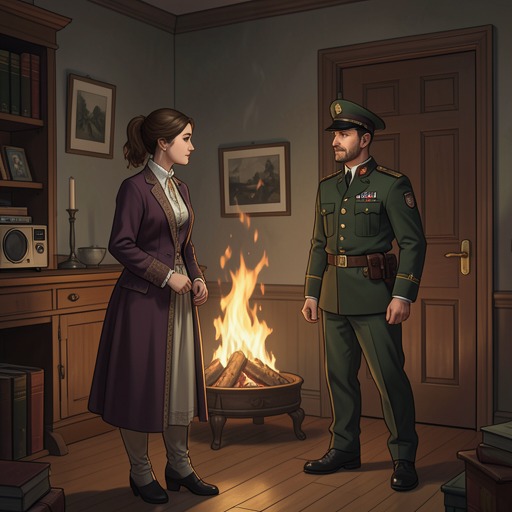
A later childhood incident made the connection between emotion and fire still more visible. While Charlie was crawling, she fell down the stairs after her feet caught around a teddy bear. She had no bruise, but Andy felt an invisible, deathlike force pass from her mind; the bear caught fire, and the flames spread to the stair carpet. The sequence gives the power an immediate, frightening logic: the toy had hurt Charlie, and then it burned. Andy ran for the fire extinguisher, while the burning bear’s black eyes remained visible through the flames. The incident links a child’s unfiltered reaction to an actual household fire, without suggesting that Charlie had planned or understood the result.
A Prohibition Charlie Fears
By the time Charlie is seven, the ability has become something she has been told repeatedly not to use. She thinks of it as the Bad Thing, a power that can escape its initial target and go everywhere. Her fear is not abstract: she remembers the earlier kitchen incident in which her mother was hurt, and the memory returns through the hurt, bandages, and screams. Charlie’s self-reproach is bound to a promise never to repeat what happened. The power therefore carries a moral burden for her as well as a physical risk: she fears not only its effects, but what it might mean if she came to enjoy using it.
Charlie understands the power alongside the push, the name Andy gives to mental force. She can push much harder than he can and does not suffer the headaches he experiences afterward; nevertheless, she associates her own pushing with fires that sometimes follow. The distinction matters. The push can be used to affect an object, but for Charlie it exists close to the more frightening ability to start fires. Her father had once tried to make that distinction sound manageable, calling her a firestarter and comparing her to a giant lighter. In the present danger, the joke no longer offers reassurance: the word pyrokinesis clangs in her mind as she stands before the phones.
Her father’s warnings also have a practical cause. The men from the Shop are pursuing them and want to examine and exploit them, and Andy does not want them to learn more about Charlie’s abilities. He has explained that her push is not exactly like his and questioned whether she can make people change their minds as he can. Charlie’s ability is thus doubly dangerous in her understanding: it may injure people, and displaying it may reveal her to the organization she fears.
The Payphone Incident
The immediate crisis leaves Charlie with little room to obey the prohibition. Andy is hurt and needs quiet and sleep, while Charlie believes they need money and that the Shop’s men may be coming. She takes a discarded shopping bag and searches the concourse for pay phones. Grief over her mother’s death and fear of the strangers around her accompany the practical task. To avoid drawing attention, she enters a booth, pretends to speak to her grandfather, and watches through the glass.
Charlie looks at the phone and shoves it with her mind. The effort is small, but she likes the sensation of pushing; that pleasure alarms her because it suggests the dangerous act could become attractive in itself. A second, very light shove makes coins pour from the return. She tries to catch them with the bag, but most scatter onto the floor, so she bends to gather what she can while repeatedly checking the booth window.
At the next phone, a serviceman is still talking. Charlie shuts the booth door, cutting off his voice, and uses the push again. This time she has positioned the bag correctly, and the coins fall into it with a jingling sound. The incident begins as an improvised attempt to secure money, but it also shows how readily Charlie can use a force she has been forbidden to reveal. The payphones yield coins; they do not, however, contain the consequences of her next loss of control.
Fire, Guilt, and the Cost of Control
When Charlie returns to Andy, she tells him that she had overheard the serviceman and sensed he was trying to trick the girl he was speaking to. As she came back, the fire started before she could stop it. She says she could have hurt him badly and that she set him on fire. Her account connects the outburst to the earlier sequence of pushing and heightened emotion, but its most important distinction is that the fire escaped her: she describes it as something that got away from her, not as an act she deliberately chose.
Andy responds by asking her to keep her voice down and calls the incident the most encouraging thing that has happened in some time. His response does not erase the danger or Charlie’s fear; it gives the event a different meaning for her wounded father, who needs her help to escape. For Charlie, however, the episode intensifies the conflict built into the ability. The same power that may help them survive can burn another person, expose them to the Shop, and revive her guilt over her mother’s injury.
Across the childhood fires and the concourse scene, the ability is presented through consequences rather than mastery. A smoldering pillow, burning household objects, a teddy bear and carpet, then a man set alight: each occurrence makes fire an outward sign of a force Charlie cannot safely treat as ordinary. Her fear of the Bad Thing is not merely an imposed rule. It grows from remembered harm, from the frightening pleasure she finds in pushing, and from the repeated discovery that an act can pass beyond its intended limits.