Lot Six intoxication
FirestarterLot Six intoxication is the altered state Andy McGee experiences during the Room 70 experiment, where euphoria, distorted perception, and apparent mental access to other people’s private knowledge make ordinary reality difficult to separate from hallucination. Its decisive feature is not simply that Andy becomes high, but that the experience leaves him with memories he cannot verify and questions he is still considering twelve years later.
Onset and Altered Perception
The state begins with Andy joking about whether the participants will shrink. When he stretches the word out and grins, the humor accompanies an unmistakable shift: he recognizes that something is happening to him and that he is getting high. His sense of the room soon changes from ordinary observation to absorbed fascination. Sounds and activity seem to unfold in slow motion, and even the word he uses to describe that effect becomes an object of playful attention. The drugged perspective makes the unfamiliar feel compelling rather than immediately frightening.
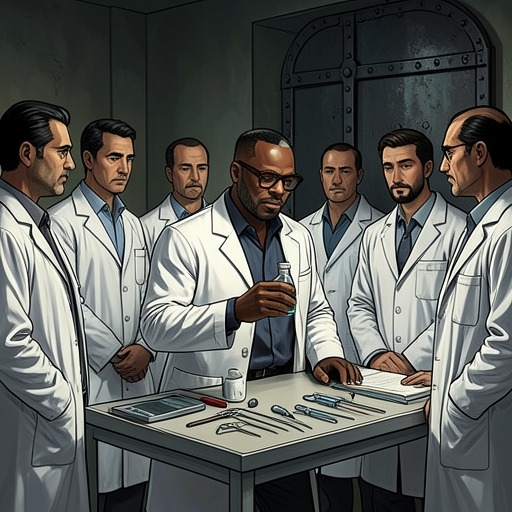
That fascination does not prevent him from noticing distress around him. Andy hears someone crying and eventually turns toward the commotion, while the people moving across the room seem to him to be advancing in slow motion. A young participant is in severe distress on a cot, and the assistants gather around him. Andy’s attention fixes on the Room 70 brain chart behind them and on a bloody mark left on it. The scene is filtered through his altered consciousness: he registers an alarming event, but its strangeness and his detached, almost clinical interest are inseparable from the state he is in.
Perception, Knowledge, and Fear
The intoxication also appears to alter what Andy can know about other people. When Ralph Baxter pauses beside his cot, a mass of information about Ralph comes to Andy without an ordinary explanation. The episode presents the knowledge as suddenly arriving rather than being discovered through conversation. Andy initially treats this as an advantage, but the mood changes when he realizes how threatening the information might be if he reveals it. He cannot tell whether the apparent knowledge is genuine or part of the drug experience, and that uncertainty turns his earlier amusement into deep paranoia.
His response to Vicky Tomlinson McGee suggests that the altered state is relational as well as private. Andy sees fear in her expression and thinks that she is picking up his emotions, like a radio. He tries to reassure her, although he is himself unsettled. Their exchange then seems to continue without spoken words: Andy wonders whether they are communicating despite Vicky’s mouth not moving, and asks internally whether she is the one reaching him. The passage leaves the status of this contact uncertain, making emotional sensitivity and possible telepathy difficult to distinguish from intoxicated interpretation.
The Room as a Broken Sequence
Andy’s later account does not settle into a reliable chronology. He remembers objects seeming to fly through the room as if driven by an invisible wind, and elsewhere recalls a participant suffering a medical emergency followed by desperate attempts at resuscitation. But he cannot establish when these events occurred in relation to one another, or even whether every remembered incident happened as he recalls it. The episode’s order is fractured by dozing and twilight consciousness; experience arrives as separate impressions rather than as a continuous, trustworthy record.
Music supplies one of the few memories that gains a later point of confirmation. During the experiment, music begins to play through the ceiling speakers and feels to Andy both soft and majestic. Much later, after consulting with Vicky, he identifies it as Rachmaninoff. The music therefore becomes a bridge between the altered interval and ordinary time: it preserves the emotional character of the experience while offering a detail the two can recall together. Even so, it does not resolve the larger uncertainty about what else in the room was real.
Memory and Uncertainty
Andy’s reflection on the episode remains unresolved. Twelve years of thinking about it on and off have not answered how much was real and how much was hallucination. That duration gives the intoxication an afterlife beyond Room 70: it remains a memory he revisits, but not one he can turn into a settled account. The uncertainty is central to the state’s significance, since apparent knowledge, extraordinary perceptions, and frightening events all come to him through the same altered consciousness.
The narration’s changes in tone enact that instability. Playful fascination gives way to fear, then to drifting attention and recollection. Details such as the Room 70 brain chart and the music remain vivid, while sequence and certainty break down. Lot Six intoxication is thus presented not as a single, neatly bounded hallucination but as an experience in which perception and memory become unreliable together, leaving Andy unable to separate the drug’s effects from what may have occurred around him.