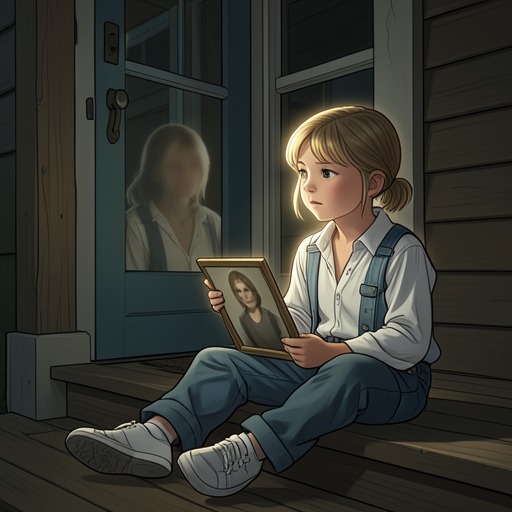
Charlie’s conditioned fear of her pyrokinetic power
FirestarterCharlie McGee’s conditioned fear of her pyrokinetic power is more than a reaction to fire: it is a prohibition learned in childhood and carried inside her as a fear that the power, once released, cannot be contained. It helps restrain an ability that could injure her or others, but it also makes an emergency act of self-preservation morally frightening. The novel sets Charlie’s fear against the protective discipline that formed it, and against the danger of forcing her to use the power before she is ready.
A Power Learned as a Prohibition
From early childhood, Charlie understands her pyrokinetic ability through the rule that it is the Bad Thing. She has been told again and again not to use it; the warning is not abstract, because she knows that she may not be able to control what happens once the power begins. It could hurt her, one other person, or many people. What frightens her most is its apparent reach: when allowed to go, it goes everywhere.
The memory of hurting her mother gives that rule its emotional force. At the airport, Charlie’s thoughts break into an anguished recollection of her mother’s pain, bandages, and screams, followed by her promise never to do it again. The fragmented return of the memory shows how the lesson persists not as a calm decision but as distress that overwhelms her ability to think about what happened. Her fear is tied to guilt and to the conviction that using the ability makes her responsible for harm that may spread beyond her control.
This fear is distinct from her understanding of the push. Charlie knows she can move things, and that she can push harder than Andy McGee without suffering his headaches. Yet she associates her own push with the possibility of fire afterward. The abilities are not interchangeable in her mind: moving something is not itself the forbidden act, but it seems linked to a danger she cannot reliably keep separate from it.
The Airport: Need Against the Rule
At the airport, Charlie is trying to find money while Andy McGee is hurt and needs quiet. She knows the men from the Shop may be coming and that they want to examine her and find out how to use her. The immediate need is practical and urgent, but the available means troubles her: when Andy explains how she might get money, Charlie weeps and says, “It’s not right. It’s not right to steal.” Her distress places the moral rule against stealing beside the larger danger of being pursued, rather than making either concern disappear.
She approaches a row of pay phones with a paper shopping bag taken from a trash basket, but hesitates over what she might do. Andy warns that if people notice a pattern connecting her to things moving, their situation will become worse. Charlie’s fear of the Bad Thing is therefore reinforced by two different dangers: the power might escape her control, and using her abilities might expose her and her father to the Shop. Even when she is frightened for Andy and needs to help them escape, the prohibition remains active. The scene makes her restraint costly: fear does not arrive after the danger has passed; it is part of the decision she has to make while danger is approaching.
Andy’s Lesson and Its Cost
The history of that restraint is dramatized in Andy’s response to the fire involving Charlie’s teddy bear. He extinguishes the flames with a fire extinguisher, then brings the foam-spattered bear downstairs. Hating himself, but believing a lesson must be made unforgettable, he thrusts the blackened, still-warm toy before his screaming daughter and demands that she look at what has happened to it. He imagines that he is burning a scar onto her soul.
The distinction matters: Andy burns the bear, not Charlie. But he deliberately makes the consequences of fire vivid through a beloved object, turning fear into a teaching instrument. Charlie cries for Teddy, while Andy insists that she see the damage. The episode gives physical form to the rule she carries: a fire may transform something loved beyond recognition, and a parent’s attempt to prevent future harm can itself become frightening. Her conditioned fear is thus presented both as protection and as emotional injury, without making those effects cancel each other out.
Fire-Training and the Possibility of Change
Dr. Joseph Wanless later interprets the McGees’ upbringing as “fire-training.” He asks Captain Hollister to imagine the terror of parents discovering that a crying infant’s stuffed animal, dirty clothes, or even her hair could catch fire. He points to fire extinguishers and smoke detectors in every room as evidence of how seriously the danger shaped life in the household. In his account, Charlie’s parents began teaching restraint unusually early, perhaps before she could crawl, just as ordinary toilet-training begins with repeated prohibitions and correction.
Wanless compares the process to a relative’s attempt to frighten a child away from matches, including briefly singeing the child’s hand. His comparison is not a claim that the two dangers are equivalent: he stresses that a child who can make fire poses stakes far beyond the ordinary consequences of delayed toilet-training. He judges the McGees as parents very highly for getting Charlie through that danger, while also describing the fear as a complex they deliberately instilled. His analysis supplies an explanation for the prohibition, not proof that it was painless or that its effects are simple.
Wanless also argues that Charlie may be overcoming the complex. He bases this possibility on the computer’s readouts, her youth, and the presence of Andy, whom he sees as an authority figure capable of helping remove the block. Yet he warns that the Shop’s pursuit is forcing Andy to reeducate her under extreme pressure: Charlie is frightened, her father is frightened, and they are in a survival situation. The fear that once served to protect her can therefore become an obstacle at the very moment others demand that she use her power. The book leaves the tension intact: fire-training may have helped keep Charlie and those around her safe, but the fear it produced is neither a simple cure nor a rule she can set aside without consequence.