The Shop's pursuit of Charlie McGee
FirestarterThe Shop’s pursuit of Charlie McGee turns a child’s extraordinary ability into an institutional claim. The organization wants to recover and study what it regards as its own creation, and its pursuit threatens not only Charlie’s freedom but also her relationship with Andy McGee. Across the evidence, the pressure moves from distant plans for testing and control to the family’s flight, Charlie’s confinement, and a perilous escape plan built around the very people who captured them.
Origins of the Pursuit
The connection to the Shop begins with Lot Six, an experiment in which Dr. Wanless told a group of twelve young adults that they would receive either water or water mixed with a small quantity of the classified compound. The injections were to be assigned by a double-blind method, and the students would be supervised for forty-eight hours. Andy McGee was among those present. Later, Andy and Vicky Tomlinson McGee married and had a daughter; Charlie showed signs of a frightening force within her early in life, and her parents tried to teach her to control it and behave normally. The supplied evidence places her ability and the experiment in the same family history, though it does not give a simple account of how the Shop’s claim to her is established.
The danger became apparent in ordinary domestic settings before Charlie could understand it. When she was a week old, a pillow in her crib began to smolder; her parents eventually stopped using the crib. Fires also occurred when bottles were late, and curtains once caught fire while Vicky was in the room. These episodes explain why Andy warned Charlie against using her power. To the family, it was a danger they had to contain; to the Shop, Charlie’s ability made her an object of institutional interest.
From Interest to Intended Control
The Shop’s pursuit is not presented as a single decision shared by everyone in the organization. Cap Hollister, considering a photograph of Charlie at four years old, hoped that she would not have to be sanctioned. He had grandchildren close to her age and regarded the child with sympathy. Yet he also anticipated that Charlie would be separated from her father, perhaps permanently, and that Andy might be sanctioned after he had served the Shop’s purposes. His response exposes the human cost already embedded in the organization’s planning: even an official who hesitates still imagines separation and punishment as available measures.
Cap also weighs the claims made by Dr. Wanless, who believed Charlie’s power might one day be catastrophic. Cap dismisses the most extravagant prediction, but that skepticism does not lead him to release her. He considers it sufficient to retain Charlie long enough to document her and chart her potential, an outcome that could reactivate the Lot Six testing program. If she could be persuaded to use her abilities for the country, he regards that as an additional benefit. The pursuit therefore has a practical institutional logic—observation, testing, and possible use—even where its officials disagree about how dangerous Charlie may become.
The Family Under Pursuit
For Charlie, the Shop’s intentions are experienced as an immediate threat. At an airport, while Andy is injured and needs rest, she understands that they need money because the bad men may be coming. She identifies them as men from the Shop who want to examine her and her father and discover how they work, with the possibility of making use of them. She takes a discarded shopping bag and approaches the pay phones, but is afraid to act: Andy has repeatedly told her not to use the power, which she knows could hurt herself or other people. The pursuit thus presses on two vulnerabilities at once—her family’s need to escape and her fear of the force her parents have tried to restrain.
The threat becomes inseparable from loss when Andy discovers that Vicky has been killed. The discovery changes the meaning of flight: this is no longer simply an effort to keep the family out of the Shop’s hands, but a struggle after the family has already been broken apart. The evidence identifies Vicky as the victim of a deliberate killing and shows Andy immediately thinking of Charlie. The Shop’s pursuit consequently bears a personal cost that cannot be reduced to its plans for research or national use.
At the Shop, Charlie’s separation from Andy continues through the arrangements made for her care. A live-in companion is installed, but Charlie refuses to accept her and stops speaking until the woman leaves. Charlie then makes an agreement with Patrick Hockstetter: she will answer his questions alone if he removes the companion. She wants Andy as her only companion; without him, she would rather be alone. The episode shows both the coercive limits on her choices and the small amount of leverage she finds within them. Her silence is not surrender to the Shop’s preferred arrangement; it is a means of resisting it.
Capture, Deception, and Escape
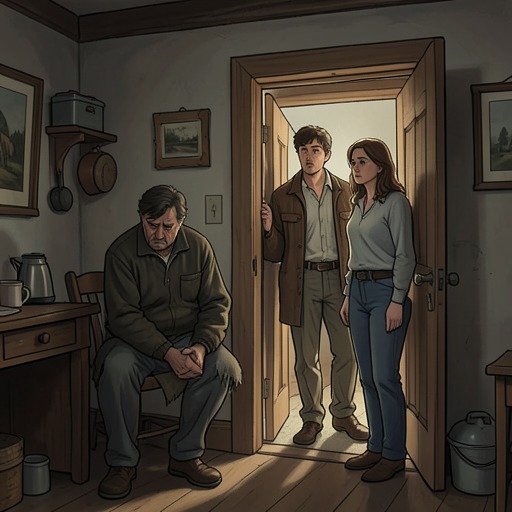
Andy’s note to Charlie clarifies how the Shop’s pursuit reaches the family at Granther’s place. He tells her that John Rainbird was in charge of the men who took them prisoner there and warns her not to trust him, despite the trust Rainbird has won from her. Andy explains that Rainbird has been convincing enough to deceive her and asks her to keep her feelings toward him unchanged while an escape is arranged. The pursuit has therefore operated not only through force and confinement but also through a relationship Charlie had come to trust.
The planned escape depends on concealing resistance inside apparent cooperation. Andy instructs Charlie to be in the stables at a specified time and says that the person who delivered his note is on their side without knowing it. He hopes to take Charlie to a major city, reach an old friend, and arrange a press conference so that the whole country will learn about them. Publicity, in this plan, is a possible defense against continued secret custody: even if the authorities still try to keep them somewhere, Andy hopes that Charlie and he can be together. The evidence presents this as a plan, not a completed escape.
The relationship between Charlie and the Shop is thus defined by a conflict over custody and purpose. The Shop sees Charlie as a subject to retain, document, test, and perhaps employ; Charlie experiences its pursuit through danger, separation, and unwanted control. Her parents’ effort to teach her restraint stands against the institution’s interest in eliciting and measuring her power. By the time Andy warns her about Rainbird, the conflict has also entered the private space of trust: escape requires Charlie to act as though a relationship remains intact while recognizing that it was used to bring her under the Shop’s control.