Charlie McGee–the Shop relationship
FirestarterCharlie McGee’s relationship with the Shop is a struggle over who will direct her extraordinary ability and what her cooperation will mean. The institution seeks to control her through capture, medication, observation, and tests; Charlie, separated from Andrew McGee and grieving her mother, tries to retain the power to choose. Her eventual willingness to undergo experiments is therefore conditional: she hopes to use the Shop’s demands as a route back to her father, not to accept the institution’s authority over her.
Capture and Institutional Control
The Shop’s interest in Charlie is rooted in the Lot Six experiment that preceded her abilities. At the experiment’s briefing, Dr. Joseph Wanless described Lot Six as a classified compound with hypnotic and mild hallucinogenic effects, to be administered to participants through a double-blind procedure and followed by forty-eight hours of supervision. The clinical language of the briefing establishes the institutional setting in which human subjects become objects of controlled inquiry. Later, the Shop’s researchers build on that history to study the powers associated with Charlie and her father.
After the Shop’s agents kill Vicky McGee, Andrew finds her body and understands that Charlie is the remaining person he must protect. The murder makes the institution’s pursuit personal and irreversible: the Shop is not merely investigating an unusual ability but has inflicted a loss that shapes Charlie’s later understanding of its personnel. When the Shop locates the McGees at Granther McGee’s camp, Cap Hollister chooses surveillance rather than an immediate attack. He believes the Shop needs Andrew as well as Charlie if it is to exercise meaningful control over her. He also worries that fear might drive Andrew to seek outside help, especially after the Manders farm incident has made a press leak more dangerous to the institution.
The Shop’s research presents control as a technical problem. A report overseen by Patrick Hockstetter argues that the powers of interest depend on the possessor’s willingness to use them: will is their first cause. The report acknowledges that Charlie’s pyrokinesis can escape the barriers of her will, but concludes that she chooses whether to set events in motion. Its account of the Manders farm, where Charlie acted after realizing that the agents were trying to kill her father, links her power to a specific protective choice. The Shop’s drug strategy follows from this theory: Thorazine is selected for Andrew and Orasin for Charlie in the belief that they can diminish the will required to act.
Separation, Grief, and Distrust
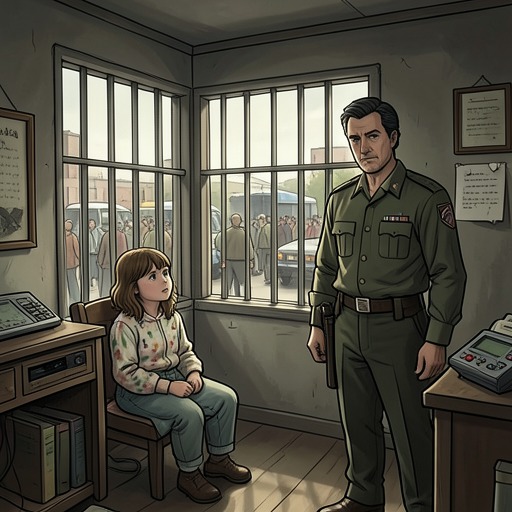
The Shop’s control of Charlie also means controlling her access to the relationship she most wants to preserve. During her confinement, an assigned companion is meant to provide a motherly presence. Charlie rejects this arrangement because the institution’s people killed her mother; she stops speaking until the companion is removed. She agrees to answer Hockstetter’s questions on the condition that he end the arrangement, and makes clear that the only companion she wants is her father. If she cannot have him, she would rather be alone.
The separation and the passage of five months leave Charlie feeling detached from time and from the people who pass through her life. She understands her own fires through guilt, believing that her actions have made her a murderer and that she deserves punishment. Her recollections of the Shop’s violence and of earlier fires haunt her, giving the institution’s attempts to manage her ability a moral weight that its research language does not capture. Medication and confinement may reduce the immediate possibility of escape, but they do not undo the grief and self-condemnation shaping her choices.
John Rainbird becomes a crucial, compromised intermediary between Charlie and the Shop. During a blackout, Rainbird reaches her at a moment when the accidental circumstances allow him to make contact with her guarded state. Charlie has come to believe him, and is startled and frightened by that trust; when his voice sounds afraid, she opens the door to ask what is wrong, though she does not yet step outside. This moment shows how the Shop’s control can be mediated through a personal bond rather than imposed only through formal testing. Rainbird recognizes that Charlie’s hope of seeing Andrew is the leverage behind her cooperation: she believes that making fires may eventually bring her father to her, while the Shop intends to use that hope to keep her participating. He warns the researchers that she is a child, not a laboratory animal, and that the father she longs for functions as the reward drawing her onward.
Conditional Cooperation and Agency
After three days, Charlie tells Rainbird she has decided to let the Shop conduct its tests. She says she will be careful and will make the researchers be careful too. Her pale, pinched appearance underscores the strain surrounding the decision, but the terms she states matter: she is not simply surrendering control. Rainbird tells her not to proceed unless she has thought it through, and her answer indicates that she has tried. Her decision reflects a constrained calculation in which the possibility of reunion remains central.
The Shop’s failure to bring her father to her exposes the weakness of its bargain. Rainbird explains to the researchers that Charlie would recognize the truth about Andrew’s condition if she saw him, and would then realize Rainbird had been serving the Shop all along. Her willingness to continue is not an endlessly renewable resource. The institution assumes it can use the promise of reunion as an incentive, but Charlie understands that she is making a choice in pursuit of a concrete relationship, not offering the Shop unlimited access to her power.
Andrew’s note later makes the conflict explicit. He tells Charlie that Rainbird led the men who captured them at Granther McGee’s camp and warns her not to trust him, while acknowledging that Rainbird has been convincing enough to earn her confidence. The revelation changes the meaning of their apparent closeness: Rainbird’s connection with Charlie has served his own purposes and the Shop’s. Andrew instructs her to conceal any change in her feelings and to be at the stables at a specified time, where he hopes to escape with her. He also frames leaving as their last flight and invokes what her mother would have wanted. Charlie’s attachment to Rainbird is thus set against the truth of his role in her capture and the possibility of reunion with her father.
Significance of the Relationship
The Shop’s relationship with Charlie is organized around a contradiction: it studies her power as an expression of personal will while trying to weaken, channel, and exploit that same will. Its researchers recognize that she chooses when to act, yet their plan depends on controlling the conditions under which she chooses. Charlie’s responses repeatedly mark the limits of that plan: she rejects the unwanted companion, withdraws her speech, insists on caution during the tests, and treats reunion with Andrew as the purpose of cooperation rather than a reward the Shop may indefinitely withhold.
The conflict also distinguishes scientific explanation from moral responsibility. The Shop can classify Lot Six, theorize about the causes of power, and select drugs intended to suppress action; those procedures do not erase the deaths and separations produced by its pursuit. For Charlie, the institution is inseparable from her mother’s death, her confinement, and the manipulation of her trust in Rainbird. Her relationship with the Shop is consequently not a simple contest between an organization and a weapon it wants to possess. It is a contest over whether Charlie can remain a choosing person within a system that repeatedly treats her choices as experimental variables or instruments of control.