Sonja Hökberg’s Sketch of Her Attacker
FirewallSonja Hökberg’s sketch of her attacker changes an old, fragmentary account of violence into a visual clue that helps identify Carl-Einar Lundberg. Hidden from the family and brought to light by Sonja’s younger brother, the pencil drawing depicts her attacker striking her and preserves a detail on his wrist that Ann-Britt Höglund recognizes. Its importance lies both in what it shows and in the limits of what it can establish: it strengthens the investigators’ theory, but does not guarantee a charge will succeed.
Discovery and Background
The drawing enters the investigation when Kurt Wallander revisits Sonja’s family home to ask about events preceding her death. Her father recalls that, toward the end of February 1995, Sonja came home bleeding after an assault. It had snowed all day; by evening the ground was white, and her blood remained visible on the snow the next morning. The memory gives the earlier attack a date and a stark physical setting, but her parents do not know who she associated with and cannot identify the person responsible.
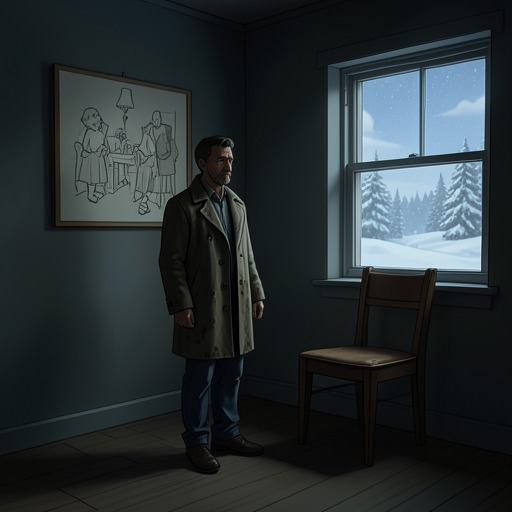
In Sonja’s room, Wallander notices a poster for The Devil’s Advocate and wonders about the image’s significance, but it does not solve the case. The more consequential discovery comes from Emil Hökberg, who challenges the police to find the person who killed his sister. He says Sonja had once been hurt and that someone hit her, though she never told him what had happened. When Wallander asks how he knows, Emil explains that she drew a picture of the assault. She was good at drawing, he says, but did not show her work; she drew pictures and tore them up. Emil had gone into her room when she was absent and found this drawing.
What the Sketch Shows
Emil retrieves the pencil drawing and asks Wallander to promise to return it. Studying it by the window, Wallander recognizes Sonja’s face and sees an attacker looming over her, his fist striking her nose. The aggressor dominates the composition. Wallander considers whether the face is as accurate as Sonja’s self-portrait: if so, it might allow the police to identify the man. The image therefore supplies more than Emil’s recollection that his sister was struck; it presents a face that can be compared with a known suspect.
A smaller mark on the attacker’s wrist proves decisive. Wallander first takes it for a bracelet, then sees that it is a tattoo. The sketch’s identifying force depends on this conjunction of visible details: a face that can be compared with Sonja’s self-portrait and a distinctive mark on the wrist. Neither detail should be mistaken for an independently verified account of the assault, but together they make the drawing a specific lead rather than a vague depiction of violence.
Identification and Investigative Use
Wallander carefully folds the paper and places it in his inside pocket, taking care to keep the rain off it as he drives to Höglund’s home. There, he asks whether Carl-Einar Lundberg had a tattoo. Höglund, who has seen photographs of him and read his case files, immediately recalls a snake design on his right wrist. The match between that detail and the mark in Sonja’s drawing gives the investigators a basis for identifying the attacker. Höglund examines the image and says it is Carl-Einar without question.
The sketch also changes the status of an investigative theory. Wallander tells Höglund that the drawing supports her theory; it is no longer only a working hypothesis. He nevertheless cautions that they may never be able to make a charge stick. The image links Lundberg to the earlier assault, but it does not by itself settle every question about the later crimes or establish all the evidence needed in court.
Limits and Significance
Wallander’s working account is that Sonja killed Lundberg’s father in revenge for the earlier attack. He also considers the possibility that Eva Persson was telling the truth when she said Sonja was responsible for both the stabbing and the assault, while treating Persson herself as an unresolved riddle. The sketch makes the proposed history more concrete, but it does not answer why Sonja killed the father or clarify what she knew about Tynnes Falk. Wallander leaves those as open questions, including who became worried that Sonja might reveal something.
The drawing’s passage from Sonja’s private room into the investigation mirrors its double role. It began as work she did not show others, among pictures she reportedly tore up; Emil’s possession of it makes that concealed record available to the police. Wallander recognizes its value, promises Emil it will be returned, and carries it through the rain to seek confirmation. The sketch thus preserves a trace of an assault Sonja had not explained to her family, while giving the investigation a testable identifying detail. Its evidentiary force is real but bounded: it sharpens the case against Lundberg without resolving the wider chain of violence and secrecy surrounding Sonja’s death.