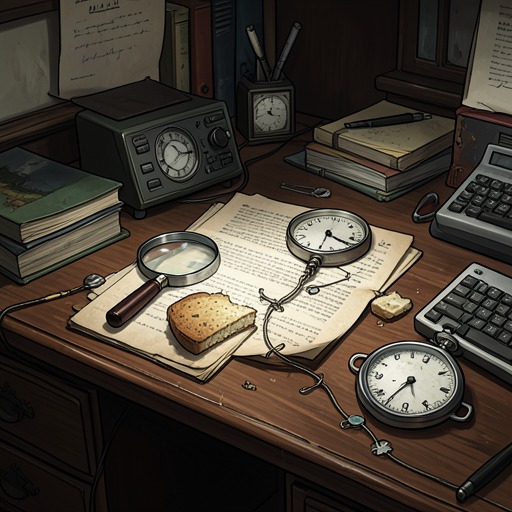
Electrical relay from the Ystad power substation
FirewallThe Electrical relay from the Ystad power substation turns a stolen corpse into a connection the police cannot ignore. Left on Tynnes Falk’s empty morgue gurney, the large, broken component points back to the site where Sonja Hökberg was found dead. Its significance lies not only in where it came from but in the calculated way it was placed: an object that makes the investigators reconsider a supposedly closed death and a murder case already complicated by a blackout.
Discovery and Physical Description
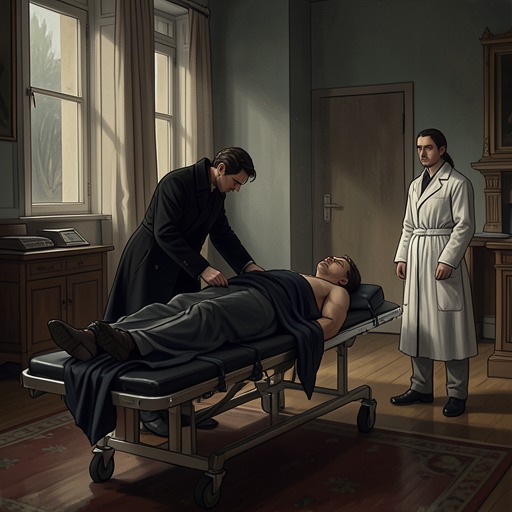
The relay enters the investigation when Martinsson tells Wallander that Falk’s body has disappeared from the coroner’s office in Lund. The report includes an unsettling substitution: a broken electrical relay has been left on the stretcher in place of the body. Wallander knows little about relays beyond their association with electricity, but Martinsson adds that this one is unusually large. Asked where such a component would normally be found, he identifies power substations, including the one where Hökberg’s body was discovered.
The details of the theft make the replacement hard to dismiss as incidental. At about 8 p.m., an employee of the coroner’s office found a locker not properly shut and discovered the missing body and relay. The janitor had last seen Falk’s body there at 6 p.m.; the theft therefore occurred within that interval. A broken lock at a back entrance opening onto the yard indicated a way into the morgue. The relay was recovered in a plastic bag, allowing investigators to seek fingerprints, while no witness or trace of Falk’s body was immediately available.
Identification of Its Origin
At first the relay offers a strong lead rather than proof. Wallander suspects it is an intentional sign, but the police still need to establish that it actually came from the Ystad power substation. He asks Nyberg to examine it and determine its origin, resisting the temptation to treat the apparent connection as settled fact before the object is checked.
That uncertainty ends when substation workers identify precisely where the relay belongs. Nyberg reports that there is no room for doubt: the component is from the substation. The confirmation transforms the relay from a suggestive resemblance into physical evidence linking Falk’s case with Hökberg’s death. Wallander feels the force of the discovery, although the link itself does not yet explain what the people responsible wanted or what the two cases conceal.
A Message Between Cases
The police had initially treated Falk’s death as natural. He had been found beside a cash machine with a blood-spattered receipt still in his hand, but the preliminary investigation and autopsy had not established a crime. The relay’s appearance in the morgue changes the meaning of that earlier decision: someone has taken the trouble to remove his body and leave an object associated with the substation where Hökberg died.
Wallander interprets the relay as a deliberate greeting to the investigators, not as something its carrier happened to possess. The object draws their attention to a relationship between the two deaths while the missing corpse suggests an effort to conceal something about Falk. The police cannot yet prove the motive for either act, and Wallander recognizes that a stolen body alone does not establish that Falk was murdered. Even so, the replacement makes it increasingly difficult to keep the cases apart.
The relay also alters the investigation’s working frame. Hökberg’s death at the substation coincided with a major power failure across Skåne, and Wallander begins to consider whether the disruption should be understood as sabotage rather than an isolated tragedy. In his developing theory, the relay makes the substation the centre of a larger pattern: the connection between Hökberg and Falk has been made explicit, but what that connection means remains unresolved. The object points toward an explanation; it does not supply one.
Evidence, Interpretation, and Narrative Role
The relay’s force depends on the difference between an observed fact and an inference. Investigators can establish that it was left where Falk’s body had been and, after examination, that it came from the Ystad power substation. They can reasonably infer that its placement was intentional and that it was meant to make them connect the substation with Falk. They cannot infer from the relay alone who removed the body, whether Falk was killed, or exactly what the removal was intended to hide. The object sharpens the questions without answering them.
Its movement into the narrative reverses the status of both cases. Falk’s death, set aside for lack of evidence of a crime, becomes newly suspect; Hökberg’s death, already bound up with the regional blackout, gains a connection to a man whose life the police had barely investigated. The relay gives that change a material form. Instead of an explanation delivered in testimony, the investigators find a broken piece of electrical equipment occupying the place of a missing human body.
In this way, the relay is both forensic evidence and a staged signal. Its association with the substation makes a concealed relationship visible, while its placement in the morgue makes the act of concealment itself impossible to overlook. The police can trace the object to its source, but tracing it does not close the case: the relay confirms that the separate investigations belong together and leaves the deeper purpose of that connection still to be discovered.