Tynnes Falk's computer
FirewallTynnes Falk's computer is the concealed center of Falk’s double life and the investigators’ first substantial route into a plot aimed at the global financial network. Hidden in a locked attic office, it is at once evidence, a guarded communications system, and a monitor for a countdown whose meaning Kurt Wallander must piece together. Its contents transform an investigation that began with a death beside a cash machine into a race to understand—and prevent—an attack reaching far beyond Ystad.
Discovery in the hidden office
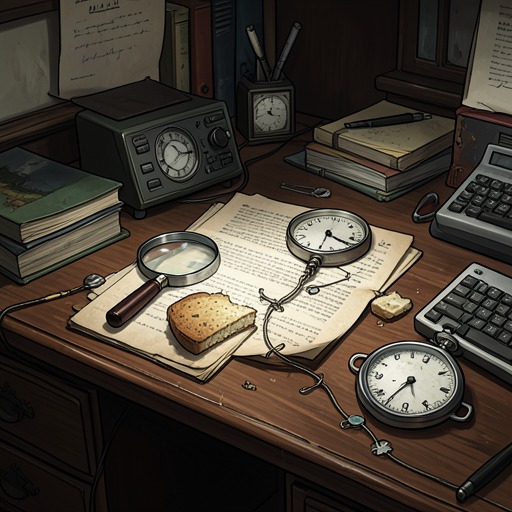
Kurt Wallander finds the computer in Falk’s second flat, a large, nearly empty attic room in a building on Runnerströms Torg. A desk and chair are its only furniture; the computer sits beside a blueprint of the power substation where Sonja Hökberg was killed. The room has a reinforced steel door, no name or letter box, and none of the ordinary clutter Wallander expects in a working office: no shelves, binders, books, or even a pen. In that silence, the computer is less a tool among other things than the room’s defining object.
The placement of the substation blueprint beside the machine immediately links Falk’s secret workspace to the case’s most disturbing events. Wallander sees the computer, the blueprint, Falk’s death beside an ATM, and the disappearance of Falk’s body from the morgue as pieces of a pattern, but cannot yet make them cohere. He does not dare turn the machine on himself. Instead, he calls in Martinsson, whose technical expertise gives the police their first access to the computer’s guarded contents.
When Martinsson starts it, the screen passes through symbols and settles on an image of the night sky. The machine automatically connects to a server. An attempt to open a file appears to notify someone elsewhere that the investigators are probing it; that person might be anywhere in the connected world. Martinsson finds the files protected by elaborate codes and barriers, and discovers that someone used the computer the previous night, after Falk was dead. The office therefore does not simply preserve Falk’s past work: the network around the computer remains active, and someone else has access without entering the room.
Breaching the defenses
Robert Modin, a nineteen-year-old recently released from jail and known for breaking into the Pentagon’s supercomputer, initially cannot get through the security. He says the system is unlike anything he has encountered and that he needs time, sleep, and freedom from pressure. His first failure makes the machine’s defenses palpable: its secrets are not waiting behind an ordinary password but buried beneath a deliberately constructed maze.
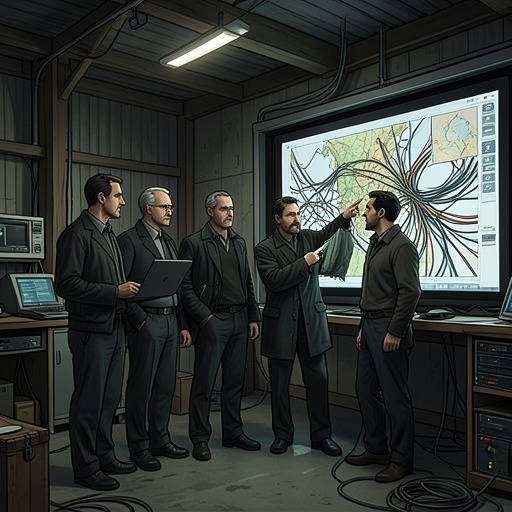
Modin eventually works around the obstacle by bringing in two computers of his own and connecting them to Falk’s. He never finds the password; instead, he gets in through what he describes as a back door. The screen changes from chaotic streams of numbers to more orderly arrangements. In a file named Jacob’s Marsh, he and Martinsson find phone numbers, names, and long numerical codes, including identifiers for institutions in the United States, Asia, Europe, Brazil, and Nigeria. Modin recognizes one code as the Pentagon. Further investigation identifies the World Bank, including a branch associated with global finance inspections, and indicates that Falk had obtained classified information by penetrating institutional networks.
The computer’s contents are difficult to interpret because Falk arranged them so that outsiders could not readily see what he was doing. When Modin sends a test message through a connection, access is denied; he has to work to cover his tracks. He and Martinsson also find that the machine contains not merely stored information but a structure that responds to attempts to trace it. When they focus on two recurring initials, JM, they disappear; left alone, they reappear and shift position through the list according to a pattern. Martinsson calls the moving elements nocturnals. Their changing coordinates give the investigators a temporal clue: the pattern is advancing toward October 20.
From coded pattern to financial threat
At first, Wallander and the computer specialists wonder whether the recurring number 20 points to the year 2000 and anticipated computer failures. Modin rejects that explanation: the countdown appears too near, and the missing zeroes do not fit. By October 17, his calculations suggest that the moving pattern will reach an endpoint on Monday, October 20. The computer can indicate that something is approaching, but it cannot by itself tell the investigators what will happen or where the operation is controlled. Pulling its plug would not resolve the danger, because it is only a monitor for a network whose full structure they cannot see.
Modin’s broader inquiry identifies the common ground among the institutions in Falk’s files: together, they are cornerstones of the global financial network. If compromised, they could be used to provoke cascading disruption—stock-market crashes, panic withdrawals, and currency exchanges so unstable that rates become uncertain. The scheme is not simply an act of computer intrusion for its own sake. The information on the machine points to a coordinated attempt to destabilize interconnected financial systems, and the countdown gives the police reason to believe that the plan is nearing execution.
The discoveries also reshape the investigation around Falk. Wallander had been trying to understand the links among Falk’s death, Hökberg’s killing, the missing body, and the substation blueprint. The computer supplies a motive for extreme efforts to protect Falk’s secrets and makes the repeated intrusions into the case look less like isolated crimes. Yet it does not answer every question: the investigators still have to distinguish the computer’s evidence from the physical violence surrounding it and identify the people directing the operation.
Countdown, danger, and the attempted trigger
The computer alerts Carter that someone has broken through its first layer of security. In Luanda, Carter reads the signal from a system Falk built to his instructions. Although he initially tells himself that the operation remains under control, the breach forces him to respond. His alarm establishes that the computer is not merely a private archive in Ystad: its defenses and signals serve a wider conspiracy, and a breach there is visible to a conspirator abroad.
As the October 20 deadline approaches, the specialists’ work points to a vulnerability across the major financial institutions. The investigation later establishes how close the plan came to activation: if Wallander or Modin had put Carter’s Visa card into the cash machine at exactly 5:31 a.m. on October 20, they would have unleashed an electronic avalanche. The account does not reduce the computer’s danger to a single screen or a single code. Its importance lies in the network of institutional weaknesses that Falk and Carter had exposed, and in the everyday action that could have triggered the attack.
That trigger is not activated. Nothing happens to the global financial system, although a selection of cash machines in Skåne behaves erratically for a day; many are shut down, no cause is located, and they later resume normal operation. Experts around the world work to repair the vulnerabilities the investigation has exposed. The computer’s revelations thus produce both an immediate reprieve and a wider consequence: institutions must confront weaknesses that the conspiracy had identified and could have exploited.
Significance and unresolved evidence
Tynnes Falk's computer changes the scale of the story. Its route from a dark, almost bare attic room to the Pentagon, the World Bank, and other institutions makes a local police investigation confront a system too dispersed for Wallander to grasp at once. The machine’s secrecy is material as well as digital: a reinforced door protects the room, layered barriers protect its files, and shifting codes conceal the operation’s timetable. Each defense buys the conspiracy time while making the investigators’ uncertainty part of the danger.
The computer also makes technological expertise indispensable to the inquiry. Wallander depends on Martinsson and Robert Modin to read what he cannot interpret, and the coded information forces him to revise his understanding of what Falk had been doing. At the same time, technical access does not yield complete knowledge. Even after the plan is stopped, the investigators do not find a satisfactory explanation for why Falk possessed the power-substation blueprints or why Sonja Hökberg was thrown against the high-voltage wires. The computer exposes the conspiracy’s scale and its intended target, but it does not close every gap between the digital plot and the deaths that brought the police to Falk’s door.