Silence and saying nothing
FosterSilence and saying nothing are not simply the absence of speech: they move between social habit, pressure to disclose, and the girl’s growing ability to decide what she will keep to herself. The novel first shows adults using talk to avoid intimacy, then places the girl between Edna Kinsella’s insistence that there be no secrets and John Kinsella’s assurance that she need not speak. At home, silence becomes her own answer—and a way to recognize what matters without explaining it.
Silence as Adult Habit
When Dan meets John Kinsella, their conversation turns through rain, cattle prices, the EEC, butter mountains, lime, and sheep-dip. The exchange is full of subjects, but the narrator recognizes it as a way men have of not talking: Dan spits; men kick divots from the grass, slap a car roof before it leaves, or sit with their legs apart as though they do not care. Speech and silence therefore coexist. The men talk about weather and farm business while avoiding more personal disclosure, and their gestures give the avoidance a physical form.
This habit is not presented as an abstract rule that everyone follows. It is something the girl has observed and knows how to read. The distinction matters when adult conversation turns directly toward her: what begins as a familiar reserve among men becomes a question of whether she must answer other people’s curiosity.
Questions, Secrets, and the Demand to Tell
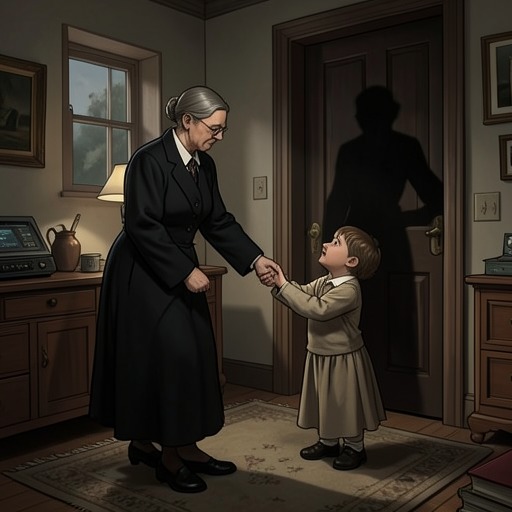
Edna Kinsella makes the opposite rule explicit. When the girl wonders whether she is supposed to tell, Edna turns her around so they face each other and insists, “There are no secrets in this house, do you hear?” She asks again whether the girl hears her. The repeated question presses for acknowledgment as well as disclosure; in the girl’s account, Edna’s dark-blue eyes and close attention make the encounter intensely direct. Silence here is not merely noticed. It is challenged by an adult who expects an answer.
The pressure to know what happened continues beyond the house. On the road after the goodbye, Mildred fires one question after another: which room the girl slept in, whether John gave her money, whether either Kinsella drinks, whether they play cards, what they sold, whether they say the rosary, what goes into Edna’s pastry, where the dog sleeps, and whether the freezer is packed. She also asks whether the deceased child’s clothes are still hanging in the wardrobe. The girl answers easily until that final question. The abrupt difficulty shows a limit to her readiness to satisfy other people’s interest, even when she has been answering everything else.
Later, John asks whether Mildred wanted to know if the freezer was packed tight. The girl reports that question, and Edna immediately asks, “Did she tell you anything?” followed by “What did she tell you?” The girl does not know what to say. These exchanges make silence a social problem that adults repeatedly try to solve by asking again. Yet the questions also expose different kinds of curiosity: practical details about a household sit beside questions about the dead child’s clothes and what the girl may have been told.
John Kinsella’s Permission
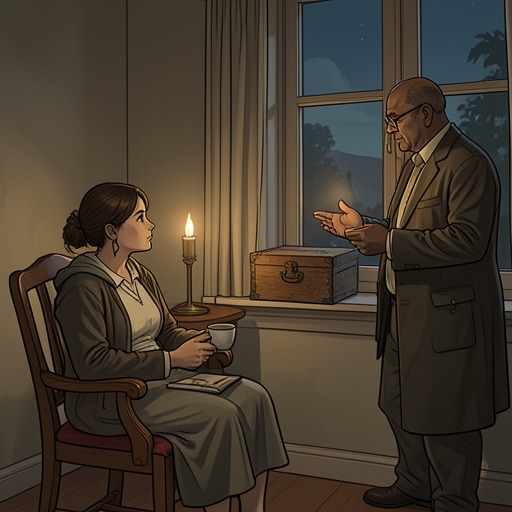
At the beach, John gives the girl a different way to understand what has happened. The strand has been washed clean of footprints, though objects have washed up beyond a crooked line in the sand: bottles, sticks, a lost mop handle, and a stable door with a broken bolt. John speaks of a horse found at sea, then says a strange thing happened to the girl that night and explains that Edna meant no harm. In his account, Edna seeks the good in people by trusting them, though that trust can disappoint her.
He then tells the girl, “You don’t ever have to say anything,” adding that a person can lose much by missing a perfect opportunity to say nothing. The assurance directly counters Edna’s rule that there are no secrets in the house. It does not require the girl to explain what she cannot yet put into words, nor does it tell her that every silence means the same thing. On the beach, with the moon disappearing behind a cloud and John lighting the lamp as they turn back, the girl listens to an explanation she does not fully understand. The permission is clear even where the situation remains obscure.
The Return and Chosen Silence
After John and Edna leave the girl at home, Mary asks what happened. The girl answers, “Nothing.” When Mary asks her to tell, she replies, “Nothing happened.” The narration makes the choice behind that answer explicit: she has learned enough to know that what happened is not something she ever needs to mention, and recognizes this as her perfect opportunity to say nothing. Her silence is not simply a failure to answer; it is a decision about who is entitled to hear what.
Then the car brakes on the gravel, and the girl runs down the lane toward John, who has turned back and is closing the gate. As she runs, memories flash through her mind: the boy in the wallpaper, gooseberries, the bucket pulling her under, the lost heifer, the weeping mattress, and the third light. These images gather the summer into a sudden, wordless rush, while her heart seems to beat in her hands and her breathing later settles as John holds her tightly. The contrast is decisive: she says nothing to Mary, but her movement toward John communicates attachment without explanation.
Narrative Significance
The novel makes silence change meaning through its circumstances. It can be part of the men’s practiced evasion, an answer Edna refuses to accept, the result of the girl reaching a question she cannot answer, or a freedom John explicitly grants. At the end, the girl uses that freedom with Mary while responding to John through action. Her silence does not erase the summer or its unresolved experiences; the memories arrive vividly as she runs. Instead, the ending shows that saying nothing can protect a private knowledge while a gesture—the rush down the lane and the long embrace—makes a bond unmistakable.