The Kinsellas’ bereavement
FosterThe Kinsellas’ bereavement is a private family loss that becomes visible to Unnamed girl through rumor, the dead boy’s clothes, and John Kinsella’s acts of care. The story never gives her a full account from the bereaved parents themselves. Instead, the loss emerges obliquely: a neighbor names the drowned child, the household continues to receive visitors and make tea, and John’s eventual embrace carries feeling that neither he nor the girl puts into words.
The loss and its uncertain account
The first indication of the family’s absence is John Kinsella’s remark that he has none of his own. He makes it while inviting people in out of the rain, adding that this does not mean he would let rain fall on anyone else. The comment acknowledges childlessness without explaining it. His hospitality immediately takes practical form: the visitors come inside, more tea is made, the ashtray is emptied, and cards are dealt. Domestic activity continues around the fact he has disclosed, without turning the invitation into a formal account of his loss.
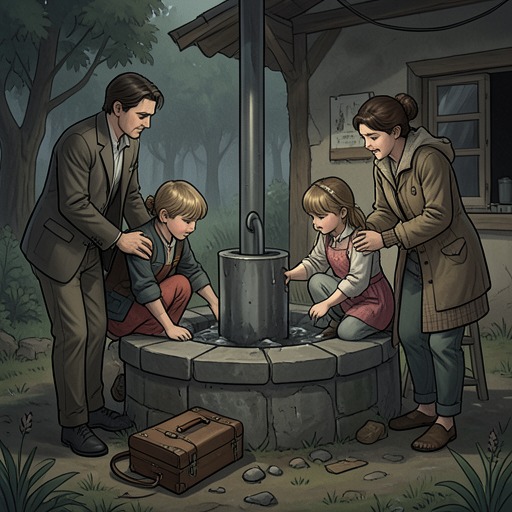
Later, on the walk home from the wake, a woman reveals to Unnamed girl that the Kinsellas’ young son died after following their hound into a slurry tank. She presents the story as what people say happened, not as knowledge she personally verifies. She also repeats another local account: John took a gun to the field intending to shoot the hound but could not bring himself to do it. The child’s death is thus conveyed through communal talk, with its bluntness and speculation intact; the account reaches the girl before either parent chooses to tell her.
The woman adds that both John and Edna Kinsella turned white overnight. The detail is also hearsay, but it gives the family’s grief a sudden bodily mark in the community’s telling. Unnamed girl is left unable to answer. As she walks between hedges, she tries not to think about what she has heard, though it occupies her thoughts; the sun remains high even as the day seems unwilling to end. The scene makes the disclosure consequential not by supplying further explanation, but by showing how abruptly the knowledge changes the girl’s experience of the walk.
Grief within the household
After Unnamed girl tells John what the woman said, the household does not open into a longer conversation about the boy. The hound comes out to greet them, and the girl realizes that she has not heard either parent call him by name. John sighs and goes to milk. He later says there will be no visitors that night because of the wake, then qualifies the explanation by saying that he does not want any. The qualification makes the wake more than a social obligation: company is expected, but his reluctance is present too.
Edna Kinsella’s grief is also bound to the clothes the girl wears. The woman has told her that she wore the dead boy’s clothes to Mass the previous Sunday; at home, John removes her shoes and puts the boy’s jacket on her. The clothing makes the loss materially present without a direct explanation from either parent. For the girl, what had been ordinary borrowed clothing becomes something newly understood, and the jacket is both an item from the dead child’s life and part of the care she receives in the household.
John’s account of Edna’s intentions is similarly restrained. At the beach, he says that a strange thing happened to the girl that night, but Edna meant no harm. He describes her as wanting to find the good in others and sometimes trusting them in the hope of not being disappointed. This offers the girl an explanation of Edna’s conduct, not a full confession of the couple’s grief. The loss remains present in the way John speaks about trust and disappointment, but the passage does not claim that bereavement alone explains Edna’s choices.
Silence, care, and the closing gesture
John tells Unnamed girl that she never has to say anything, calling silence a thing she need never do without. His maxim has immediate force in a story where she has just been made to hear intimate family knowledge through another person’s gossip. She cannot supply an answer to the disclosure, and John does not demand one. His words make room for her silence rather than asking her to comfort him or explain what she feels.
The next decisive gesture comes when John sees that the girl can see what he has pointed out and puts his arms around her, gathering her close as though she were his. The embrace gives physical expression to an attachment that the scene does not label or simplify. It does not undo the death, and the narration does not present the girl as a replacement for the boy. Instead, the gesture places tenderness beside bereavement: the dead child’s jacket is on her, John holds her, and the story allows the closeness to stand without explanation.
Narrative significance
The account of the Kinsellas’ bereavement is built from partial disclosures rather than a single explanatory scene. A casual remark about having no children precedes the girl’s discovery; village rumor supplies the circumstances of the drowning; the wake, John’s reluctance to receive visitors, and the boy’s clothes give the loss a place in daily life. The sequence keeps a distinction between what the community says and what the parents themselves confirm, while showing how gossip changes the girl’s understanding of the home where she is staying.
That indirectness also shapes the emotional ending. John does not answer the girl’s report with a detailed history of his son, and the girl cannot find words for what she has heard. His invitation to silence and his embrace become the clearest forms of response. Bereavement is therefore not resolved by disclosure; it remains an absence that the family carries into ordinary acts of hospitality, work, clothing, and care.