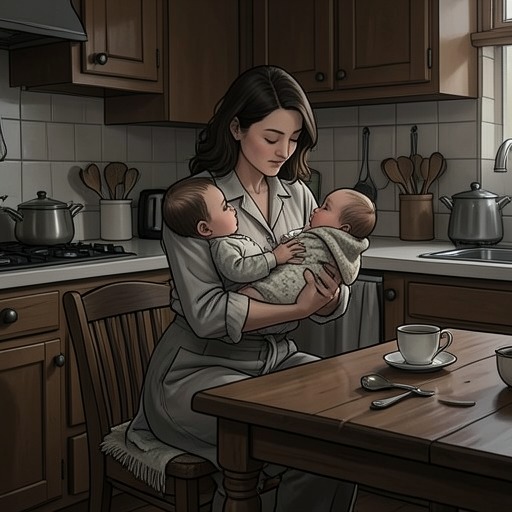
The girl chooses silence after returning home
FosterUnnamed girl’s silence after returning home marks a change in what she believes she owes other people: when Mary asks what happened during the summer, she says that nothing happened, though she knows the experiences she is withholding are real and significant. The refusal turns silence from an imposed absence of speech into a choice, and the reunion that follows shows how much feeling that choice leaves unspoken.
Questions Before the Return
Before the homecoming, Unnamed girl has already encountered competing rules about what may be said. Edna Kinsella tells her, “There are no secrets in this house, do you hear?” The statement makes disclosure sound like an obligation, reinforced by Edna’s demand for an answer. Later, when Unnamed girl is out walking with Mildred, the questions arrive in an almost uninterrupted stream: Mildred asks about the room, money, drinking, cards, prayer, food, the dog, the freezer, and the child’s clothes. Unnamed girl answers readily until the final question stops her. The exchange establishes that she can give information, but that some subjects resist being treated as ordinary household details.
The contrast extends to adult conversation. When Dan and John Kinsella meet, their talk moves through rain, cattle prices, the EEC, butter, lime, and sheep-dip; a pause is filled by Dan spitting, and the men’s gestures—kicking at grass, slapping a car roof, sitting with legs apart—accompany what the narrator recognizes as their way of not talking. This earlier scene does not make the men’s reticence identical to Unnamed girl’s later decision. It does, however, place speech and its avoidance within a wider pattern: people can communicate through what they discuss, what they leave alone, and the gestures that take the place of explanation.
The Question at Home
At the family home, John Kinsella praises Unnamed girl to Mary and tells her to keep her head in her books, adding that he wants to see gold stars in her copybooks when he next visits. He kisses her; Edna embraces her. Their car then pulls away, and only after it is gone does Mary ask, “What happened at all?” Unnamed girl answers, “Nothing.” Mary presses her with “Tell me.” The repetition gives the exchange its force: a broad question is followed by a denial, then a direct invitation to disclose more.
Unnamed girl answers again, “Nothing happened.” The narration makes clear that this is not because she cannot recall the summer. She has learned enough to understand that what happened is not something she needs to mention. She calls the moment “my perfect opportunity to say nothing,” identifying the silence as an available choice rather than a failure to answer. Mary’s questions ask for a story; Unnamed girl declines to supply one, keeping the meaning of the summer outside the conversation.
Silence as a Chosen Boundary
The refusal gains significance beside Edna’s earlier insistence that the Kinsella home contains no secrets. Unnamed girl has heard the demand for openness, and she has experienced others’ curiosity about the private arrangements of that home. Yet on returning, she does not carry those details into a report for Mary. Her answer does not deny that the summer mattered; instead, it withholds the account from a question that would make it speakable on someone else’s terms.
The passage also distinguishes silence from indifference. Unnamed girl’s narration acknowledges both that she knows what occurred and that she has grown into the judgment that she need not tell it. The brief spoken answer is therefore supported by an inward decision. What remains unsaid is not empty space: it holds the difference between having experienced something and consenting to explain it.
The Answer Beyond Words
Immediately after the exchange, a car brakes on the gravel in the lane. Unnamed girl runs toward it without stopping to consider what to do. As she rounds the bend, she sees John Kinsella closing the gate; when he sees her, he stops, and she runs into his arms. He lifts her and holds her tightly for a long stretch. Her heart’s pounding and her unsettled breathing gradually settle as they remain together, while a gust shakes large raindrops from the trees above them.
The movement from “Nothing happened” to this embrace gives the silence a further dimension. Unnamed girl does not explain the summer to Mary, but her body answers John Kinsella’s return with urgency, and he answers by holding her. The scene does not turn her refusal into a confession or make speech necessary to validate the attachment. Instead, it places a chosen silence beside an unmistakable act of recognition: she keeps the story to herself, then runs toward the person with whom its emotional force is shared.