Lost Age
GunsoulThe Lost Age was the vanished civilization that preceded the Spiral Dancer’s Thunderdance and the Sky-Biter’s world-unmaking. Though Yuan Guang was born long after it had ended, its roads, cities, military technology, and monumental architecture remain embedded in his world: not as a recoverable past, but as fragments that shelter settlements, inspire landmarks, and preserve weapons whose purpose can threaten the present.
Chronology and the End of an Age
The Lost Age had died before Yuan Guang was born, and he had never learned to mourn it. For him, it was not a personal memory or a lost home. It was an era known through what had survived, and through the dangers that still followed from its remains. That distance matters: the world’s inhabitants live among traces of the old civilization without necessarily sharing a common account of what it was or why its destruction should be grieved.
The book gives the later cataclysms a compressed chronology. The Spiral Dancer completed her Thunderdance and ascended fifty years before the account of Yuan Guang’s life; the Sky-Biter unmade the world forty-five years before it. The Lost Age came before both. Its ending therefore belongs to a sequence in which human history is not merely interrupted by ordinary political change: the Wayfinders’ ascensions alter reality itself. The Spiral Dancer’s passage into the heavens left the Thunderlands, while the Sky-Biter’s departure was bound to the unmaking of the world. The chronology places the Lost Age on the far side of a rupture whose effects remain visible in the land.
Roads, Cities, and Material Remains
Yuan Guang has heard that fleets of cars once travelled across highways made of stone, extending across half the world. The roads are now ruins, but their scale persists in the landscape. Gatesville stands beneath one such highway: immense concrete pillars rise like hills to support an ancient stone bridge. Seen from a distance, the structure resembles a monumental archway, and the town has adapted itself to its shadow. Poorly built shacks crowd the underpass, while better buildings stand above on the bridge, where residents can watch for approaching enemies and conduct business below. An old transport route has become both shelter and defensive vantage point.
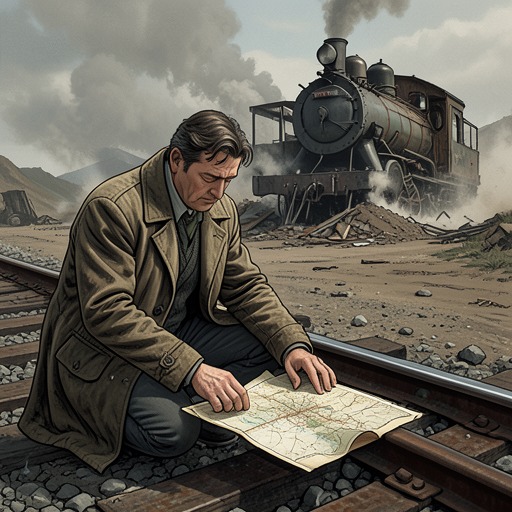
Other remnants testify to the scale of Lost Age urban life. Along Orient’s route, Yuan Guang sees the remains of a vast city: crumbling skyscrapers lean against one another, bridges are cracked, and a faint blue miasma of qi, associated with the regrets of the dead, hangs over the empty streets. Orient passes a ruined station without stopping. The scene turns the Lost Age’s infrastructure into more than scenery: buildings and transit sites remain legible as parts of a once-connected world, yet they are now abandoned places that a living train must leave behind.
The History Road also preserves the old age in altered form. Its landmarks include a metal pylon called the Eiffel Tower and a four-faced mountain called Mount Rushfort. Yuan Guang has helped Orient and Holster modify one of these landmarks, while assuming that the mountain commemorates four Lost Age sect patriarchs who looked down on their disciples. That interpretation is his supposition, not confirmed history. The landmarks are at once ruins, remembered names, and objects reshaped for present use; their surviving forms cannot guarantee that later inhabitants understand their original significance.
Technology, War, and Dangerous Knowledge
Lost Age technology survives in objects whose meaning is disputed and whose power can outlast the civilization that made them. The Cube of Natho was created during the chaotic years before the Sky-Biter’s ascension. Manhattan says it could become the world’s salvation in the right hands or a weapon of terrible power in the wrong ones, and refuses to explain its full function. Arc supplies a military context: Natho was an alliance that ruled the west until the Sky-Biter consumed half its nations, and it fielded weapons capable of destroying entire cities. Arc suspects the cube may be one of those weapons, while warning that Nuclear Path cultivators are drawn to destruction. The artifact’s danger lies partly in the gap between its surviving object and the incomplete knowledge available to those who pursue it.
The threat is not confined to the cube. Kaguya explains that nuclear cultivators would inevitably unleash The Nuke trapped inside it, and offers to leave the artifact alone if Yuan Guang accepts the burden of guarding it and promises to keep The Nuke contained. Her warning makes Lost Age knowledge an active political concern: a relic can draw modern powers into conflict even when its original makers and their world are gone. The proposed Unspeakable Vow would bind the present to a duty imposed by an ancient weapon’s continued existence.
The Bullet Church gives another view of how the past is reinterpreted. Its enormous stone building looms like a Wayfinder’s temple, and its battered murals appear to Yuan Guang to have once honored an ancient Lost Age demigod slain during the world’s unmaking. That reading is an inference. In the present, the building houses a bustling market of rifles, shotguns, cannons, and explosives. Scraps pray before improvised altars devoted to customized guns, while weapons are also used in lethal games. The old sacred architecture has not simply been preserved: it has become a setting where firearm worship, commerce, and violence occupy the same space.
The Past in the Present
The Lost Age is encountered less as a complete history than as a set of material residues with competing uses. A highway can become a town’s roof and lookout; a monumental building can become a weapons market; a ruined station can lie beside a route that Orient chooses not to stop at. An artifact can promise salvation, threaten mass destruction, or become the object of a vow. In each case, survival is selective: structures and devices endure, while their purposes and histories are only partly recoverable.
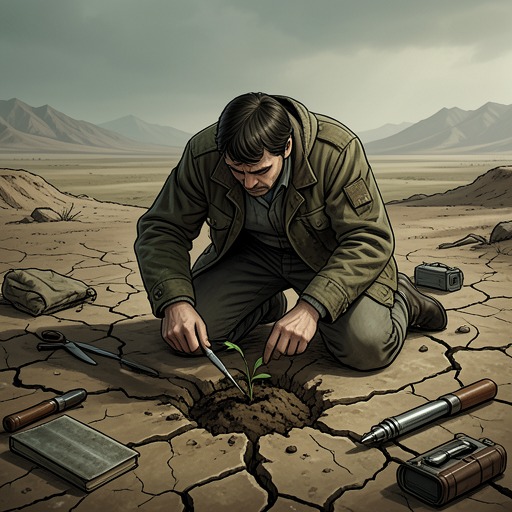
That uneven survival also shapes how Yuan Guang responds to the past. Travel for pleasure seems incomprehensible to him, because crossing the wasteland means facing constant danger; he reflects that the Lost Age must have been very different for people to travel simply to sightsee. His reaction does not establish exactly how safe or prosperous the old world was, but it marks the distance between its remembered possibilities and the hazards of the present. The era is therefore both a source of astonishing infrastructure and a contrast that makes contemporary insecurity newly visible.
Narrative Significance
The Lost Age gives the novel’s landscape historical depth without making that history whole. Ruins are not passive reminders: they organize settlements, frame routes, furnish public spectacles, and preserve lethal capabilities. Even the History Road’s landmarks can be repurposed, while the Cube of Natho forces its guardians to decide whether forgotten knowledge should be protected or left buried. Through these remains, the past presses into present decisions without offering a reliable guide to its own meaning.
The contrast between the Lost Age and the world after the Thunderdance is particularly stark. The old highways once carried fleets across vast distances; now couriers risk their lives to cross a wasteland. The great cities and stations persist as ruins, while the legacy of ancient warfare survives in weapons that modern powers may reactivate. The Lost Age is thus neither simply an object of nostalgia nor a closed chapter. It is the buried foundation of the present world—and a continuing source of both possibility and catastrophe.