Fleas
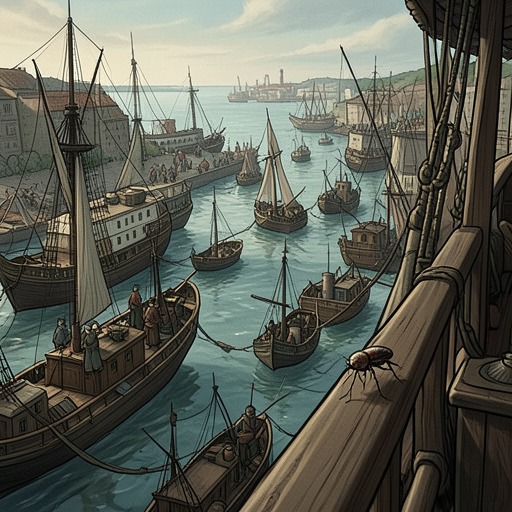
HamnetFleas are the smallest but most persistent agents in a chain of transmission that carries infestation from a captured monkey in Alexandria toward Stratford. Their journey unfolds through unnoticed transfers between a boy, a cat, sailors, a rat, a horse, and travelers’ clothing. By following what people scarcely perceive, the narrative turns fleas into a thread linking maritime trade, sickness, death, and the possibility of contagion reaching home.
Origin and First Transfers
The chain begins when a boy tries to keep a monkey that has become his companion. The animal is pulled away on a chain, and the boy watches it go. In the struggle, three fleas leave the monkey. The boy does not know that he has received anything from the encounter; the fleas’ inheritance is not affection or memory but the means to continue elsewhere.
One flea drops to the ground and is crushed beneath the boy’s foot. Another settles in his fair hair, then leaps from his forehead to the shoulder of an innkeeper when the boy pays for local beer. The third remains in a fold of the red handkerchief around the boy’s neck, a gift from his beloved in his homeland. These different fates begin with the same brief contact, but only some of the fleas find another host.
Later, aboard ship, the boy brings his favorite cat close to his neck. The cat is almost white, with a striped tail, and the flea leaves the handkerchief for the thick white fur there. The animal soon becomes ill and, as if recognizing the person who hates it, settles in the ensign’s hammock. When the ensign finds the cat dead, he curses it, removes it without care, and kicks it across the cabin. The disturbance does not end the flea’s journey: fleas remain where the cat had been, and one reaches the ensign’s warm armpit while he sleeps.
A Shipboard Route Through Sickness
The flea’s movements take place amid a ship already made vulnerable by vermin and illness. Sailors from the Isle of Man complain that the quarters are infested with fleas as they slap at their necks and shoulders. Rat hunters among the Polish sailors kill rats with a shovel, but their efforts coexist with the infestation rather than ending it. The narrative places ordinary shipboard practices—shared quarters, cargo, animals, and sleep—alongside the invisible traffic of parasites.
The ensign is confined below with illness. The next day he is delirious, foaming at the mouth, and has a tumor on his neck; the captain orders the ship’s doctor to visit him. The report that several cats have also died adds another sign of a spreading sickness, though the captain initially gives little weight to the news. As the ship continues, the second officer develops African fever, with blackened fingers and a body so hot that sweat falls through the knots of his hammock. He is buried at sea with two Polish sailors off Naples. The flea’s course is not presented as a clinical diagnosis, but its passage among hosts makes the relation between vermin and shipboard illness difficult to ignore.
From Rat to Glassmaker
In Venice, the boy is sent ashore to find cats for the ship, where more men have been confined with fever. He helps steady a handcart whose boxes are about to spill, then runs toward cats beneath a fish stall. Neither he nor the glassmaker notices the flea that passes from the boy to the man’s sleeve and climbs to his left ear, where it bites behind the lobe. The glassmaker is cold in the canal mist and intent on getting the boxes aboard so he can be paid and return to Murano, where orders await him.
The narration gives the flea a history that no human witness possesses. Before reaching the glassmaker, it has spent roughly the previous week in a rat and, before that, in a cook who died near Aleppo. Its route connects a dead cook, a rat, the boy, and a working craftsman across successive settings without any of them understanding the connection. At the level of human attention, these are separate incidents; the flea makes them one continuous passage.
The Journey Inland
Fleas emerge from rags after a stay in a warehouse without a host, hungry and exhausted, but soon recover. They jump between a horse and the people encountered on the road: a woman who gives the rider a measure of milk, a child who approaches to stroke the horse, and a young man at an inn. The transfer is neither planned nor confined to the ship. It proceeds through brief acts of hospitality and curiosity, ordinary contacts that leave no visible account of what has passed between bodies.
By the time the rider reaches Stratford, fleas have laid eggs in the seams of his doublet, the horse’s mane, the stitching of the saddle, the filigree and waves of lace, and the rags protecting the glass beads. The eggs are described as descendants of the flea from the monkey. The image enlarges the journey beyond the survival of one insect: the original encounter has produced a lineage distributed among clothing, animal hair, leatherwork, and goods. The rider delivers letters, lace, and the box of beads to an innkeeper outside town, placing these infested materials within the same network of everyday exchange.
Narrative Significance
Fleas make distant movement legible at a scale that people cannot readily see. A monkey’s capture in Alexandria, a sick animal aboard ship, a rat, the bustle of Venice, and a horse reaching Stratford become parts of one chain because the narration follows the parasite across the gaps between human scenes. Its path depends on chance—the lost handkerchief, a cat held close, a handcart steadied, a horse stroked—and on the material surfaces that carry eggs and hosts onward.
The resulting account gives disease a route without granting the people along it knowledge of that route. Sailors notice fleas and dead cats, and a captain hears reports of fever, but no one witnesses the full sequence. By making that sequence visible to the reader, the narrative sets private intention against the indifferent reach of contagion: people may travel for work, tend animals, or carry goods, while an unseen passenger turns those separate acts into a history of transmission.