Rats
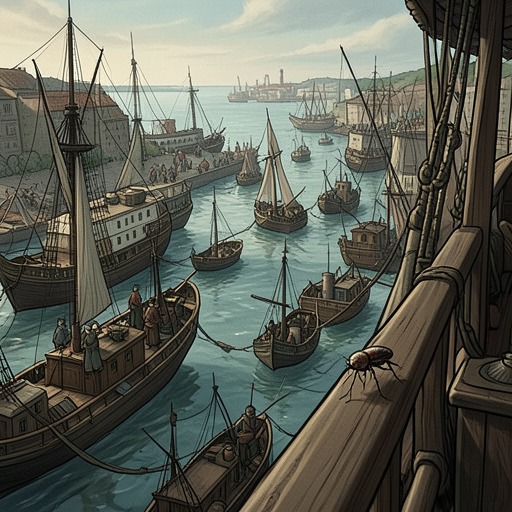
HamnetRats become a force that reshapes a trading voyage: after the ship’s Cats die, they multiply in the holds, attack provisions, and accompany cargo from port to port. The narrative follows them not as isolated vermin but as mobile inhabitants of a crowded maritime world, where goods, animals, and people share confined spaces and the consequences of illness travel with them.
Shipboard Proliferation
The ship’s Cats die before the vessel reaches Aleppo, leaving the Rats without their principal predators aboard. At Aleppo, the crew unloads more clove and coffee along with a large number of Rats, which escape onto dry land. The detail makes the cargo’s contents consequential beyond their commercial value: Rats are part of what the ship transports, and unloading releases them into a new place.
By the time the ship reaches Constantinople to collect hides bound for the north, the absence of Cats has become a practical crisis. The Rats gnaw through packing materials and reach the salted meat. The second officer reports that fifteen or sixteen were in the kitchen that morning. Their presence invades both the ship’s stores and its daily routines; food is no longer securely separated from the animals living among the cargo.
The infestation also unsettles the crew. The second officer describes men losing morale and spending the day looking toward the horizon through the porthole, while more sailors fall ill. The Rats are not simply a nuisance to be cleared away: they become part of the conditions under which the crew must continue working, eating, and enduring a voyage already marked by sickness and death.
Hunting and Failed Control
The captain hires replacement sailors at Ragusa after several men die of the same fever, described as swelling the neck and covering the skin with red and sometimes black blisters. The newcomers are Polish, reserved, and distrusted by the Manx crew, who will not share their cabins. Yet the newcomers prove effective at hunting Rats. Their skill offers the ship a form of control that the existing crew has not managed to establish.
The hunt is a carefully staged ambush. The Polish sailors bait a cable, wait with a large shovel, and leap on a Rat when it appears. They kill it with a blow, cutting off its tail and hanging it from a belt; afterward, they pass around a bottle of clear liquid. From across the cabin, a Manx sailor watches and recoils from the spectacle, then slaps his own neck and shoulder because he is covered in fleas. The scene sets practical success against disgust: the Rats can be killed, but their presence has already entangled the crew with vermin and made the ship’s shared interior feel contaminated.
The captain’s attempt to solve the problem by obtaining Cats in Venice comes amid mounting desperation. He wants to hurry the cargo to England, collect his stipend, and finish the voyage. Meanwhile, two more men are confined to a cabin with fever, one Manx and one Polish. The ship’s measures against Rats unfold alongside, rather than apart from, the continuing illness of its human passengers.
Cargo, Contagion, and Ports
The Cats obtained in Venice sleep in the hold atop boxes of Murano beads. The boxes’ wooden surfaces, knots, and chalk marks seem to attract them, bringing the animals into close contact with the cargo. Because few people visit the hold, the Cats die there one after another without anyone noticing. Flies move from dying Rats to the Cats’ striped fur, then across the boxes and into the cloth around hundreds of tiny, multicolored millefiori beads. The passage traces a material route across animals and objects, though it does not establish a single, certain cause for every illness aboard or elsewhere.
That route extends beyond the ship. The master glassmaker has already gone to Murano, where the factory has stopped because many workers have fallen ill with a virulent, mysterious fever. Elsewhere, deaths among the sailors continue: the second officer and two Polish sailors are buried at sea off Naples. The narrative places the Rats within this widening pattern of animal deaths, human sickness, and interrupted work, while leaving the precise mechanism of transmission uncertain.
At Barcelona, the few Polish sailors still aboard go ashore and disappear into the confusion of the port. The captain presses the remaining men to continue despite their exhaustion. The ship proceeds through Cádiz, Oporto, and La Rochelle, loses more crew along the way, and eventually heads north toward Cornwall. When it enters London, only five crew members remain. Rats are one element in this chain of maritime movement and loss: carried among cargo, multiplying where Cats are absent, and linked by the flies to the bodies and goods around them. Their presence makes the ship’s trade route feel less like a controlled passage of merchandise than a network in which living creatures and disease cross boundaries together.