Cats
HamnetCats occupy two sharply different worlds in the novel: on ships, their deaths trace the passage of disease through a trading network; at home, their multiplying presence becomes part of Judith’s daily life and a source of companionship and practical value. Their recurrence connects fragile individual lives with the larger currents of travel, illness, grief, and household continuity.
Shipboard Cats and the Spread of Disease
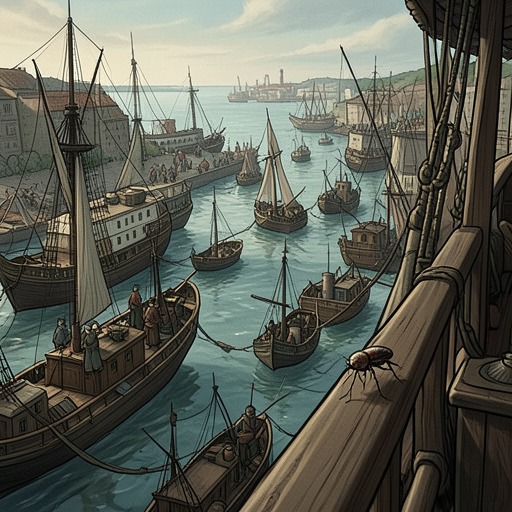
A nearly white cat with a striped tail becomes an unwitting link in a chain of transmission beginning in Alexandria. A flea that has travelled on a monkey jumps from a boy’s Red Handkerchief into the cat’s thick white fur when the boy brings the animal close to his neck aboard ship. The cat falls ill, then moves into the ensign’s hammock, as if recognising the man’s hostility. When the ensign finds the dead animal there, he curses it, pulls it out, and kicks it across the cabin. The violence does not interrupt the chain: four or five fleas remain where the cat had been, and one reaches the sleeping ensign’s damp armpit to feed.
The ship’s response initially treats the deaths as a nuisance rather than a warning. After several cats die, the captain orders them thrown overboard. Three striped tails are grasped, and the bodies are cast into the Mediterranean; a cabin boy watches through a hatch and wipes his tears with his handkerchief. That small act of mourning gives the animals an importance the ship’s command does not recognise. The captain’s order removes the visible bodies, but not the danger travelling among the crew.
The illness becomes harder to dismiss as the voyage continues. The ensign develops a fever and a swelling in his neck; later, the second officer and other sailors fall ill with the same fever, which blackens fingers and raises blisters on the skin. By the time the ship reaches Constantinople, all its cats have died and rats are damaging the packing and reaching the salted meat. The second officer reports fifteen or sixteen rats in the galley that morning, while more men are falling sick. The sequence places animal death beside human illness and growing rat infestation, turning the ship’s hold and provisions into parts of a single vulnerable environment.
Cargo, Animal Bodies, and the Voyage
Cats also occupy the ship’s less frequented hold, where Venetian animals sleep on boxes of Murano glass beads. When they die one after another, their bodies remain unnoticed on the cargo. Flies move from dying rats to the cats’ striped fur, then across the boxes and into the packing cloth around hundreds of tiny, brightly coloured millefiori beads. The glassmaker who made the beads has already returned to Murano, where workers have fallen ill with a mysterious virulent fever and production has stopped. The cargo thus brings together the animals, the sick workforce, and the trade routes through which goods continue to move even as people and cats die.
The cats’ absence has practical consequences on board as well. With every ship cat dead, the rat population becomes a conspicuous problem, chewing the bales and reaching stored food. The captain’s crew is depleted by illness and death; after a stop in Ragusa for replacement sailors and further losses along the route, only five crew members remain when the vessel reaches London. The surviving cabin boy goes in search of a ship to the Isle of Man with the sole surviving Venetian cat under his arm. The image reverses the earlier disposal of the dead cats: one animal is carried carefully onward, a living remnant of the passage.
Judith’s Cats and a Private Refuge
In Stratford, cats belong not to a ship’s precarious ecosystem but to Judith’s daily world. As a child, she returns to a narrow wedge-shaped recess between the kitchen and the pigsty, a small place where two children could sit with their backs against the stone. Now she slips into it with stolen willow rods and weaves a roof. Two cats, grown from kittens, follow her; their striped faces are identical and their paws have white socks. Judith waits there with her hands together, singing to herself, the cats, and the little woven shelter. Their implacable green eyes watch her as she fills the enclosed space with repeated notes and words.
In the new house, the cats remain close to Judith. They sleep on the blankets beside her, one on either side, while her sleep is light and easily broken. Their proximity is part of the room’s nighttime arrangement, not a cure for the unease that shapes the household. Elsewhere, Agnes walks the corridors and listens to the house; Judith’s cats share the sleeping space with her daughter as the family tries to live amid absence and grief.
The cats multiply into a household population. Judith’s cats have kittens, and in time those kittens have kittens too. The cook tries to remove the litters by drowning them, but Judith will not allow it. Some cats go to Hewlands, others to Henley Street, and others are distributed through the village; despite this dispersal, the garden fills with cats of different sizes and ages. They share long, fine tails, white ruffs, and leaf-green eyes, and are described as agile, sinewy, and strong. Their numbers become useful as well as abundant: there are no mice in the house, a benefit the cook eventually has to acknowledge.
Companionship, Work, and Recognition
Judith’s care for the cats is active and sustained. She looks after the garden, runs errands, and clears Agnes’s workbench, but she also spends hours grooming the cats and communicating with them through affectionate sounds and gestures. Each spring she has kittens to sell, recommending them as excellent mousers. In contrast to Susanna, who finds the garden’s plants, bees, and visitors distracting, Judith is at ease among its living activity. The cats belong to the practical economy of the household, yet her attention to them is also a form of companionship that is not dependent on explanation.
They give Judith a subject on which she can speak with unusual ease. When Joan visits, Judith sits on the floor with two cats in her lap and three more around her, rubbing against her sides, back, and hands. She talks about their names, favourite food, and preferred sleeping places. Agnes knows that Joan detests cats, believing that they steal her breath and make her itch, and cannot quite suppress a smile at the scene. Judith then points out that two cats are brothers even though they do not look alike from a distance: close up, she says, their eyes are exactly the same colour. The observation draws the animals into a conversation about resemblance and kinship, while showing Judith speaking confidently in company where she might otherwise be quieter.
Across the novel, cats are neither merely decorative nor uniformly safe. At sea, they are vulnerable bodies caught in a lethal chain of illness, and their deaths foretell the danger to sailors. At home, their repeated births, distribution, and work against mice make them part of the household’s survival, while Judith’s attachment gives them a more intimate place in her life. Their movement between these settings makes the contrast especially strong: the ship disposes of dead cats, but Judith protects kittens; a cat is once carried as the surviving remnant of a ruined voyage, while her garden becomes full of generations. Their presence gives the narrative a way to register both the fragility of life and its persistence through care, routine, and recurrence.