Red Handkerchief
HamnetThe Red Handkerchief is a personal gift that also becomes a material link in the novel’s imagined route of plague into England. Given to a cabin boy by his beloved in his homeland, it travels at his neck through a shipboard sequence of death and departure. A flea hidden in its fold leaves the cloth for a cat, making the handkerchief part of a chain whose consequences extend far beyond the boy’s private attachment to it.
A Gift Carried on the Voyage
The handkerchief belongs to the cabin boy, who wears it around his neck. The narration identifies it as a gift from his beloved in his homeland, giving the cloth a personal history distinct from the cargo and animals surrounding it. It is not described as a protective charm or as something the boy understands to be dangerous; its significance emerges from what it carries without his knowledge.
The cloth’s color changes over the course of the voyage. By the time the ship reaches London, the handkerchief that was once red has faded. That visible alteration registers the passage of time and hardship in a small, intimate object that remains with the boy while the crew and cargo are repeatedly diminished or dispersed.
The Flea in Its Fold
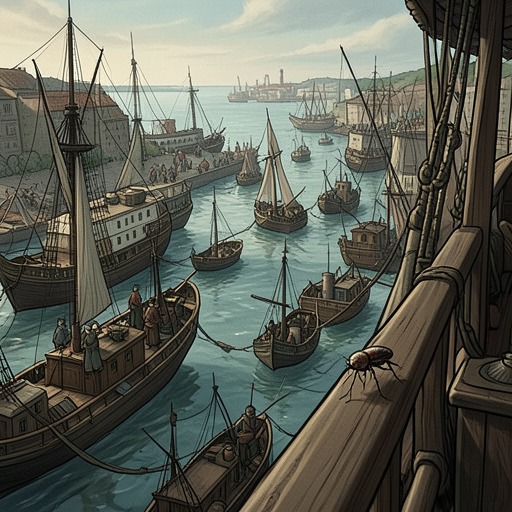
After a monkey’s fleas scatter during a shipboard disturbance, one falls into a fold of the handkerchief. The boy does not see it. Later, when he returns to the ship for the night and brings his nearly white, striped-tailed cat close to his neck, the flea jumps from the cloth into the thick white fur on the cat’s neck.
The transfer makes the handkerchief a specific link in the novel’s chain of transmission: a flea from the monkey reaches the boy’s clothing, then the cat, and subsequently the shipboard environment. The cloth is not itself a source of illness, and the boy does not knowingly carry the flea. Its role is quieter and more contingent: an ordinary fold provides a temporary hiding place along a route shaped by chance encounters among people and animals.
Loss at Sea and Arrival in London
The cat becomes ill and dies. When the captain orders the dead cats thrown overboard, three are taken by their striped tails and cast into the Mediterranean. Watching from a hatch, the cabin boy wipes his tears with the Red Handkerchief. The gesture returns the cloth to its intimate role—as something close at hand in grief—even as the animals’ deaths belong to the larger, destructive course of the voyage.
The boy eventually reaches London still wearing the now-faded handkerchief, with the only surviving cat from Venice under his arm. The detail carries the cloth forward beyond the ship’s deaths and links it to the onward movement of people and animals. The text does not say that the boy knows what the handkerchief once concealed; its importance lies in the reader’s awareness of the unnoticed passage it enabled.
Narrative Significance
The Red Handkerchief joins private affection to the novel’s account of epidemic transmission without turning the gift into an intentional instrument. Its path is rendered through small physical movements—a flea settling in a fold, jumping to fur, and the boy using the cloth to wipe away tears. Those details place large-scale historical consequence beside ordinary touch and attachment.
The novel’s author’s note distinguishes the historical record from its speculation: Hamnet’s burial is recorded, but the cause of his death is not. The handkerchief’s part in the plague’s route belongs to the novel’s imagined explanation, not to a documented account of the real family’s history. Within that fiction, the cloth embodies how a chain of consequences can travel unnoticed inside an object valued for an entirely different reason.