Venetian millefiori glass-bead chest
HamnetThe Venetian millefiori glass-bead chest turns an ordinary object of trade into a material link between distant places, household work, and illness. Made in Murano and sent through a succession of ports and carriers, the smallest chest in a merchant cargo reaches a seamstress on Ely Street, where Judith eagerly opens it. Its journey is not merely decorative: the cloth used to pack the beads shelters fleas, and the novel follows those parasites along a route that helps explain how plague could reach Stratford. The chest’s lovely, fragile contents and its dangerous, nearly invisible stowaways travel together.
Making and Packing the Beads
The beads are the work of a master glassmaker on Murano, skilled in shaping small stars and flowers from millefiori glass. Their layered colors—five or six in each bead—make them objects of fine workmanship, intended to be admired and used as decoration. But the circumstances of their making are abruptly altered when a fight among the factory stokers distracts the glassmaker. His hand slips, and two fingers enter the white-hot flame. The pain is so intense that he initially fails to understand what has happened; the factory responds in alarm, and within hours both fingers have been amputated.
The next day, while the injured glassmaker lies at home under the effects of poppy syrup, a fellow worker packs the beads. The usual packing method is to nestle them in wood shavings and sand, but the coworker does not know this. He gathers rags from the factory floor and wraps the beads in them instead. The mistake preserves a practical detail of the glassmaker’s absence while giving the rags a second, consequential role: they become a hiding place for fleas. The small, brightly colored beads are packed with an infestation no one sees.
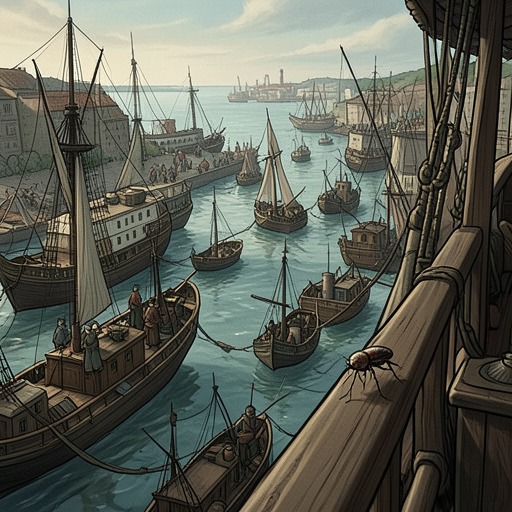
The novel sets the making of this cargo within a much wider history of infection. A flea has passed from an Alexandria monkey to a rat, and from the rat to a cook who died near Aleppo. Later, fleas move among rats and cats aboard the ship; dead cats lie unnoticed on top of the boxes in the little-visited hold. The account does not make the chest a passive backdrop to these events. Its wooden surfaces, knots, and chalk marks attract the ship’s cats, while its rags give fleas a place to survive. The object’s material features become part of the chain of events.
A Cargo Moves North
The ship carries the beads and other goods through a voyage marked by illness and losses. At a stop in Sicily, the cabin boy sees the glassmaker’s damaged hand as the man tries to keep a loaded cart from overturning. The boy steadies it, then runs off after noticing cats beneath a fish stall. In the same encounter, the flea that came from the monkey passes from the boy to the glassmaker’s sleeve and bites behind his left earlobe. Neither man recognizes the transfer. The glassmaker is cold and preoccupied with getting the boxes aboard and earning his fare home to Murano.
The ship continues on. A second officer develops a violent fever and is buried at sea with two Polish sailors off Naples. At Barcelona, surviving Polish crew members go ashore and disappear into the confusion of the port. The captain presses on, and the vessel calls at Cádiz, Oporto, and La Rochelle before turning north toward Cornwall and London. By the time it reaches London, only five crew members remain. The cabin boy leaves to look for a ship to the Isle of Man, still wearing a handkerchief that was once red and carrying the only surviving Venetian cat beneath his arm.
The cargo is held at customs and then distributed among London’s merchants and traders. The glass is destined for a dealer in Bermondsey; textiles go to cloth sellers and haberdashers in Aldgate, while other goods are sent to their own buyers. The bead chests have their own separate itinerary. They remain on a warehouse shelf for almost a month, after which individual boxes are dispatched to Shrewsbury, York, and Oxford. The last and smallest chest, still wrapped in the factory rags, is sent to a posting inn at the far end of the city. After a further week, an innkeeper hands it to a man riding toward Warwickshire.
The journey inland changes the contents as well as their location. The beads click together rhythmically in the rider’s leather saddlebags over the two-day trip. Two are crushed beneath the weight of their fellows, and five more are irreparably chipped. Meanwhile, fleas emerge from the rags, hungry and weakened by their time in the warehouse without a host. They recover by jumping between the horse and rider and among people encountered on the road: a woman who gives the rider milk, a child who approaches to pet the horse, and a young man in a roadside inn. By the time the rider reaches Stratford, flea eggs have been laid in the seams of his clothes, the horse’s mane, the saddle stitching, the lace, and the rags around the beads.
The Chest Reaches Judith
The rider leaves the chest, along with letters and lace, with an innkeeper outside Stratford. The letters are delivered individually by a boy for a penny. The chest is carried to a seamstress on Ely Street, who has ordered Venetian beads for the bodice of a gown commissioned by a councilman’s wife. The customer wants to wear it at the harvest festival and has insisted that Venetian beads are essential to the garment. The order has travelled all the way from London to Venice and back; after delays and renewed inquiries, the beads have finally arrived.
The seamstress is about to unwrap the chest when Judith, a neighbor’s daughter who helps her sew, sort colored thread, and cut cloth, comes through the door. The seamstress shows her the box. Judith is short for her age and beautiful, and her eager response is immediate: she wants to see what is inside. The seamstress sets the chest on the table, gives Judith scissors, and tells her to cut through the filthy wrapping rags. Judith takes the box with enthusiasm, and a smile lights her face. The narrative has brought a child’s excitement and a nearly invisible danger to the same threshold: the chest arrives as a promised pleasure, while the fleas in its discarded wrapping belong to the infection moving through the story.
The connection is framed as part of the novel’s account of how plague reaches Warwickshire in the summer of 1596. It is a constructed chain of contingent encounters: a worker’s injury changes how the beads are packed; a cabin boy and glassmaker meet; the cargo crosses the Mediterranean and travels north; fleas find hosts along the way; and the last chest reaches a seamstress whose young helper opens it. The journey makes the movement of disease legible through minute particulars of labor, shipping, storage, and delivery rather than through a single dramatic arrival. At the same time, the chain does not establish a documented historical cause of Hamnet’s death. The author’s note explicitly says that the cause is unknown and identifies the novel’s plague explanation as speculation.
Material Trace and Narrative Meaning
The chest’s significance depends on the contrast between what can be seen and what cannot. Its beads possess a vivid, describable surface: stars and flowers, layers of five or six colors, chips and broken pieces after the road. The fleas and their eggs are almost imperceptible, but they pass through the same packing and transport system. The object thus carries two histories at once: skilled manufacture and commercial desire on its visible side, biological danger in the rags around it. Damage to the beads records the physical strain of travel; the fleas’ spread records a parallel journey that the people handling the cargo do not know they are making.
The chest also joins the novel’s domestic and historical scales. The gown’s Venetian decoration is ordered for a local harvest celebration, and Judith’s chance to unwrap the delivery is a small episode of work and anticipation. Yet the trade route that serves that ordinary purpose links Murano, Alexandria, London, and Stratford. By placing the chest in a seamstress’s room, the narrative makes long-distance commerce consequential within a household and lets an apparently incidental object participate in the approach of disaster. Its final arrival does not explain every historical uncertainty; instead, it gives the novel a concrete, fragile route through which contingency can be imagined.