Agnes’s Note About Leaves and Rain
HamnetAgnes’s Note About Leaves and Rain is a short inscription Agnes writes at her husband’s desk on the night before she disappears. Its image of thick woodland branches making rain imperceptible is both an observation she forms at the window and a message whose meaning her husband cannot recover from the page. The note matters not for its legibility but for its passage between people: when Agnes is gone, her husband remembers its two recognizable subjects, and Bartholomew’s response links them to the search.
Making the Note
Before writing, Agnes lies beside her husband, fitting her body against his while he presses his face to her back and winds a lock of her hair around his fingers. She senses his worry about the approaching birth and understands that he is turning over the question of whether she will survive. She imagines reassuring him that both children will live for many years, but keeps this knowledge to herself because people do not like to hear such predictions. The note follows this private exchange, though it does not directly state the reassurance she has withheld.
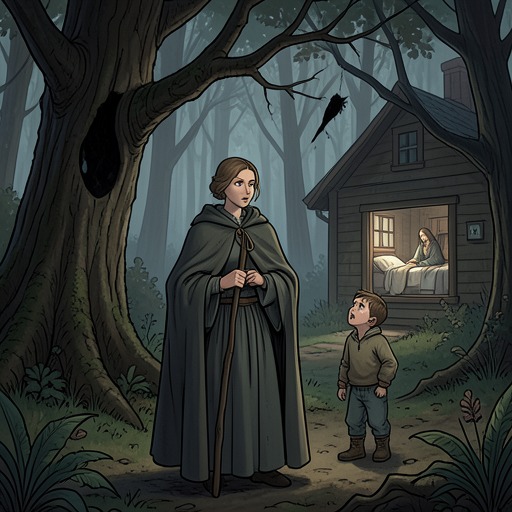
Agnes gets up, opens the curtains around the bed, and goes to the window. With her open hand against the glass, she looks at the dense branches outside and thinks of how they make the rain go unnoticed. She carries that observation to the desk beside the fireplace, where her husband keeps his papers and pen. The words begin as something seen from inside the room, not as a message first composed for an audience.
The contrast between Agnes’s writing and her husband’s gives the inscription its particular form. He has studied at school, learned Latin and oratory, and writes fluently, in a regular hand Agnes cannot follow when he works late. She can write only a little: her letters are small and crowded, and their order may be difficult for others to decipher. Still, she knows enough to put down a version of the thought about branches and rain. The note enters a space shaped by her husband’s practiced writing, but its awkward script marks it as hers.
The Page and Its Reader
After Agnes has gone, her husband notices that the pen has been left point-down in the ink, an unusual and wasteful thing for him to do. He lifts it carefully so that drops will not fall on the rolled pages. Only then does he see that something has been added to what he wrote the previous night. His attention to the damaged pen leads him to the new writing; the ordinary desk object becomes the means by which the message is discovered.
The added line slopes across the page, its words seeming to slide as though they grow heavier toward the end. There is no punctuation and no clear beginning or ending. He makes out the words for branches and rain, but the latter is misspelled, and the other words remain uncertain. He smooths the page with one hand and runs the pen’s feathers across his face with the other, trying to make sense of the line. The repeated return to branches does not make it readable: he can identify fragments without recovering a complete message.
The page also unsettles him because Agnes has never before taken his pen and written at his desk. He wonders whether she intended the addition for him and whether it matters that he understand it. These remain questions rather than answers. He calls for her, receives no response, and goes downstairs; the inscription is the first sign he finds that she has left something for him, but it does not tell him where she has gone.
From Inscription to Search
When Agnes’s husband later tells Bartholomew that she wrote something on a paper before leaving, he still cannot say what it means. He recalls only that it concerned rain and branches and admits that he did not understand it fully. The physical note is no longer present in this exchange; its contents survive through his partial memory of the page.
Bartholomew considers the two words for a few seconds, turning their order over in his mind. He then takes up his staff and tucks it into his belt, telling Agnes’s husband to get up. The sequence makes the remembered image consequential: what had been an unreadable line to one reader becomes sufficient to prompt another to act. The account does not explain the phrase as a fully decoded instruction, so its force lies in the response it provokes rather than in a stated solution.
Meaning and Form
The note holds together a precise natural observation and an incomplete communication. At the window, Agnes sees how the abundance of branches hides the rain; on the page, her cramped, unpunctuated writing makes the thought itself difficult to see. The image of concealment thus finds an echo in the inscription’s condition: a message exists, but its recipient can retrieve only pieces of it.
Its significance also depends on the difference between knowing and telling. Agnes has sensed her husband’s fear and imagined a future in which she and both children survive, yet the sentence she writes does not spell out that reassurance. Her husband, meanwhile, recognizes the written fragments but cannot turn them into certainty. The note carries Agnes’s perception beyond her immediate presence without making her intention transparent. Its words remain unresolved, while their remembered pattern helps move the search forward.