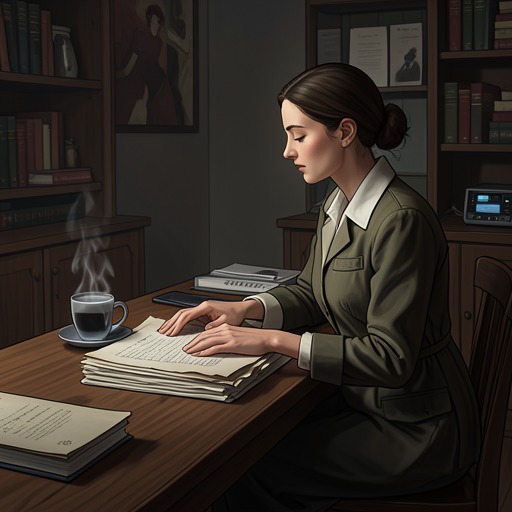
“True memory has to be material”
Happening“True memory has to be material” names the narrator’s method for approaching the past: memory is not treated as a transparent record of former thoughts, but as something that must be traced through tangible evidence and lingering sensation. The phrase turns the problem of remembering into a problem of proof, and gives physical details a central role in making experience available to writing.
The Problem of Proof
The narrator observes that writing invariably raises the issue of proof. An engagement book and a diary survive, but they do not provide a sure account of what was thought and felt at the time. Inner experience is described as abstract and evanescent, difficult to verify retrospectively; surviving records therefore cannot, by themselves, restore it with certainty.
Material Traces
What can be recalled concretely instead comes through sensations associated with people and things outside the self: the sparkling snow at Le Mont-Dore, Jean T’s bulging eyes, and the ballad of Sœur Sourire. These details are not presented as a complete record of the past. Their force lies in their persistence as sensory traces, which offer the narrator firmer ground than uncertain recollection of interior states.
Role in the Narrative
The maxim connects the act of writing to the material world: the past becomes approachable through particular sights, bodies, and sounds that have remained in memory. By distinguishing these traces from thoughts that cannot be securely recovered, the narrator makes the limits of recollection part of the narrative’s method. The phrase is thus both a claim about what memory can substantiate and a guide to how the story can be written.