Seeking help for a clandestine abortion
HappeningSeeking help for a clandestine abortion is the narrator’s passage from a private decision to a difficult search for people and information capable of making it possible. In Rouen in 1963, Jean T’s referrals, an unsuccessful visit to a doctor, and LB’s eventual practical assistance form a fragile network shaped by criminal law, limited money, and the dangers of secrecy. The search makes visible the distance between wanting to end a pregnancy and being able to obtain help safely.
The decision and its constraints
Three days after tearing up her pregnancy certificate, the narrator encounters Jean T, a married student with a steady job whom she had once helped by sharing lecture notes. His politics and connection to a movement supporting contraception and birth control make him seem like a possible source of help. Over a drink at the Café Métropole, she hints that she is pregnant, hoping his activities might be useful. He is the first person she tells.
Jean T cannot offer an immediate solution, but invites her to dinner at his home outside Rouen. There, his attention shifts between her predicament and his own conduct: he presses her for intimacy, then presents his behavior as a test of her moral strength. The narrator regards the episode as unpleasant but, given her urgent need, does not treat it as a reason to sever contact. She believes he has promised to find a doctor and has no one else to turn to. The encounter establishes an uneasy pattern: the people around her may be curious or willing to talk, yet their interest does not necessarily become practical assistance.
Two days later, Jean T takes her to lunch near the bus station, in a rebuilt part of Rouen unfamiliar to her. He jokes that he and other men could fit her with a probe, then mentions a married couple whose wife had undergone an abortion and nearly died. He does not know their address, but suggests contacting LB, a freelance journalist at the newspaper Paris-Normandie whom the narrator recognizes from a university lecture. The account of LB’s experience offers reassurance, but the referral leaves the narrator with another task: she must locate LB herself.
Searching through a closed network
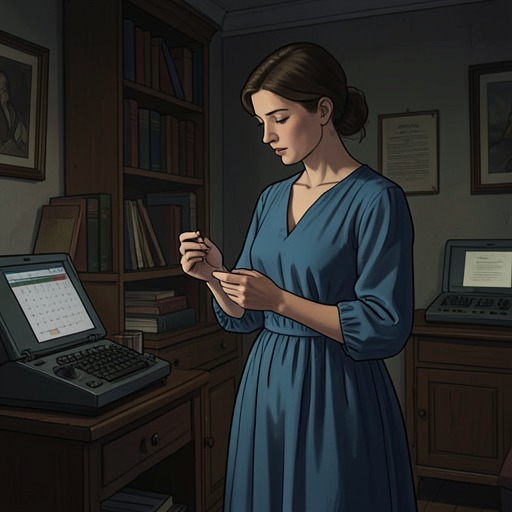
The narrator’s search proceeds through places and connections without a reliable guide. She looks for LB in university lecture halls and lobbies, watching entrances at midday and in the evening. For two successive evenings she waits outside the offices of Paris-Normandie, afraid to go inside and ask for LB because she does not want to appear suspicious or burden her at work. On the second evening she waits in the rain, scanning the newspaper display and looking along the Rue de l’Hôpital. In her room afterward, her diary records that the search has failed and that she is becoming desperate.
The difficulty is not simply that the right contact is hard to find. The narrator has no clear source of practical information. She searches library indexes for abortion and finds only medical publications concerned with the clinical consequences of illegal procedures, not the instructions she needs. She also sets out to find a doctor willing to help, studying brass nameplates in Rouen’s streets but unable to bring herself to ring the bells. She imagines that doctors in Martainville, a working-class district, might be more understanding. The city becomes a landscape of possible doors, none of which guarantees an answer.
A visit to a general practitioner on Boulevard de l’Yser brings confirmation of her pregnancy but not the assistance she seeks. In a doctor’s office arranged like a middle-class living room, she says that she is tired and that her period is late. After examining her, the elderly doctor confirms that she is most certainly pregnant. She cannot bring herself to ask him directly to perform an abortion and instead begs him to make her bleeding return. He gives her a prescription for calcium capsules and oestradiol injections, speaks at length about men who seduce and abandon young women, and then turns the conversation to whether she knows a son of his friend. The visit ends without an invitation to return or a plan to provide the care she needs.
Law, class, and the limits of professional help
The narrator understands the doctor’s refusal within the wider threat of criminalization. Under the law, not only those performing abortions but also people who advised or encouraged them, and women who had abortions, could face fines and imprisonment; medical professionals risked losing their right to practise. In the narrator’s analysis, a patient without money or connections represents a danger to a doctor’s career. The law therefore acts beyond the courtroom: it narrows what can be asked, what can be answered, and which relationships can safely carry information.
The barriers also intersect with the narrator’s class background. Born into a family of laborers and shopkeepers, she is the first to pursue higher education, but education has not removed the poverty she associates with the stigma of an unintended pregnancy. She has little money and no dependable access to professional care. The search is consequently not a matter of choosing among equivalent options. The people with the authority to help may refuse, while those with relevant knowledge are difficult to locate and may themselves have been endangered.
The doctor’s prescription deepens that predicament. Unable to rely on the college nurse, whom she fears might become suspicious, the narrator asks a medical student to arrange an injection. A young woman comes to her room and administers it without questions; the next day, when neither student is available, the narrator gives herself another injection. Her diary notes that two injections have produced no result. She learns only later that the prescribed drug was used to prevent miscarriage. The episode shows how an official medical encounter can leave a patient not merely unsupported but acting on treatment whose purpose runs counter to her intention.
LB’s intervention and the search’s significance
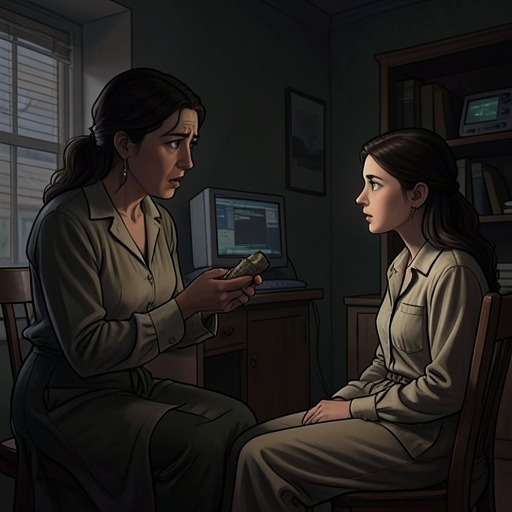
A week or so before Christmas, when the narrator has nearly given up hope, LB comes to her room. Jean T has encountered her in town and told her that the narrator needs to see her. LB supplies what the earlier contacts could not: a specific address, an account of how the procedure is arranged, and money. She directs the narrator to Madame P-R, a middle-aged paramedic working at a clinic at Impasse Cardinet in Paris’s 17th arrondissement. Because the word impasse evokes the disreputable setting of popular stories about illegal abortion, LB clarifies that the address opens onto the main Rue Cardinet.
LB explains that Madame P-R uses a probe and that the patient waits for a miscarriage. She describes the woman as reliable and careful about sterilizing her instruments, while also acknowledging that the precautions had not prevented LB from contracting septicemia. LB advises the narrator to obtain antibiotics afterward by asking a general practitioner to prescribe them for a minor ailment. The narrator already has a penicillin prescription. The service costs four hundred francs, and LB offers to lend her the money. At this point, an address and a loan turn a prolonged, uncertain search into an actionable route, though the account makes clear that the proposed care remains dangerous.
The help comes through a chain rather than through a single institution: Jean T passes word to LB; LB shares experience, a contact, and funds; the narrator’s earlier access to a prescription becomes part of her preparation. Later, when Jean T, LB, and JB visit her in hospital, she and LB compare their abortions and joke about a cheaper local alternative that JB has heard of. Their laughter marks a change in the immediate balance of fear and humiliation, not an erasure of what the search and procedure cost.
The episode also belongs to the book’s larger argument about what can be spoken after the law changes. The narrator rejects the idea that the end of criminalization makes the earlier experience irrelevant: silence can preserve the secrecy that once surrounded it. Her account of looking for help gives concrete form to that secrecy through missed encounters, hesitant questions, an ineffective prescription, and a woman willing to share both knowledge and money. The search is thus at once a practical effort to secure care and a record of how access depended on precarious relations between women under a law that endangered those who sought or offered assistance.