Tom Riddle's diary
Tom Riddle's diary is a seemingly ordinary, shabby black diary from fifty years ago that becomes the central instrument of the year's terror at Hogwarts. Purchased from a variety store on Vauxhall Road, it was originally owned by Tom Marvolo Riddle, a brilliant but orphaned half-blood student who later became Lord Voldemort. The diary is not merely a record but a magical container that preserves Riddle's sixteen-year-old self, allowing him to interact with and ultimately possess whoever writes in it. It is the mechanism by which the Chamber of Secrets is reopened, and its destruction marks the decisive defeat of Voldemort's scheme.
Discovery and Appearance
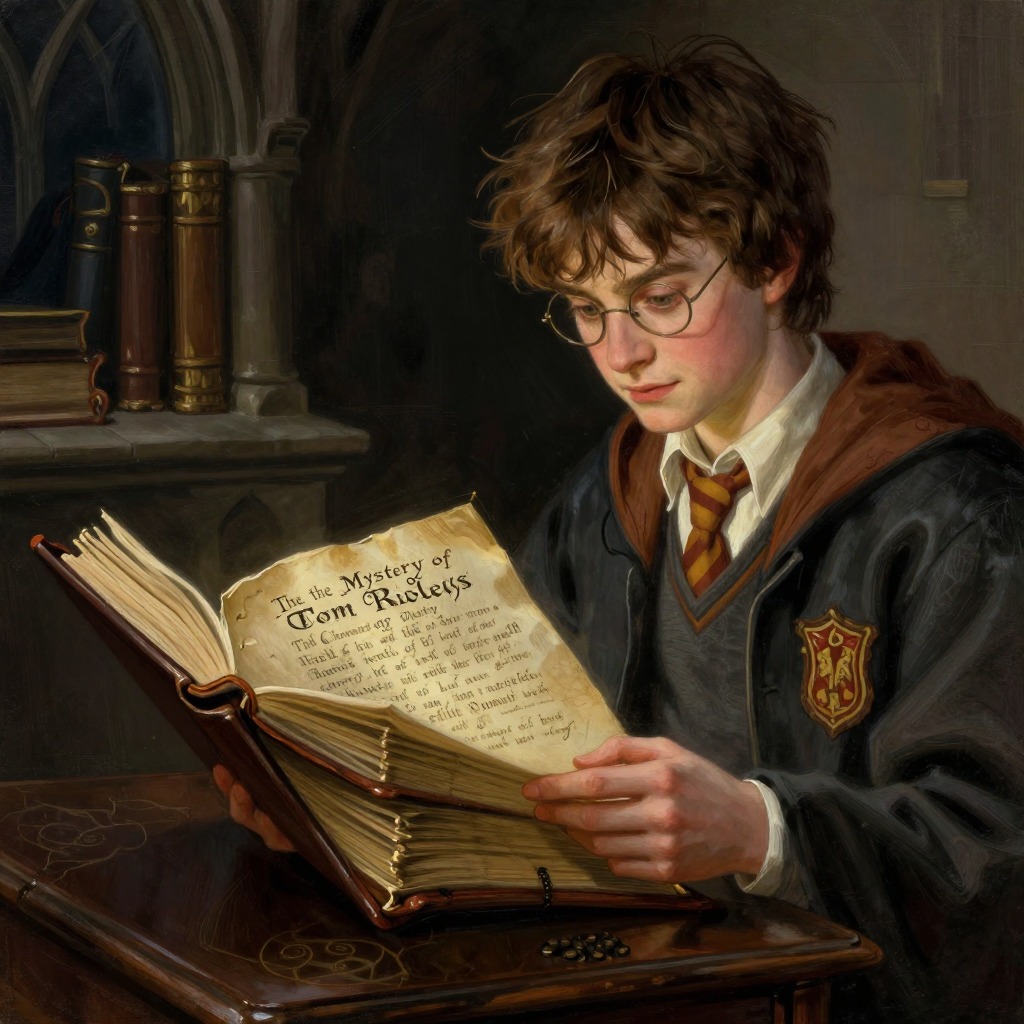
The diary is first found by Harry Potter in Moaning Myrtle's bathroom, where it had been thrown by a terrified Ginny Weasley in an attempt to dispose of it. It is a small, thin book with a faded year on the cover indicating it is fifty years old. The first page bears the name "T. M. Riddle" in smudged ink, and all subsequent pages are completely blank, showing no trace of writing even when subjected to magical Revealers or invisible ink detection. Despite its blankness, the diary possesses a strange allure; Harry finds himself absentmindedly picking it up and turning its pages, feeling as though Riddle is a half-forgotten friend. The diary is also magically resistant to damage—when Harry's ink bottle smashes over his other books, the diary remains perfectly clean, and the ink he deliberately drops onto its first page is sucked into the paper and vanishes.
Magical Properties and Function
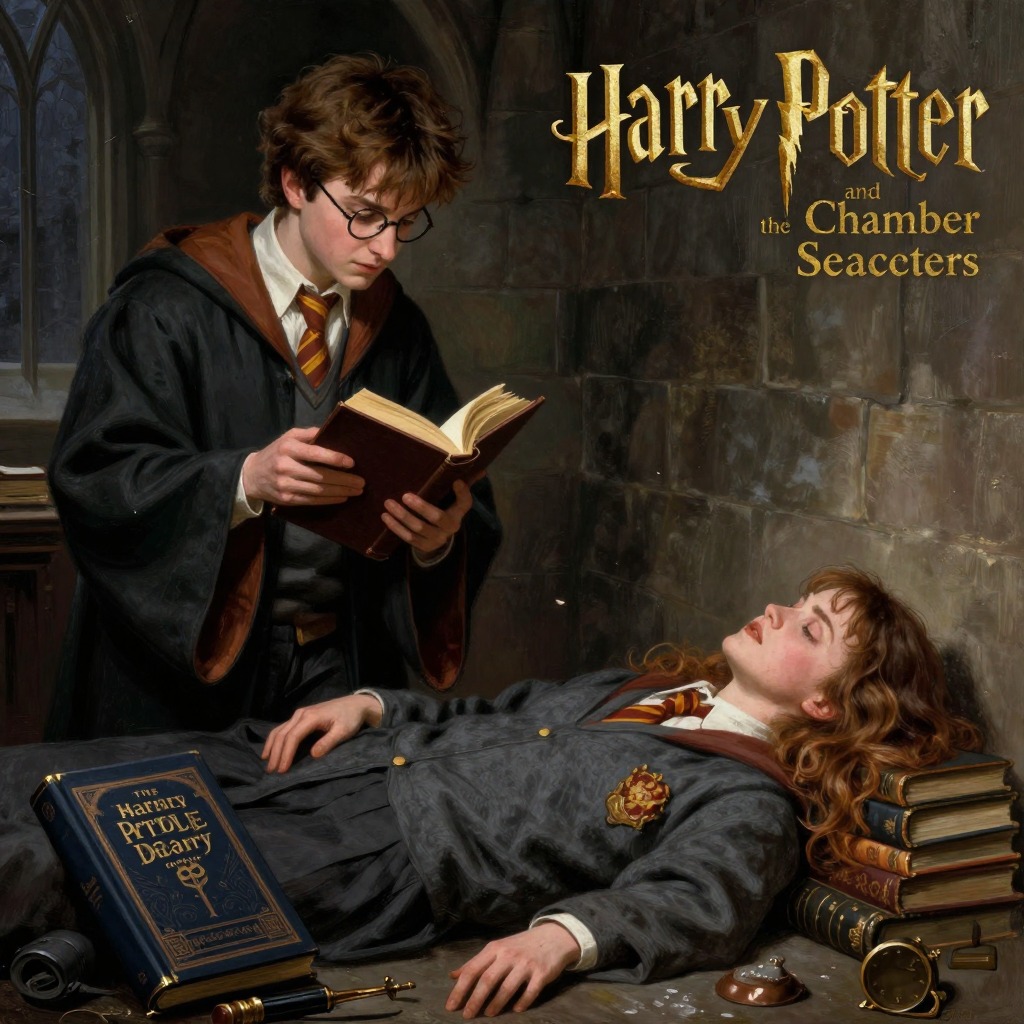
The diary operates as a preserved memory of Tom Riddle, allowing him to communicate in real time with anyone who writes in it. When Harry writes "My name is Harry Potter," the words sink into the page, and Riddle's own handwriting oozes back out, beginning a conversation. The diary can also transport the writer into Riddle's memories: when Harry writes "OK," the pages blow open, and he is physically pulled into a vision of Hogwarts fifty years earlier, witnessing Riddle frame Rubeus Hagrid for opening the Chamber. More dangerously, the diary feeds on the emotional energy of its writer. Ginny Weasley, who found it among her schoolbooks, poured out her soul to it for months, and Riddle grew "stronger and stronger on a diet of her deepest fears, her darkest secrets." He then began to pour his own soul back into her, possessing her and forcing her to commit the attacks: strangling roosters, daubing threatening messages on walls, and setting the basilisk on Muggle-born students. Ginny became increasingly forgetful and terrified, writing entries like "I think I'm losing my memory" and "I think I'm the one attacking everyone, Tom!" before finally stealing the diary back from Harry and being compelled to write her own farewell on the wall and descend into the Chamber.
Connection to Lord Voldemort
The diary's deepest secret is revealed in the Chamber of Secrets, where the memory of Tom Riddle emerges as a solid, misty figure. Using Harry's wand, Riddle writes his full name—Tom Marvolo Riddle—in the air and rearranges the letters to spell "I am Lord Voldemort." He explains that he fashioned this new name while still at Hogwarts, rejecting his Muggle father's name in favor of one that would be feared. The diary is thus a direct link to Voldemort's past, preserving his sixteen-year-old self with the explicit purpose of continuing Salazar Slytherin's work. Riddle admits he spent five years researching the Chamber and left the diary behind so that he could "lead another in my footsteps." The diary also reveals the deep connection between Harry and Voldemort: Riddle notes their shared traits as half-bloods, orphans raised by Muggles, and Parselmouths, and he is obsessed with understanding how Harry survived his killing curse as a baby.
Destruction and Aftermath
The diary is destroyed in the Chamber of Secrets when Harry, after being healed by Fawkes's tears, seizes a basilisk fang and plunges it into the heart of the book. The diary emits a long, dreadful, piercing scream as ink spurts out in torrents, and the basilisk venom burns a sizzling hole straight through it. Riddle's memory writhes and vanishes, and Ginny Weasley, freed from his possession, wakes up. The ruined diary is later used by Harry as evidence to expose Lucius Malfoy's role in the plot: Harry stuffs the diary into his own sock and forces it into Malfoy's hands, who throws the sock aside. Dobby the house-elf catches the sock, which, as a gift of clothing from his master, sets him free. Dumbledore later confirms that the diary was one of Voldemort's old school things, and he warns Malfoy not to give out any more of them.
Thematic Significance
The diary embodies the novel's central themes of choice, identity, and the danger of trusting objects that can think for themselves. Mr. Weasley's maxim—"Never trust anything that can think for itself if you can't see where it keeps its brain"—is a direct warning against the diary's deceptive allure. The diary also forces a confrontation between Harry and his own potential: Riddle insists they are alike, but Dumbledore's explanation that the Sorting Hat placed Harry in Gryffindor because he asked not to be in Slytherin proves that "it is our choices, Harry, that show what we truly are, far more than our abilities." The diary is a tool of possession and manipulation, but its destruction affirms that even the most powerful dark magic can be overcome by loyalty, courage, and the willingness to act for others.