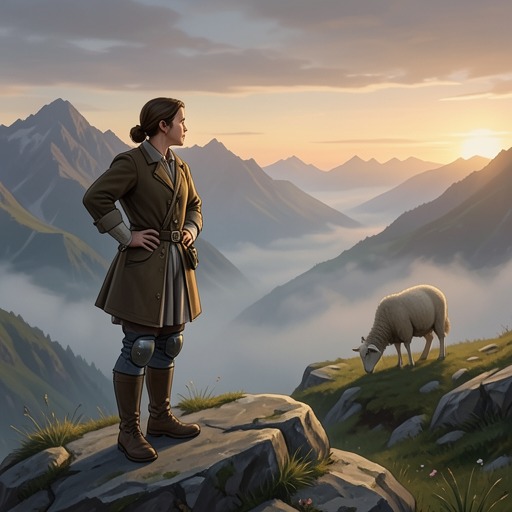
“The sun says good-night to the mountains”
Heidi“The sun says good-night to the mountains” is Heidi’s vivid way of understanding the Alpine sunset: not as a blaze consuming the peaks, but as the sun’s daily farewell. Alm-Uncle gives her that explanation after her first day among the goats, turning a spectacle she can see into an image of care and return. The phrase recurs when Heidi tries to comfort Peter’s Grandmother and when she longs for home in Frankfurt, linking the mountain landscape to affection, memory, and the pain of separation.
A sunset first mistaken for fire
At the close of Heidi’s first day out with Peter and the goats, she watches the sun sink behind the high mountains. Golden light lies across the grass and flowers; the rocks begin to glow. The change overwhelms her: she springs up and cries that everything is on fire, from the rocks and snow mountain to the sky and fir trees. Peter, still peeling his stick, answers calmly that it is always like that and is not really fire. His matter-of-factness does not lessen her excitement; it marks how differently the two children meet the same familiar sight.
Heidi runs about trying to take in the view from every side. As the colors shift, she calls attention to the snow and pointed rocks, then exclaims that the mountains have turned rose color and that roses seem to cover the rocks. Peter tells her that mountains do not have names. The exchange brings together her impulse to look closely and name what she sees and his unastonished acceptance of the scene. When the light fades and the colors die away, Heidi sits down distressed, as though something beautiful has ended altogether.
The wonder continues after the sunset. Heidi returns to the fir trees and tells Alm-Uncle how beautiful the fire and roses on the rocks were. She also opens her apron to show him the flowers she has gathered, but they have wilted into what look like dry bits of hay, their flower cups closed. Alm-Uncle explains that they prefer the sun and should not be shut up in an apron. Heidi resolves not to gather any more. The fading flowers make a small, concrete counterpoint to the mountain spectacle: the beauty she wants to carry away cannot be preserved by enclosing it.
Alm-Uncle’s explanation
Heidi recounts the whole day to Alm-Uncle, especially the evening colors, and wants to know how the apparent fire came about. Peter has not been able to explain it. Alm-Uncle identifies the sun as its cause and describes its colors as a farewell: “When he says good-night to the mountains he throws his most beautiful colors over them, so that they may not forget him before he comes again the next day.” His account replaces the children’s competing descriptions—not fire, but a recurring natural event—with a personified image that makes the sunset legible to Heidi.
The explanation also gives the sunset a rhythm of departure and return. The sun goes away for the night but will come again the next day; its colors are a gift meant to be remembered in the interval. Heidi is delighted and longs for the next day, when she can climb with the goats and see the farewell again. Before that, she sleeps soundly on her bed of hay, dreaming of shining mountains covered with red roses and of Snowflake leaping among them. The phrase thus grows from a single visual astonishment into an image that persists into her dreams.
A language for comfort and homesickness
Heidi carries the image beyond the sunset that first inspired it. When she tries to imagine how Peter’s Grandmother might see again, she appeals to the brightness of summer: when the sun shines and says good-night to the mountains, they turn to fire and the yellow flowers shine like gold. She hopes that the return of summer light will make the world bright and beautiful for the old woman. Peter’s Grandmother tells her that no light can penetrate her eyes and that she will never again see the mountains or flowers. Heidi breaks into tears and asks who could make it light for her. In this exchange, the sunset phrase expresses Heidi’s wish to share beauty, but cannot undo the grandmother’s blindness.
In Frankfurt, Heidi invokes the same familiar world while pleading to go home. She says Snowflake will begin crying if she stays away too long, Peter’s Grandmother is waiting, and Greenfinch will be beaten because Heidi is not there to give Peter any cheese. She also says she can never see how the sun says good-night to the mountains. Alongside the goats and the people she loves, the sunset is part of the daily life from which she has been separated. Fraulein Rottenmeier responds by calling the child out of her mind, so Heidi’s account of home becomes, to the household, further evidence of her distress rather than a reason to let her return.
Meaning and recurrence
The expression depends on a contrast between what the sunset looks like and what Alm-Uncle says it means. Heidi’s first vision is an eruption of fire and roses; Peter sees a familiar occurrence, while Alm-Uncle presents the colors as a farewell that promises the sun’s return. The phrase holds spectacle and recurrence together: the light vanishes, but the nightly gesture belongs to a cycle that will begin again. It also gives Heidi a way to describe the mountains not as an abstract landscape but as a presence involved in a continuing relationship with the sun.
Its later uses preserve that original mixture of joy and vulnerability. Heidi remembers the colored mountains as an assurance of summer brightness for Peter’s Grandmother, though her hope cannot restore the old woman’s sight. In Frankfurt, the same recollection sharpens the difference between the life Heidi longs for and the life she is living. The phrase’s significance therefore lies not only in its account of sunset, but in its recurrence: a child’s delighted image becomes a language for consolation and a precise expression of homesickness.