The morning breaks
HeidiThe morning breaks is a hymn associated with sunlight, consolation, and patient trust. In Heidi's hands, it becomes more than a text to be read: it offers Peter's Grandmother a moment of inward brightness despite her blindness, and gives Heidi a practical way to comfort someone she loves. Its significance grows through repeated reading, as the hymn's words move from a dusty book into shared memory and a language of care.
Identification and First Encounter
The hymn enters a sequence in which reading and pictures awaken powerful feelings in Heidi. When Frau Sesemann gives her illustrated books, Heidi is delighted by their colored images until a picture of a sunlit pasture, its flock and shepherd beneath the sinking sun, makes her cry. The scene recalls home and happiness to the child, and the grandmother responds with kindness, offering to tell her the tale attached to the picture. The episode establishes how readily images of light and pastoral life reach Heidi's feelings; later, the hymn about the sun gives her a way to share comfort rather than remain alone with sorrow.
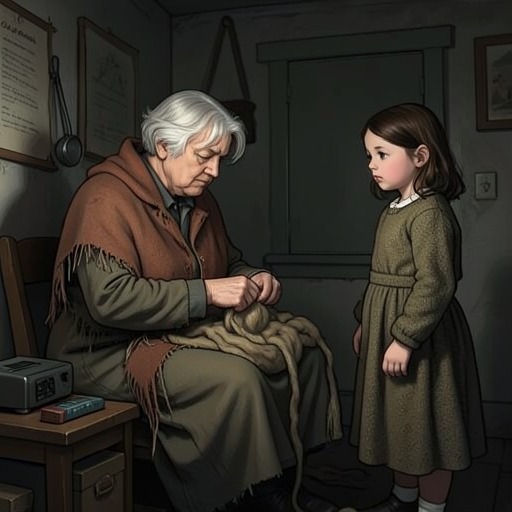
By the time Heidi visits Peter's Grandmother in the mountains, she can read and has discovered that reading aloud gives pleasure to others as well as to herself. She notices Peter's Grandmother's old songbook and offers to read one of its hymns. The book has lain untouched on a shelf for a long time, and Heidi climbs onto a chair to retrieve it, bringing down a cloud of dust. Peter's Grandmother pushes aside her spinning wheel and listens in expectation. Heidi turns the pages, reads a few lines softly to herself, then chooses the hymn about the sun.
Reading and Consolation
Heidi begins with the words “The morning breaks,” and reads with growing warmth of expression. The hymn's movement toward rest after difficulty culminates in “I wait in peace—God's time is best.” Peter's Grandmother listens with folded hands; tears run down her face, but her expression is joyful. When Heidi finishes, she asks to hear it once more. The request turns reading into a repeated act of consolation: Heidi begins again, sharing the verses that have moved her listener rather than treating the reading as a one-time performance.
Peter's Grandmother names the effect directly: “Ah, Heidi, that brings light to the heart! What comfort you have brought me!” She repeats the glad words, while Heidi watches a change come over her face. Its familiar troubled expression gives way to peace and joy. The scene does not suggest that the hymn restores physical sight; instead, its light is emotional and spiritual. The contrast between blindness and inward brightness is made especially clear by Peter's Grandmother's face, which appears newly peaceful as she listens.
The hymn's comfort also becomes part of Heidi's own understanding of what can be done when sorrow returns. Later, The doctor asks whether Heidi can understand how someone might be surrounded by beauty yet be unable to enjoy it, and feel greater sadness because of that contrast. The question brings Peter's Grandmother's blindness to Heidi's mind. She answers that in such a situation one should say one of Peter's Grandmother's hymns: they bring the light back a little and can make her happy again. Heidi identifies the sun hymn among the verses she knows, explaining that Peter's Grandmother likes her to read favorite passages two or three times over. The doctor then asks Heidi to recite verses, showing how the comfort first shared in the grandmother's room can also be described and carried into another conversation.
Repetition, Memory, and Meaning
The hymn belongs to a continuing practice, not just to the first reading. During later visits, Heidi fetches the hymnbook and selects favorite hymns one after another. She knows them by heart, and Peter's Grandmother lies with folded hands as a peaceful smile settles over her worn face. Heidi pauses to ask whether she is already feeling better; Peter's Grandmother says that listening has made her feel better and asks Heidi to continue. Repetition matters here because the familiar words can be returned to when darkness and sorrow press in again. Heidi's reading makes the book available as both a remembered text and a recurring act of companionship.
The hymn's language of light also sits alongside Heidi's practical efforts to improve Peter's Grandmother's life. Heidi proposes using her money to provide her with fresh white rolls, imagining that nourishment might make her stronger and that strength might make things seem lighter. She then notices the songbook and offers to read. The two forms of care are distinct: bread answers bodily need, while the hymn offers comfort through words and shared attention. Heidi does not treat either as an abstract remedy; she brings what she can, returns to visit, and reads aloud.
The morning breaks thus links literacy, faith, and attentive companionship without making them interchangeable. Heidi's ability to read turns a book that had rested unused into a source of immediate comfort, while Peter's Grandmother's response teaches Heidi how a hymn can be offered again when sadness returns. The title's dawn imagery is borne out not by a change in Peter's Grandmother's sight, but by the peace that reading brings to her heart and by the repeated bond between the two readers.