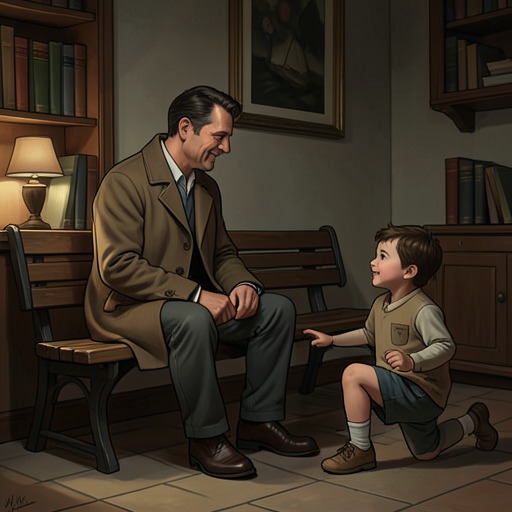
I will arise and go to my father
Heidi“I will arise and go to my father” is the returning son’s decision to leave misery behind and seek his home again. In the tale Heidi reads to Alm-Uncle, the line leads toward a welcome rather than rejection; in the frame story, its account of return and forgiveness reaches the isolated grandfather and is followed by a change in his conduct. Its significance lies both in what the son says and in the way Heidi’s reading brings those words into Alm-Uncle’s own life.
The phrase in the tale
The line comes after the son has left home, wasted his inheritance, and fallen into hardship. He remembers his earlier life with his father and recognizes his own ingratitude. His resolution, “I will arise and go to my father,” is joined to a confession: “Father, I am not worthy to be called thy son; make me as one of thy hired servants.” The words make the return an act of acknowledged fault, not a demand to recover his former standing.
Heidi reads the episode in sequence: the son’s departure, his decline, his recollection of home, and his decision to go back. The tale’s reversal comes when the father sees him “a great way off.” Rather than wait for the son to complete his appeal or tell him that he had been warned, the father has compassion, runs to him, and kisses him. The son confesses, but the father answers with a robe, a ring, shoes, and a feast. The declaration therefore opens a route home whose outcome is more generous than the returning son expects.
Heidi’s reading to Alm-Uncle
The phrase is heard in a conversation already shaped by Alm-Uncle’s bleak claim that a person whom God has forgotten remains forgotten forever. Heidi answers that return is possible, recalling what Heidi’s grandmother told her and pointing to the tale in her book. She hurries up the steep ascent toward the hut, eager to read it to him. The scene makes the story a reply to Alm-Uncle’s assertion, not merely a passage selected for reading.
At the hut, Heidi opens the book to the particular tale, whose pages fall open because she has read it so often. She reads of the son at home among his father’s flocks, then of his departure and degradation, before reaching the words of return. At the point when the father sees his son from far away, she pauses and asks Alm-Uncle what he thinks will happen. She offers the possibility that the father might still be angry and say, “I told you so!” Then she continues to the embrace and welcome. Her question makes the difference between punishment and reconciliation explicit before the story resolves it.
Alm-Uncle does not respond with the pleasure or astonishment Heidi expects. He says the tale is beautiful but remains grave and silent. Heidi then gently moves the book in front of him and points to the picture of the returned son, dressed anew and standing beside his father as one of his sons again. The pictured restoration gives visible form to what the spoken tale has promised: the son is not merely permitted to approach but received back into the family.
Alm-Uncle repeats the confession
The tale’s words recur after Heidi has gone to sleep. Alm-Uncle climbs the ladder and sets his lamp near her bed. He looks at the sleeping child, whose hands remain folded as if she had fallen asleep praying, and stands silently beside her for a long time. He then folds his own hands and says, “Father, I have sinned against heaven and before thee and am not worthy to be called thy son.” Two large tears roll down his cheeks.
The wording echoes the son’s confession in Heidi’s reading, though Alm-Uncle does not repeat the exact declaration “I will arise and go to my father.” Instead, he takes up the words of unworthiness addressed to a father. That change shifts the passage from a story Heidi recounts to a confession Alm-Uncle makes himself. The tale’s movement from remembered wrong to the possibility of welcome is thus carried into the frame narrative, while the text leaves the old man’s unspoken thoughts unstated.
Return given an outward form
The next morning, Alm-Uncle stands outside the hut in the bright morning and hears the bells from the valley. He calls Heidi to get ready because they are going to church together. The decision follows the night in which he repeated the returning son’s confession; the narrative places the two acts in close succession rather than explaining them through further speech. Heidi is astonished to see him in his Sunday coat with silver buttons, a striking change from the grandfather she has known in their life on the mountain.
The phrase’s pattern of departure and return consequently resonates on two levels. Within the tale, the son turns back toward his father and is welcomed. Around that reading, Heidi insists to Alm-Uncle that a return remains possible, and his nighttime repetition of the confession is followed by the concrete step of going to church with her. The episode does not state that the two stories are identical, or spell out every conclusion Alm-Uncle draws. It does show the tale’s words becoming consequential: a remembered confession is followed by a public act of return, while the father’s compassionate reception supplies the reading’s central image of hope.