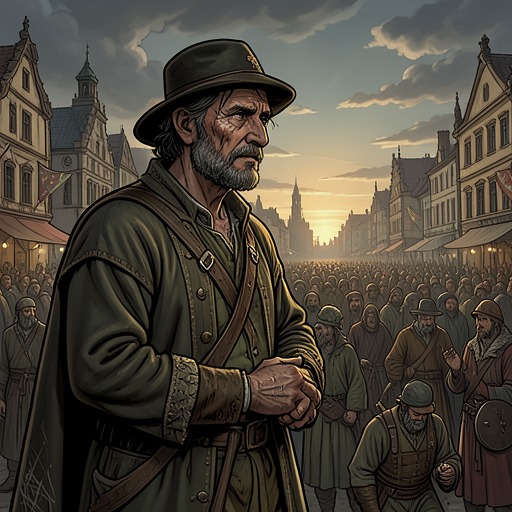
Alm-Uncle Reconciles with Dorfli
HeidiAlm-Uncle’s reconciliation with Dorfli is both a religious turning point and a practical return to community. Heidi’s reading of the prodigal son gives her grandfather a language for regret and return; the next morning he goes with her to church, asks the pastor’s forgiveness, and accepts a winter home in the village. His private repentance is thus followed by public gestures of belonging, and the villagers answer those gestures with an unexpectedly warm welcome.
The parable and the private turning point
The change begins at the mountain hut, when Alm-Uncle reflects that a person whom God has forgotten can never return. Heidi objects: her grandmother has told her otherwise, and the tale in her illustrated book supports her belief. She hurries up the steep path, eager to read it to him, and opens to the familiar story whose pages fall naturally to the passage she knows so well.
The parable describes a son who leaves a loving home, squanders his inheritance, and falls into hardship before recognizing how kindly his father had treated him. He resolves to return, confess his wrongdoing, and ask to be treated as a hired servant. Heidi pauses before the father’s response, inviting Alm-Uncle to consider what will happen; then she reads that the father welcomes the son, restores him to the household, and celebrates his return. The story directly answers the old man’s bleak assertion that return is impossible. Rather than explain its application, Heidi points to the picture of the reunited father and son, the returned son dressed again as a member of the family.
Alm-Uncle calls the tale beautiful, but his grave expression leaves Heidi quiet. Hours later, while she sleeps with her hands folded as if she had fallen asleep in prayer, he watches her beside the lamp. Her peaceful, trusting face moves him to fold his own hands and confess that he has sinned and is unworthy to be called a son. The scene makes the parable’s lesson personal: Heidi has not argued him into reconciliation so much as placed before him an image of return that he can finally accept.
A public return to church
The following morning Alm-Uncle calls Heidi down and tells her to put on her best dress because they are going to church together. She wears her smart Frankfurt dress; he wears his Sunday coat with silver buttons. The narrator marks the occasion through this unusual change in their routine and appearance: Heidi is astonished to see him dressed for church, and the bells ringing from the valley sound to her like a festival as they descend together.
They enter the church at Dorfli after the congregation has assembled and singing has begun, and sit at the back. Before the hymn is over, the news has passed from neighbor to neighbor: Alm-Uncle is in church. The congregation’s attention shifts from the service to the significance of his presence. The sermon, described as warm and thankful, affects those assembled, and his return is received as a source of shared joy rather than merely a private decision.
After the service, Alm-Uncle takes Heidi by the hand and goes to the pastor’s house. Villagers watch to see whether he will leave the meeting angry or whether the encounter will be peaceful. Their uncertainty exposes how firmly the community has associated him with hostility. Yet some begin revising their judgment even before they know what is said: seeing him carefully lead Heidi, they question whether the stories about his cruelty have been exaggerated. The miller points to the child’s own choice to leave a comfortable household and return to her grandfather as evidence against the villagers’ assumptions.
Apology and a winter plan
In the pastor’s study, Alm-Uncle asks the pastor to forget the harsh words he spoke during an earlier visit and not to resent his stubborn rejection of well-meant advice. He acknowledges that the pastor was right and he was wrong. He now intends to find a place in Dorfli for the winter because Heidi is not strong enough to endure the severe cold on the mountain. He also recognizes that if the villagers distrust him, he has brought that judgment on himself.
The pastor responds warmly, welcoming him as a neighbor and friend and expressing pleasure that he has returned to church. He welcomes the prospect of spending winter evenings together and says they can find suitable friends for Heidi. This welcome makes the reconciliation concrete: Alm-Uncle is not merely allowed back into the village but offered companionship for himself and a social circle for his granddaughter. The pastor also takes Heidi’s hand and treats her kindly as he walks with them to the door.
Outside, the waiting congregation sees the pastor shake hands with Alm-Uncle as though reluctant to part from a close friend. The villagers then come forward to greet him, each trying to be among the first to offer a handshake. Their words express pleasure at seeing him again and a wish to talk with him. When he says he is considering returning to his old quarters in Dorfli for the winter, their collective approval confirms that the community’s suspicion is giving way to welcome. Many accompany him and Heidi partway up the mountain, asking him to visit when he next comes down.
Reconciliation confirmed among neighbors
The return is tested in a more intimate setting when Alm-Uncle enters Peter’s home and greets Peter’s Grandmother. He proposes doing more patching before the autumn winds arrive, connecting his return to practical care for the house. Peter’s Grandmother is delighted to see him and thanks him for what he has done for her. She then asks him not to send Heidi away again before her death, fearing the loss of the child who has become so important to her.
Alm-Uncle reassures her that he will not punish either her or himself by taking Heidi away, and says they are all together now and hopes they may remain so. His answer extends the reconciliation beyond the pastor and the villagers: it also secures, for the present, Heidi’s closeness to Peter’s Grandmother. He leaves the scene not as an isolated man whose return is only symbolic, but as someone prepared to share ordinary responsibilities and relationships in Dorfli.
The event’s movement is from the claim that return is forever impossible to a sequence of returns: the prodigal son in Heidi’s book, Alm-Uncle to church, Alm-Uncle to the pastor’s friendship, and Alm-Uncle into the company of his neighbors. The change does not erase his earlier estrangement; he openly accepts responsibility for it. Instead, the story makes reconciliation visible through specific acts—confession, a Sunday walk, a handshake, a winter plan, and reassurance to Peter’s Grandmother—each answered by an invitation or welcome.