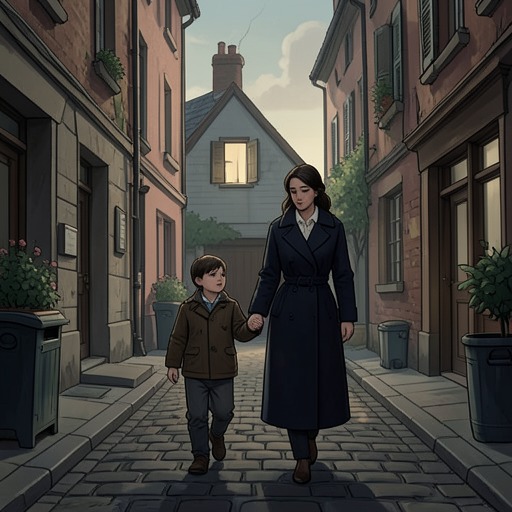
Heidi is left in Alm-Uncle’s care
HeidiHeidi is left in Alm-Uncle’s care when Dete brings her up the mountain and declares that her four years of responsibility are over. The handover is abrupt, and the old man initially receives it with suspicion; its lasting significance lies in what follows. Heidi settles into life at his hut, while her visits, questions, and attachments gradually make care—not isolation—the defining work of their relationship.
Causes and Background
The journey begins on a clear June morning. Dete leads Heidi up from Mayenfeld toward the mountain, past Dorfli, where neighbors call out to greet her. Heidi is so heavily dressed for the heat that her small shape is obscured by layers of clothing and a thick red woollen shawl; her nailed mountain shoes make the steep climb laborious. At the time, she appears to be five years old or younger. The journey places a very young child in the care of a grandfather she has barely known.
At the hut, Dete makes the responsibility explicit: she has looked after Heidi for four years and now considers it Alm-Uncle’s turn, since he is the child’s next of kin. The account later clarifies the burden behind this transfer: Heidi’s dying mother had left her in Dete’s care. Dete says she must earn her own living and insists that Alm-Uncle will be answerable if harm comes to the child. Her words turn a family handover into an argument about duty, while her swift departure leaves little room for negotiation.
The Handover at the Hut
Alm-Uncle is sitting on a bench beside the hut, looking over the valley, when Heidi, Dete, and Peter arrive. Heidi reaches him first, goes straight up, offers her hand, and greets him as her grandfather. He shakes her hand abruptly and studies her beneath his heavy eyebrows; she gazes back without flinching. Dete identifies the child as the daughter of Tobias and Adelaide, whom Alm-Uncle has not seen since she was a year old.
The old man asks what the child has to do with him. He sends Peter away with the Goats, then hears Dete’s declaration that Heidi is to remain. Dete does not wait for an answer. She calls goodbye as she turns down the mountain, and the villagers’ reproaches follow her through Dorfli: they ask where she has left the child and condemn her for leaving a helpless little one up there. Dete is distressed by their words, but reassures herself that earning money may eventually let her do more for Heidi. The exchange ends with the child still at the hut and the adult who brought her already gone.
Heidi Makes a Home
After Dete disappears, Alm-Uncle returns to his bench and sits silently, smoking and staring at the ground. Heidi, by contrast, explores. She looks into the empty shed where the Goats are kept, listens to the wind rushing through the three fir trees, and then comes back to stand in front of him. The contrast establishes two different responses to the transfer: the old man withdraws into silence, while the child begins to make the unfamiliar place her own.
Inside the hut, Heidi is told to put away her bundle of clothes. She pushes it behind Alm-Uncle’s belongings in the cupboard, as if to keep it out of sight, then asks where she is to sleep. Given permission to choose, she climbs a short ladder into the hayloft. There she finds a heap of fresh hay and a round window overlooking the valley. The hut’s sparse ground-floor room—table, chair, bed, hearth, and cupboard—offers little conventional comfort, but the loft gives her a place she is pleased to claim.
The Relationship That Follows
The handover begins with an unsettled question of responsibility, but the relationship that develops is shown through repeated acts of attention. In winter, Heidi visits Peter’s Grandmother. When she notices a shutter flapping in the wind, she frets that it may break a pane and immediately imagines that her grandfather can mend it. The grandmother explains that the house rattles and admits that she fears it may collapse while she and the others sleep. Heidi’s tears at learning that the old woman will never see the mountains or flowers again give way to a lively account of life with Alm-Uncle and the things he makes from wood.
On a later visit, heavy blows against the cottage wall frighten the grandmother until Heidi tells her that Alm-Uncle is repairing the house. He hammers around the walls and climbs onto the roof, using up the nails he has brought. The repairs answer the grandmother’s fear in a concrete way: the cottage no longer groans and rattles through the night. Heidi’s winter visits also change the rhythm of the grandmother’s days. She listens for the child’s footsteps, enjoys their conversations, and finds the afternoons passing quickly; Heidi, in turn, becomes deeply attached to her.
Alm-Uncle’s care extends beyond these visits. When Clara arrives at the mountain hut, he makes an opening in the shed wall by removing two boards so that her chair can pass through, then tends to her with gentleness as she wakes in the sunlight. Later, Heidi asks for the bed she slept in at Frankfurt, with its high pillows and thick coverlet, so that Peter’s Grandmother can lie comfortably and keep warm. These episodes do not erase the roughness of the original handover, but they show how the household formed around Heidi becomes a place where needs are noticed and answered.
The transfer also leaves Heidi’s upbringing contested. The pastor tells Alm-Uncle that she should already have been attending school and argues that a child cannot grow up among Goats and birds without learning. Alm-Uncle refuses, preferring her mountain life; later, Dete returns with a plan to take Heidi to Frankfurt as a companion for Clara. There, Dete presents the child as about ten, but Heidi says Alm-Uncle told her she was eight, exposing the gap between Dete’s account and the child’s own understanding. Together these disputes show that leaving Heidi with her grandfather establishes a home without settling who has the right to shape her childhood.