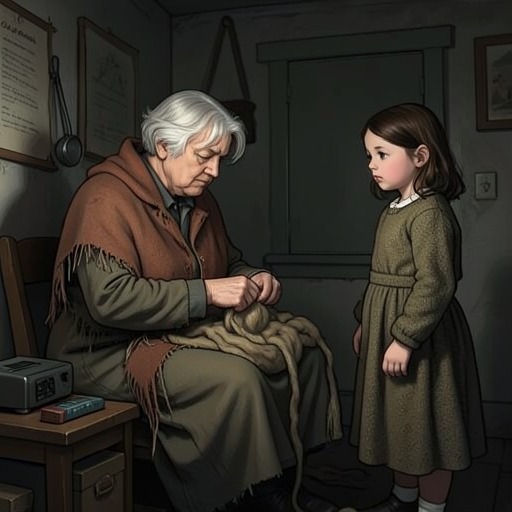
Heidi’s Frankfurt bed
HeidiHeidi’s Frankfurt bed is more than a remembered comfort: once Heidi learns how Peter’s Grandmother sleeps, she asks that the bed be sent from Frankfurt to make the old woman warmer and more comfortable. The request turns a possession associated with Heidi’s time away from home into a concrete means of care, and its arrival brings Peter’s Grandmother a sound night’s sleep.
From separation to a remembered possession
The bed’s significance grows out of the circumstances that first take Heidi away from the mountain. Dete says she has cared for Heidi until then but is leaving for a good position in Frankfurt; in her view, responsibility now belongs to Heidi’s grandfather, Alm-Uncle. The arrangement divides care between relatives and makes Heidi’s life in Frankfurt possible, but it also sets up the movement of people and goods between that household and the mountain.
At Alm-Uncle’s home, Heidi’s first meal offers a contrasting picture of how care is made tangible. He fills a bowl with milk, places it on a chair so that she can reach it from her three-legged stool, and gives her bread and golden cheese after her long, hot journey. This is not the Frankfurt bed, but it establishes a material pattern in the story: attention to another person takes the form of food, furniture, warmth, and arrangements suited to immediate need. The later request for a bed extends that practical care beyond Heidi herself.
The bed and Heidi’s longing for home
In Frankfurt, Heidi’s stories to Clara Sesemann repeatedly return to the mountain and to her desire to go home. Her longing becomes so strong that she tells Clara she must leave the next day, then finds comfort in the thought that each day brings two more white rolls for Peter’s Grandmother. At dinner and supper, Heidi pockets the rolls rather than eating them because the old woman has no white bread and can hardly manage the hard black bread. The details make Heidi’s absence from home inseparable from her concern for someone left behind.
When Heidi is finally preparing to leave, Clara gives her a basket containing twelve white rolls for Peter’s Grandmother, among other things. Heidi also places her beloved book in the basket and wraps another object in her old red shawl; Fraulein Rottenmeier takes the conspicuous red bundle out and throws it down, and Heidi looks imploringly to Herr Sesemann. The scene records how objects carried between households can embody attachment, but it does not establish that the bed is among the possessions Heidi takes home. The bed’s later importance lies instead in Heidi’s decision to ask for it once she recognizes the old woman’s need.
A request shaped by the grandmother’s need
After Heidi returns, Peter’s Grandmother tells her that the white bread has helped her feel stronger, though she has eaten only one roll because she fears running out. Heidi proposes writing to Clara for more, recalling the large supply in the wardrobe and Clara’s promise to replace what had been taken. Brigitta points out a practical difficulty: the rolls would become hard and stale, while buying fresh white rolls from the baker in Dorfli is beyond what she can afford. Heidi then remembers that she has money and decides that Peter can bring a fresh roll up from Dorfli each day, with two on Sundays.
The bed request follows this same attention to circumstances, but it addresses a more fundamental discomfort. When Frau Sesemann asks whether Heidi has another wish, Heidi specifies the bed she slept in at Frankfurt, with its high pillows and thick coverlet. She explains that Peter’s Grandmother has to lie with her head downhill and can hardly breathe, and that she must wear her shawl in bed to keep from freezing. The request is precise: the bed’s raised pillows and warm covering answer problems Heidi has observed, rather than representing a general wish for a valuable gift.
Frau Sesemann is moved by Heidi’s reminder that happiness in one household should not make people forget those who lack basic comforts. She says she will telegraph Frankfurt at once and have Fraulein Rottenmeier pack the bed that very day, so it can reach the mountain in two days, God willing. The transfer thus depends on a chain of relationships: Heidi identifies the need, Frau Sesemann authorizes the gift, and Fraulein Rottenmeier is to prepare it for dispatch.
Arrival and continuing care
Heidi hurries to tell Peter’s Grandmother that the bed is coming with all three pillows and the thick coverlet. The old woman initially responds with sadness, fearing that the visitors may be taking Heidi away; Frau Sesemann follows Heidi into the room and reassures her that Heidi will stay with her and that the family hopes to visit the Alm again. The bed’s promise is therefore accompanied by a promise of continued personal connection: assistance from Frankfurt will not require Heidi’s permanent separation from home.
The ending confirms the bed’s practical consequence. It arrives, and Peter’s Grandmother sleeps so soundly through the night that she is expected to grow stronger. Frau Sesemann also sends a large parcel of warm clothing, so the improvement is not attributed to the bed alone: the bedding and clothes together answer cold and discomfort in the mountain winter. The narrative gives the bed a clear, limited result—rest and the prospect of renewed strength—rather than claiming a complete cure.
Significance as an object of care
The bed connects two domestic worlds through a specific need. In Frankfurt it is a familiar place of sleep for Heidi; on the mountain, its pillows and coverlet promise relief to an elderly woman whose present sleeping conditions leave her uncomfortable and cold. Its movement makes care visible as a transfer of resources, alongside the white rolls, money for fresh bread, and the warm clothing parcel.
The object also marks a change in the direction of Heidi’s longing. In Frankfurt, she imagines the mountain and yearns to return; once home, she uses what she has learned about comfort there to notice what Peter’s Grandmother lacks. The bed carries the benefit of Heidi’s time away back into the household she missed. Its decisive importance is therefore not simply that it once belonged to her, but that she recognizes its usefulness to another person and asks for it on her behalf.