Grandmother’s Hymnbook
HeidiGrandmother’s Hymnbook is the long-neglected volume that Heidi discovers on Peter's Grandmother’s shelf and turns into an instrument of comfort and shared care. Its role grows through repeated reading: first Heidi reads aloud, then she plans to make the hymns available every day, and finally Peter reads from the same book himself.
The book’s rediscovery
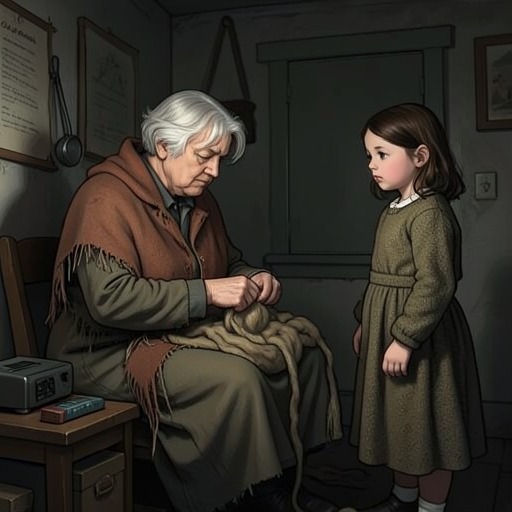
The book enters the scene as a concrete household object: it has been left untouched on a shelf for so long that Heidi raises a cloud of dust when she takes it down. She wipes it clean, sits beside Peter's Grandmother, and asks which hymn she would like to hear. When the older woman leaves the choice to her, Heidi turns through the pages and quietly tests a line here and there before selecting a hymn about the sun.
The sequence gives the book a small but distinct physical presence. Heidi must climb onto a chair to reach it; she then handles it carefully enough to wipe away the dust and brings it to a stool beside the listener. The movement from shelf to reading place marks a change in its use: a book that had lain idle becomes something opened and heard. Heidi’s discovery that she can read makes that change possible, while Peter's Grandmother’s eager attention gives the volume an immediate purpose.
Reading as comfort
Heidi’s first reading gathers warmth as it proceeds. The hymn she chooses begins with the morning breaking, and she reads with increasing expression. The choice matters in a room where Peter's Grandmother describes life alone in silence and darkness. The hymns do not restore her sight or change her circumstances, but hearing their words comforts her and renews her happiness. She tells Heidi that, when the child reads, her heart rejoices again.
The book’s effect recurs beyond this first occasion. On a later visit, Heidi brings it from the next room and selects favorite hymns one after another; by then she knows them all by heart. Peter's Grandmother lies with folded hands as she listens, and a peaceful smile comes over her worn face. The scene makes the book more than a prompt for a single comforting moment: its familiar hymns can be returned to, and their repeated hearing helps interrupt the loneliness of the older woman’s days.
From an occasional visit to a daily plan
The book also shapes Heidi’s response to the limits of visiting. After hearing how much the hymns comfort Peter's Grandmother, Heidi thinks that reading to her every day might help her feel better. Yet Heidi knows she may have to wait a week, perhaps two, before she can climb the mountain again. The distance between visits turns the book’s consoling use into a practical problem: how can its words reach Peter's Grandmother when Heidi is not there to read them?
Heidi’s answer is to enlist Peter. The following day, after he has attended school and come to see her, she tells him that he must learn to read so that he can read one or two hymns to Peter's Grandmother each day. Peter initially refuses, but Heidi insists; her purpose is not simply to improve his schooling but to give him the ability to carry the hymns to their listener. In this plan, the book links literacy with responsibility: reading becomes a way for Peter to help care for his grandmother, rather than a skill pursued only for its own sake.
Peter takes up the book
The plan reaches its first clear result when Peter announces that he must read one of the hymns because Heidi told him to. His mother hastily fetches the book, and Peter sits at the table to read. Peter's Grandmother waits joyfully for the words, while his mother listens in astonishment and exclaims at the end of each verse. The same volume that Heidi once had to dust and open for her grandmother is now read aloud by Peter.
The change does not erase the book’s earlier function; it extends it. Heidi’s reading had shown Peter's Grandmother that the hymns could bring comfort, and her instruction gives Peter a way to continue that comfort between Heidi’s visits. The book thus connects three people through a simple, repeatable act: one person reads, another hears, and a third learns to take over the reading. Its narrative significance lies in that passage from neglect to use, and from a single act of kindness to a shared practice.