Illustrated Storybook
HeidiThe Illustrated Storybook is the picture book that opens reading to Heidi and later gives her a way to speak to Alm-Uncle about estrangement, forgiveness, and return. First encountered in Frau Sesemann’s Frankfurt home, it moves from an object of pictures that Heidi can only look at into a book she reads repeatedly, treasures as her own, and carries back to the mountain. Its most important tale—the prodigal son’s return—ultimately becomes a bridge between Heidi’s new literacy and her grandfather’s reconciliation with religious and communal life.
The pictures that awaken Heidi’s desire to read
Frau Sesemann first gives Heidi books to look at after hearing that the child has supposedly been unable to learn her alphabet. Heidi gazes delightedly at the colored illustrations until one page stops her: a green pasture filled with young animals, a shepherd leaning on his staff among his flock, and the sun sinking in a wash of golden light. The picture brings her to tears. Its peaceful mountain scene recalls a world unlike the life she is living in Frankfurt, though the narrative does not reduce her response to a single explanation. Frau Sesemann notices the strength of the reaction and offers to tell Heidi the story associated with the picture that evening.
The grandmother then turns the book from a collection of images into an invitation to literacy. She tells Heidi that she can learn to read, rejects the discouraging belief Heidi had accepted from Peter, and promises that the book will be hers once she can read it. The promise joins an immediate reward to a new possibility: the pictures will no longer remain mute, and the stories behind them will become accessible to Heidi herself. Heidi responds with an eager wish that she could read already. The Illustrated Storybook thus stands at the point where her apparent inability gives way to confidence and active desire.
A possession and a daily reading practice
When Heidi learns to read, Frau Sesemann confirms the promise by placing the large, beautifully illustrated book at Heidi’s place at the table. Heidi asks whether it will remain hers even when she goes home; Frau Sesemann assures her that it is hers to keep. The gift matters as more than a lesson’s reward. It gives Heidi a lasting possession whose value is not confined to the household where she received it, even as Clara Sesemann hopes Heidi will stay with her in Frankfurt.
From that evening onward, Heidi repeatedly reads the book’s tales, both privately and aloud. Reading becomes her chief pleasure rather than a task she must endure. When Frau Sesemann invites her to read to the others, Heidi is delighted; the pictured scenes grow clearer through the reading, and Frau Sesemann expands on them by explaining and telling more. The book supports a shared practice: Heidi gives voice to the printed story, while her grandmother helps interpret it. Its multiple tales and illustrations also make the days pass quickly as the time approaches for Frau Sesemann to return home.
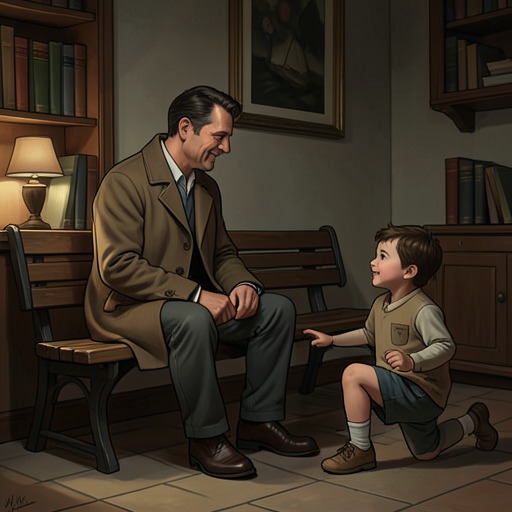
Among all the pictures, Heidi favors the shepherd at home with his father’s sheep and goats. She also returns to the contrasting images of the son far from home, reduced to tending swine and living on their husks, and of the father running to welcome his returning child. The sequence gives the book a visual structure of departure, loss, and restoration. Heidi reads this tale over and over, aloud and to herself, and never tires of hearing Frau Sesemann explain it to her and Clara Sesemann. The story’s return motif will matter again after the book leaves Frankfurt.
The book carried to the mountain
Back at the hut, Heidi recognizes that Alm-Uncle’s bleak belief that no one can return from being forgotten conflicts with what she has learned from the tale. She hurries up the steep path and tells him that the story in her book shows that people can return. The book is not merely recalled as a lesson: Heidi runs inside for it, then comes back with it under her arm. Its pages fall open at the familiar story, a sign of how often she has read it.
Heidi reads aloud the son’s movement from a happy home to waste and deprivation, and then to remorse and longing for his father. At the moment when the returning son is still far away, she pauses to ask Alm-Uncle what he thinks the father will do. She continues with the father’s compassion and welcome, the new robe, ring, and shoes, and the feast that celebrates the lost son’s return. The printed story becomes a conversation with a listener who does not immediately answer. When Heidi asks whether it is beautiful, Alm-Uncle agrees, but remains grave. Heidi then gently pushes the book toward him and points to the image of the son restored to his father, dressed again as one of the family.
Meaning and consequence
The Illustrated Storybook’s effect on Alm-Uncle unfolds through the contrast between Heidi’s confident reading and his silence. The narrative does not present him as instantly changed by the tale: he sits without speaking, and Heidi’s pointing gesture makes the image available to him without forcing a reply. That night, however, he looks down at the sleeping Heidi, whose folded hands and peaceful expression seem to move him. He folds his own hands and voices a confession of unworthiness that echoes the prodigal son’s words. The story has supplied a pattern in which guilt does not have to end in permanent separation.
The next morning Alm-Uncle calls Heidi to get ready and announces that they will go to church together. The book does not itself make that decision, but it has given Heidi a story with which to challenge his despair and has placed the possibility of return before him in words and pictures. Its movement through the novel—from the sunlit pasture that first makes Heidi weep, to the tale she reads at home beside her grandfather—joins her education to an act of comfort. The Illustrated Storybook is at once a gift, a source of delight, and the means by which Heidi shares a vision of homecoming with someone who has come to believe that homecoming is impossible.