Carp
HomunculusCarp occupy an unusual place in the novel: they are living creatures, a necessary resource in Ignacio Narbondo’s experiments with reanimation, and the focus of claims about immortality and prophecy. Their role is not merely symbolic or scientific. They are stolen, studied, transported, and traded, and their handling connects the work of a secretive laboratory to the hunger of people in the streets.
Reputation and Reported Properties
The novel presents several different accounts of what carp mean and what they can do. Bill Kraken recalls a past theft in which he drove a wagon to obtain about half a dozen fish from the oceanarium. He says Sebastian Owlesby cut them up soon afterward, and that a gland within them was understood to contain an elixir. The carp were then passed to a beggar woman on Old Pye, who sold them at Billingsgate Market. Kraken describes the transaction as having produced some good, though the fish had first been taken for the experimenters’ purposes.
A later conversation gives the carp a more expansive reputation. Kraken tells Willis Pule that science has studied them, chiefly in China, and that they are said to live forever and grow to the size of the pool in which they are kept. He joins these reported properties to religious imagery: in his account, the biblical leviathan is ultimately a carp, and its emergence from the sea will herald a coming catastrophe. Kraken presents himself as a man of both science and spirit, but admits that he trusts neither completely. The novel therefore frames these claims as part of his account, not as independently established facts about carp. Their supposed longevity nonetheless makes them an apt point of contact between laboratory hopes of defeating death and Shiloh’s apocalyptic preaching.
Carp in Narbondo’s Laboratory
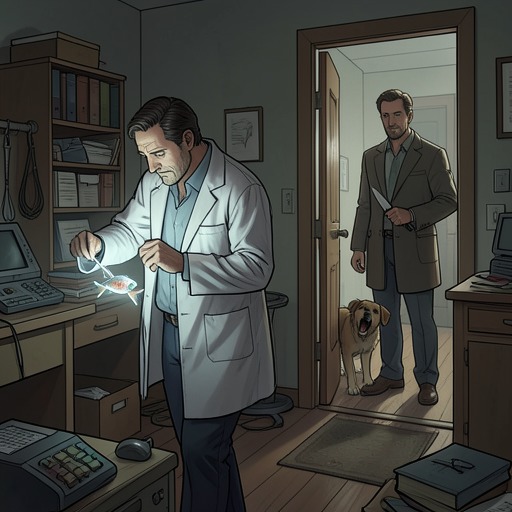
Narbondo’s laboratory makes the fish’s practical value concrete. It contains large aquaria with aquatic plants and several arm-length koi, alongside chemical apparatus, containers of amber liquid, preserved specimens, and a human skeleton. In one experiment, Narbondo feeds worms to the fish. Five eat; a sixth ignores the food, gulps air, and struggles to remain near the surface. Narbondo selects that ailing carp, removes it from the aquarium, and works to obtain a small gland from its organs, preserving the gland in a vial of amber liquid.
The scene establishes a methodical connection between the living fish and Narbondo’s work on the dead. The corpse he is considering has been dead for two weeks, and he doubts that animating it would accomplish much beyond frightening people. He imagines that Shiloh might present it as a sinner restored by a miracle, but the laboratory’s equipment and Narbondo’s extraction of the gland place the proposed transformation within an experimental process. When Shiloh objects to the waste of a fish while people nearby go hungry, Narbondo answers that his work makes the dead walk again. Their exchange exposes the competing uses of the carp: a source for an experiment, food that could feed people, and an object around which religious claims can be made.
A Stated Requirement for Reanimation
Sebastian Owlesby’s notebooks, read aloud by Langdon St. Ives, make the carp’s role in the experiments explicit. Owlesby records that a cadaver brought in by Short and Kraken remains dead despite having been filled with fluids. Without a carp and a fresh gland, he fears the body will decompose before the experiment can proceed. His entry presents the fish and its gland as necessary materials, while also registering his growing anxiety that the work may end in murder and horror. The carp is thus not an incidental laboratory animal: its availability is a condition Owlesby believes the experiment requires.
The same dependence governs Narbondo’s preparations for another experiment. When a fresh cadaver is brought to a slab, Narbondo also retrieves a living but sluggish carp from a trough beneath a jar of yellow fluid and places it beside the body. He works quickly, while Willis Pule assists only when ordered. The scene shows the fish being incorporated into the procedure, although the cited episode does not establish the experiment’s eventual result. Across the laboratory scenes, the repeated need for a fish and a gland gives carp a material function in the novel’s attempt to cross the boundary between death and renewed movement.
Bargaining, Disposal, and Human Need
Carp also enter the plot through exchange and conflict. In a later confrontation, Narbondo tells Shiloh that Shiloh’s mother’s soul resides in a carp, then says the fish has been damaged by an assistant. He throws it out of the window and displays a gland, valuing it at two hundred fifty pounds. Shiloh offers to trade a woman for the gland. The episode sets a spiritual claim against the price of a laboratory substance: the fish is made to stand for a soul, while the gland becomes a bargaining object with a stated monetary value. Narbondo’s assertion about the mother’s soul belongs to this contested exchange and is not confirmed as a fact by the scene.
The fish’s disposal recalls the earlier laboratory encounter with Shiloh. There, Narbondo throws a carp and its discarded entrails onto the pavement, where people who are already hungry begin fighting over them. In another episode, Willis Pule arranges for a boy with a barrow to carry carp to Narbondo at 266 Pratlow Street, instructing him to deliver them while they are still breathing. Pule hopes to act against Bill Kraken before Kraken becomes sober, but Narbondo soon arrives, angry that the fish have not reached him. The delivery is therefore both a logistical task for the experiments and part of the shifting dealings among Narbondo, Pule, and Kraken.
Narrative Significance
The carp recur at the intersection of knowledge, belief, and material need. Their gland is treated as an experimental necessity, but the fish themselves are also food, merchandise, and subjects of extraordinary claims. The novel does not resolve Kraken’s report of immortality into a scientific explanation, nor does it verify Shiloh’s spiritual interpretation of a particular carp. Instead, it shows how different characters attach competing meanings to the same animal while acting upon it for very practical ends.
That contrast gives the carp a distinctive narrative function. In the laboratory, they help make reanimation seem like a process with material requirements rather than a miracle; in Shiloh’s religious world, they can be linked to souls and prophetic signs; on the street, they become something hungry people may seize and eat. The recurring movement from aquarium to table, vial, wagon, pavement, or bargaining exchange exposes the distance between grand promises of eternal life and the immediate conditions of ordinary survival. The carp connect those scales without erasing the difference between them.