Zombies
HomunculusZombies are the compromised result of corpse-animation experiments conducted by Ignacio Narbondo and Sebastian Owlesby. Their existence turns a scientific ambition into a practical and ethical crisis: the experiments require freshly obtained bodies and a substance derived from Carp, while the resulting dead remain diminished, difficult to manage, and liable to decay.
Identity and Experimental Basis
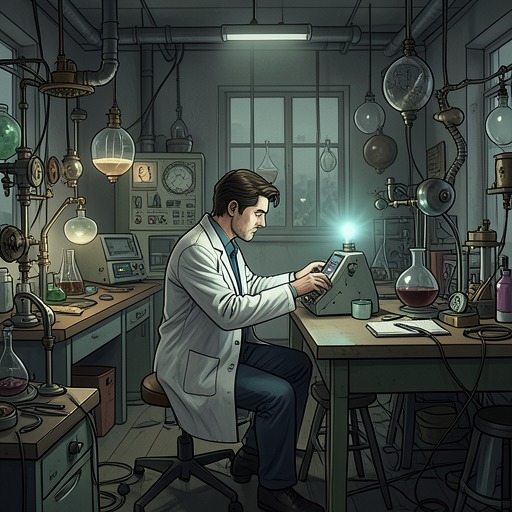
The animated dead are treated as material outcomes of experimentation rather than as independent supernatural beings. Sebastian Owlesby’s notebooks record his work on corpse animation, while a later account of an unsuccessful trial describes a recently obtained body filled with fluids but still entirely inert. Owlesby identifies the missing ingredient as a fresh Carp and its gland, which he believes contains an elixir. In this method, the dead body alone is not enough: reanimation depends on a biological substance that must be procured along with it.
Owlesby’s notes connect the procedure to an escalating disregard for human life. In late May 1861, his experiments had advanced to requiring the brain of a living person. He and an unnamed accomplice took the head of a sleeping indigent in St. James’ Park. The notebooks show Owlesby recognizing that his work had moved beyond abstract inquiry, even as he continued to pursue it under Narbondo’s influence. A later Limehouse killing likewise arose from their effort to obtain material for the experiments; Owlesby’s account presents the murder as having failed to supply what they needed.
Behavior and Fragility
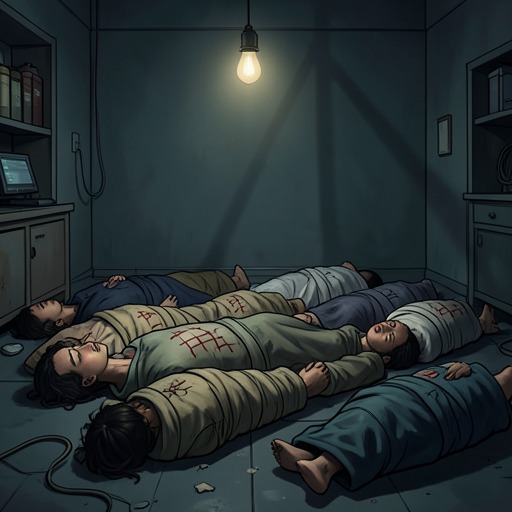
The creatures display limited, repetitive activity rather than ordinary human agency. Two prisoners brought to Langdon St. Ives’s manor are treated as animated dead. One is found dead after a day without food; St. Ives observes that starvation did not cause its death, since it already seemed dead when it was brought in. The episode distinguishes the creature’s condition from a living person’s, while leaving its exact needs uncertain.
The second prisoner consumes the black pudding left for it and repeatedly thumps against the closet door. St. Ives and Hasbro consider whether a closet might feel more like a home to an animated dead man than a hillside, a bleak joke that registers the creature’s confinement without attributing complex thought to it. By the following morning it, too, is dead. The broken bowl left at its mouth marks the end of the brief episode; eating does not restore it to life or protect it from collapse.
Bodies, Materials, and the Cost of Reanimation
The search for the ingredients binds the creatures to a chain of corpse-taking and animal exploitation. Bill Kraken recalls driving a wagon during a nighttime raid on the oceanarium, after which Sebastian Owlesby cut up roughly half a dozen Carp on Baker Street. The fish were then sold at Billingsgate Market. Kraken’s account connects this theft to the experiments’ demand for the Carp glands, while showing how the work reaches beyond the laboratory into theft and covert handling of animals.
The supply of human bodies is equally criminal. Owlesby writes of a corpse taken from the gallows that remained lifeless despite being prepared with fluids; without a fresh Carp and gland, he feared it would decompose before they could use it. His notes describe the effort as a path from which he could no longer find his way back. The reanimated dead are therefore not merely the experiment’s result: they embody its dependence on vulnerable human bodies, stolen remains, and repeated attempts to overcome the limits of decay.
Narrative Significance
The zombies make the consequences of Narbondo and Owlesby’s ambition visible in forms that are both uncanny and plainly material. Their shuffling, thumping, and brief consumption of food do not amount to recovery; the figures remain dead, dependent, and short-lived. St. Ives’s restrained decision to deny one prisoner more food and let it die underscores the ethical uncertainty of how to treat a being that moves but cannot be understood as living in the usual sense.
Their appearances also connect different strands of the investigation. Kraken’s recollection of the Carp theft, the notebooks’ record of Owlesby’s decline, and the later confinement of the two prisoners all reveal aspects of the same enterprise: the search for a means of arresting decay has produced neither secure mastery over death nor stable life, but a succession of crimes and fragile, failing bodies.