Narbondo’s carp-gland reanimation requirement
HomunculusNarbondo’s carp-gland reanimation requirement is the material condition at the center of Ignacio Narbondo’s corpse experiments: an attempt to animate the dead depends on obtaining and preparing a gland from a carp. The fish is not incidental laboratory stock. Its organ functions as a scarce experimental ingredient, and its condition can determine whether a body is ready for an attempt at animation. Across the novel, this dependence links scientific ambition to animal use, the supply of human corpses, and the competing schemes of Narbondo, Sebastian Owlesby, and Shiloh.
The Ingredient and Its Preparation
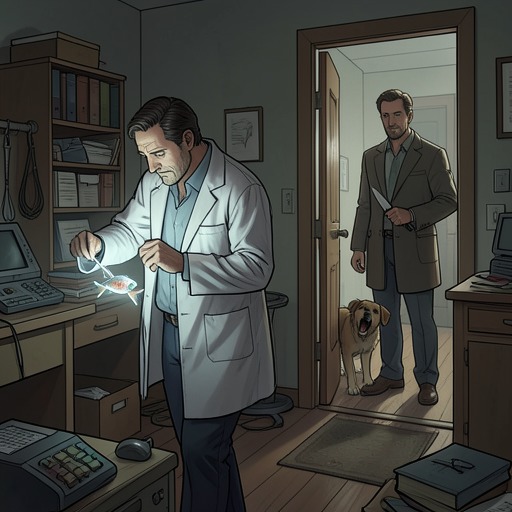
Narbondo’s laboratory makes the procedure’s dependence on fish visible. Its aquaria hold arm-length koi, while glass vessels contain chemical preparations and preserved specimens. Narbondo tests the fish by giving them wriggling worms: five feed, but a sixth, already weakened, struggles at the surface and repeatedly sinks among the water plants. He catches that fish, secures it to a board, opens it, and extracts a small, bean-shaped gland. After spraying it with fluid, he places it in a vial of amber liquid. The sequence presents the gland as something Narbondo must locate, remove, and preserve before it can be used.
The practical importance of the ingredient is also established through Sebastian Owlesby’s lost notes. They describe attempts to animate corpses and record the difficulty of proceeding without both a suitable corpse and a fresh carp gland. Owlesby’s account makes the dependency more than a preference: without the ingredient, a body may deteriorate before the experiment can be attempted. The research therefore relies on two vulnerable materials at once, a human body and an animal organ, whose availability and condition constrain the work.
A Repeated Experimental Procedure
Narbondo’s experiments combine the gland with a larger apparatus and a sequence of actions. In one observed attempt, he directs yellow mist over a corpse, takes material from a jar, and uses a press-like device to put it into the corpse’s mouth. The body moves, briefly lifting itself, but the effort does not produce sustained animation; it falls back onto the slab. The scene demonstrates both the procedure’s ambition and its limits. The gland is a necessary part of the attempt, but its presence does not guarantee a successful result.
A later experiment makes the process more elaborate. Narbondo prepares a fresh corpse and a living but sluggish carp, then works quickly to set them alongside one another. He sprays the corpse, removes the carp gland, and continues with tubing, fluids, and assistance from Willis Pule. As the yellow mist fills the room, the corpse rises and moves. The movements remain unstable, and the scene does not present the result as a restored, functioning life. Instead, the body’s brief animation is an uncertain achievement assembled from animal material, chemicals, equipment, and labor.
Supply, Cost, and Human Consequences
Because the gland must be acquired from a carp, the rule reaches beyond the laboratory. Bill Kraken recalls that he drove a wagon during a nighttime theft of about six carp from the oceanarium. Sebastian cut up the fish soon afterward, and a woman later sold them at Billingsgate Market. Kraken says the affair attracted attention in the Times and an investigation by Scotland Yard. His recollection connects Narbondo’s experimental requirement to organized theft and the circulation of stolen fish through London’s markets.
The same dependency gives the gland a price in Narbondo’s dealings with Shiloh. When Shiloh seeks a demonstration involving his mother, Joanna Southcote, Narbondo has a damaged carp and a gland he values at two hundred and fifty pounds. He uses the ingredient as leverage in their negotiations, while Shiloh offers a woman in exchange. Narbondo’s bargaining makes plain that the supposed route to miraculous restoration is also a transaction in which bodies and experimental materials are treated as assets. The prospect of a performance does not remove the technical need; it makes that need part of the deception and the negotiation.
Failed Promise and Narrative Significance
Shiloh’s hopes expose the distance between the rule’s mechanical promise and its human meaning. He wants his mother restored, while Narbondo considers how to satisfy the missionary even when the available fish and gland are compromised. In another experiment, the corpse rises only briefly before collapsing, and the attendant observers are left with an incomplete and disturbing demonstration rather than a stable resurrection. The novel repeatedly distinguishes movement from recovery: the procedure can make a dead body stir, but that motion does not establish that the person has returned.
The gland also makes Narbondo’s work dependent on more than his own ingenuity. Fish, preserved fluids, apparatus, corpses, and assistants all affect what he can attempt and whether the attempt holds. The animal organ serves as a small but consequential hinge between laboratory practice and the surrounding criminal plots. Its scarcity leads to theft; its value enables bargaining; its use sustains the hope of animation without fulfilling the promise of restored life. In this way, the requirement defines both the reach and the limits of Narbondo’s method: he can produce brief, unstable motion, but the ingredient cannot by itself turn reanimation into resurrection.