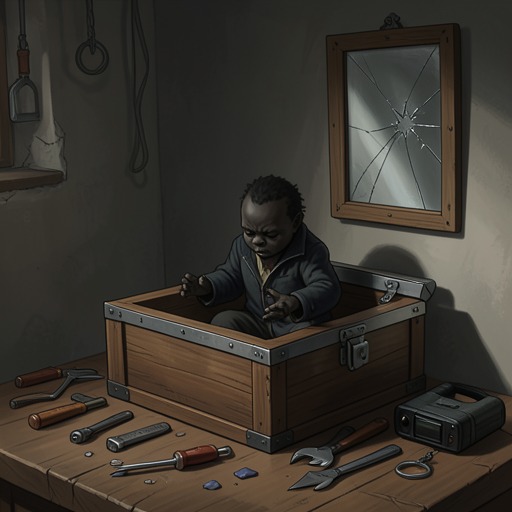
Homunculus confinement requirement
HomunculusThe Homunculus confinement requirement holds that the Homunculus must remain in a box, but that the enclosure must allow it to breathe. This condition makes confinement more than a matter of locking away a powerful being: the container has to preserve the life it restricts, and its necessary opening gives other characters a means to reason about what can be done with it.
Definition and Operation
In Nell Owlesby’s account, the Homunculus is described as prodigiously old and capable of arresting entropy. She says it can separate water into ice and steam and animate the carcass of a rat, yet its thwarting of time has left it shrunken. Despite those powers, it must be kept in a box. The account establishes the requirement without explaining why the box is necessary beyond the stated need to confine it.
The enclosure cannot simply be sealed. At the Trismegistus Club, William Keeble argues that the box is not airtight and that the Homunculus must breathe. His reasoning treats ventilation as a basic constraint on any plan involving the container: the occupant is a little man, not a fish, so confinement cannot mean suffocation.
Consequences for the Box
The breathing requirement turns the box into a practical weakness as well as a restraint. Keeble proposes that the group intercept the dirigible when it lands, take the box, and sink it in a stone-filled bag from Westminster Bridge while the river is in flood. This is a proposed plan, not a reported outcome. Its logic depends on the Homunculus needing air and on the box not being tight enough to isolate it from its surroundings.
Keeble also insists that the group should keep the box out of Ignacio Narbondo’s hands, connecting the physical problem of containment to the struggle over who controls the Homunculus. The rule therefore shapes both the handling of the object and the competing characters’ plans; it does not itself settle whether the box will remain secure or who will possess it.
Narrative Significance
The requirement places a limit on the Homunculus’s apparent power. Its abilities reach beyond ordinary life and decay, yet its confinement depends on a simple material condition: it must be enclosed, and it must breathe. The box is consequently neither an ordinary prison nor a fully sealed barrier. It is a device whose usefulness and danger arise from the same fact—that it can hold the Homunculus only while accommodating the needs of the being inside.