Commandor
HungerThe Commandor is the editor of a Christiania newspaper, a figure of considerable literary authority whose paper had exercised the greatest influence upon the protagonist from his earliest youth. He is described as having curly hair, beautiful brown eyes that are a little restless, and a habit of tweaking his nose. No Scotch minister could look milder than this truculent writer, whose pen always left bleeding scars wherever it attacked. The protagonist feels a peculiar feeling of awe and admiration in his presence, and the tears are on the point of coming to his eyes when he stands before him.
Professional Encounters and Rejections
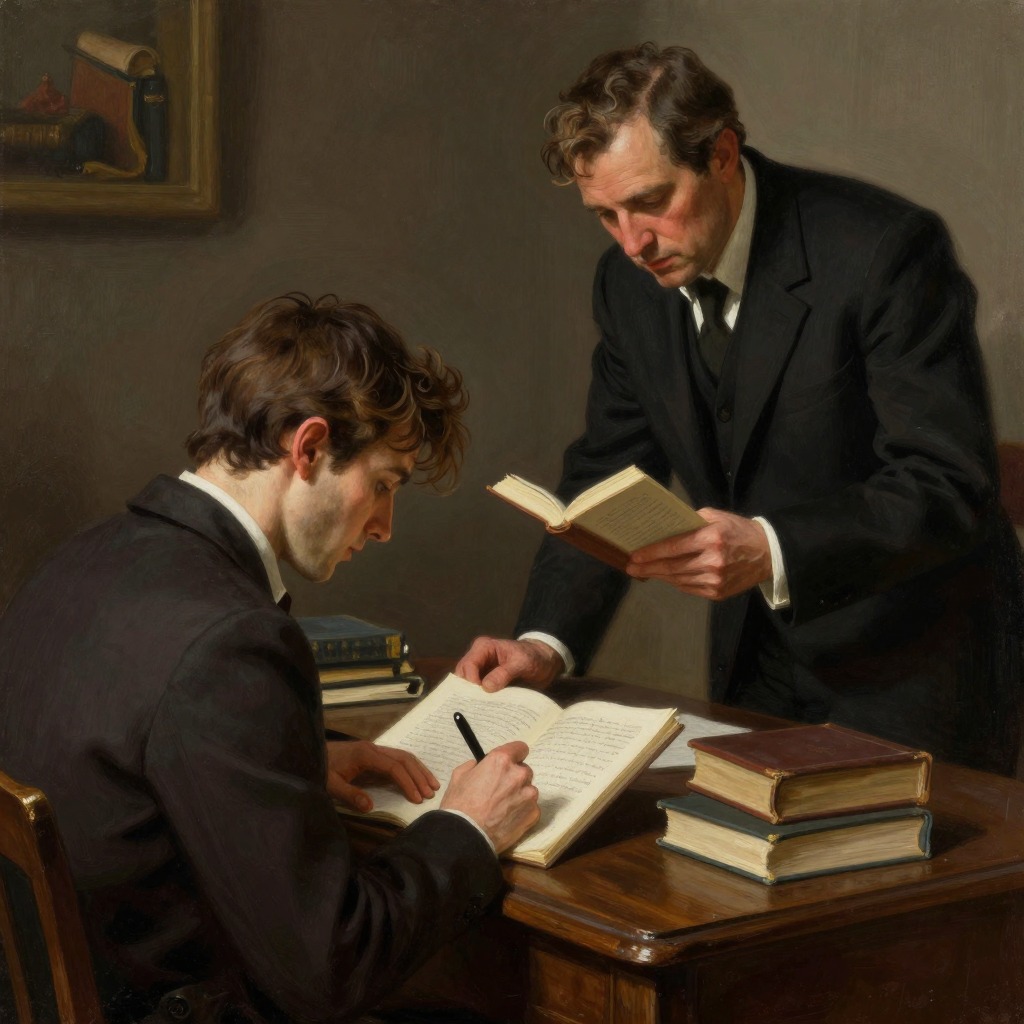
The Commandor first appears when the protagonist delivers a character sketch of Correggio to his office. The editor takes the papers, goes through them, and places them slowly together while considering. He explains that everything has to be of such a popular nature to be of any use to his paper, and asks if the protagonist cannot try to write something a little more commonplace or hit upon something that people understand better. His forbearance astonishes the protagonist, who understands that his article is rejected yet could not have received a prettier refusal. Despite the rejection, the Commandor offers that if the protagonist needs it, he is welcome to draw a little in advance, saying he can write for it. The protagonist, humiliated by this offer since the editor had just seen he was not capable of writing, declines, saying he can pull through yet a while. He makes a resolution not to return until he can bring something that satisfies him perfectly, something that would astonish the Commandor and make him order half-a-sovereign paid without hesitation.
The Second Encounter and Half-Sovereign
Weeks later, the protagonist encounters the Commandor by chance near the railway square. He is standing face to face with him, and in a state of desperation, he says he would have called upon him long ago with something but nothing has come yet. The Commandor replies in an interrogative tone, asking if he has not got it finished. The protagonist's eyes fill with tears at his friendliness, and he coughs with a bitter effort to regain his composure. The Commandor tweaks his nose and looks at him, then asks if he has anything to live on in the meantime. When the protagonist replies that he has not eaten anything that day, the Commandor exclaims that it will never do for him to go and starve himself to death, and he feels in his pocket. He hands the protagonist half-a-sovereign, making no fuss about it, simply giving it and reiterating that it would never do to let him starve to death. The protagonist stammers an objection and does not take it at once, feeling it is shameful and really too much. The Commandor tells him to hurry up, saying he has been waiting for the train and hears it coming now. When the protagonist takes the money, dumb with joy and never saying a word of thanks, the Commandor adds that it is not worth while feeling put out about it, as he knows the protagonist can write for it. He then goes off, leaving the protagonist standing on the pavement gazing after him, weeping quietly and silently.
The Protagonist's Ambition and the Commandor's Standards
The Commandor's standards shape the protagonist's creative ambitions. The protagonist works at an allegory about a fire, a profound thought upon which he intends to expend all his energy and bring to the Commandor in payment, hoping to show that the editor had helped a talent this time. He has no doubt but that the Commandor will eventually see that, and he works persistently, buoyed up by the hope of at last succeeding in getting together an article on some subject or another. The Commandor's rejection of the Correggio sketch, delivered with such forbearance, becomes a benchmark the protagonist measures himself against, and his offer of advance payment becomes a source of both humiliation and gratitude.
Narrative Role and Significance
The Commandor functions as a figure of literary authority who represents both the establishment's standards and the possibility of unexpected mercy. His rejection of the protagonist's work is delivered with a kindness that astonishes the protagonist, and his offer of half-a-sovereign at a moment of extreme desperation becomes a turning point in the narrative. The protagonist's reaction to the Commandor's generosity—weeping, being unable to thank him, and later trying to overtake him to express gratitude—reveals the depth of his degradation and the power of even small acts of kindness in a world of relentless poverty. The Commandor's presence in the novel underscores the gap between the protagonist's literary ambitions and his physical reality, and his occasional interventions highlight the precariousness of the protagonist's existence, where a single half-sovereign can mean the difference between life and death.