Poverty
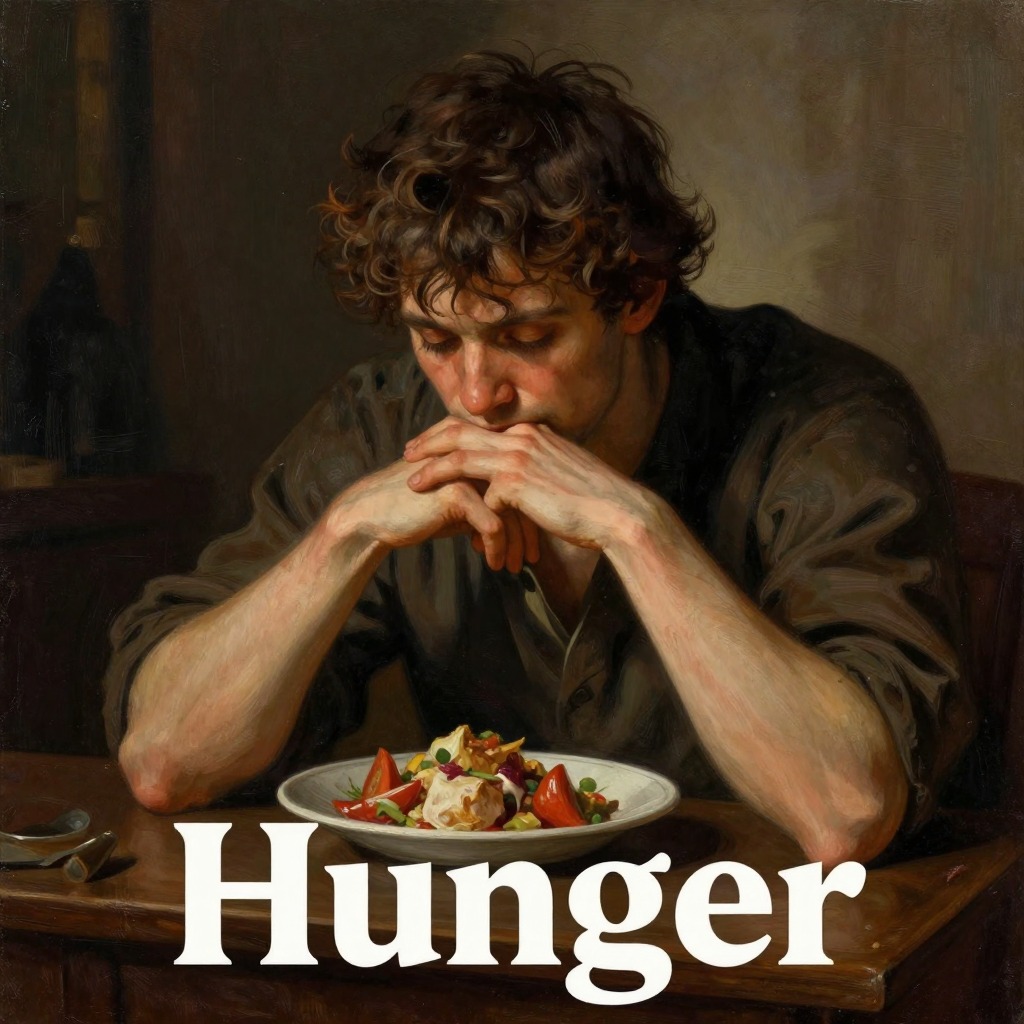
HungerPoverty is the central, relentless condition that defines the protagonist's existence in Knut Hamsun's Hunger, functioning not merely as a lack of money but as a totalizing state that erodes his physical health, mental stability, social identity, and moral compass, driving the novel's episodic plot and its profound exploration of human endurance and degradation.
Identity and Material Deprivation
The protagonist's poverty is established from the first pages as an all-encompassing material lack. He lives in a bare attic room with no stove, no proper door fastening, and walls papered with old newspapers, where he sleeps on his socks to dry them by morning. His belongings have been taken one by one to his "Uncle," the pawnbroker. He has no comb, no book, and his only diversion is a little red rocking-chair. His clothes are in tatters: he sprinkles water on the shiny knees of his trousers to make them look newer, and he pawns his waistcoat for one shilling and sixpence to get money for a meal. He cannot even afford a pencil, having left it in the pawned waistcoat pocket. His poverty is so extreme that he counts his remaining assets—a shaving-book with six tickets—as a treasure that cheers him. He is forced to lie about his address to a stranger, inventing the name "Happolati" on the spot, and later gives a false name, "Andreas Tangen," at the police guard-house when he is homeless. The constant need to manage appearances, such as blackening his trouser knees with spittle before applying for a job, underscores how poverty strips him of dignity and forces him into a life of petty deception.
Physical and Psychological Toll
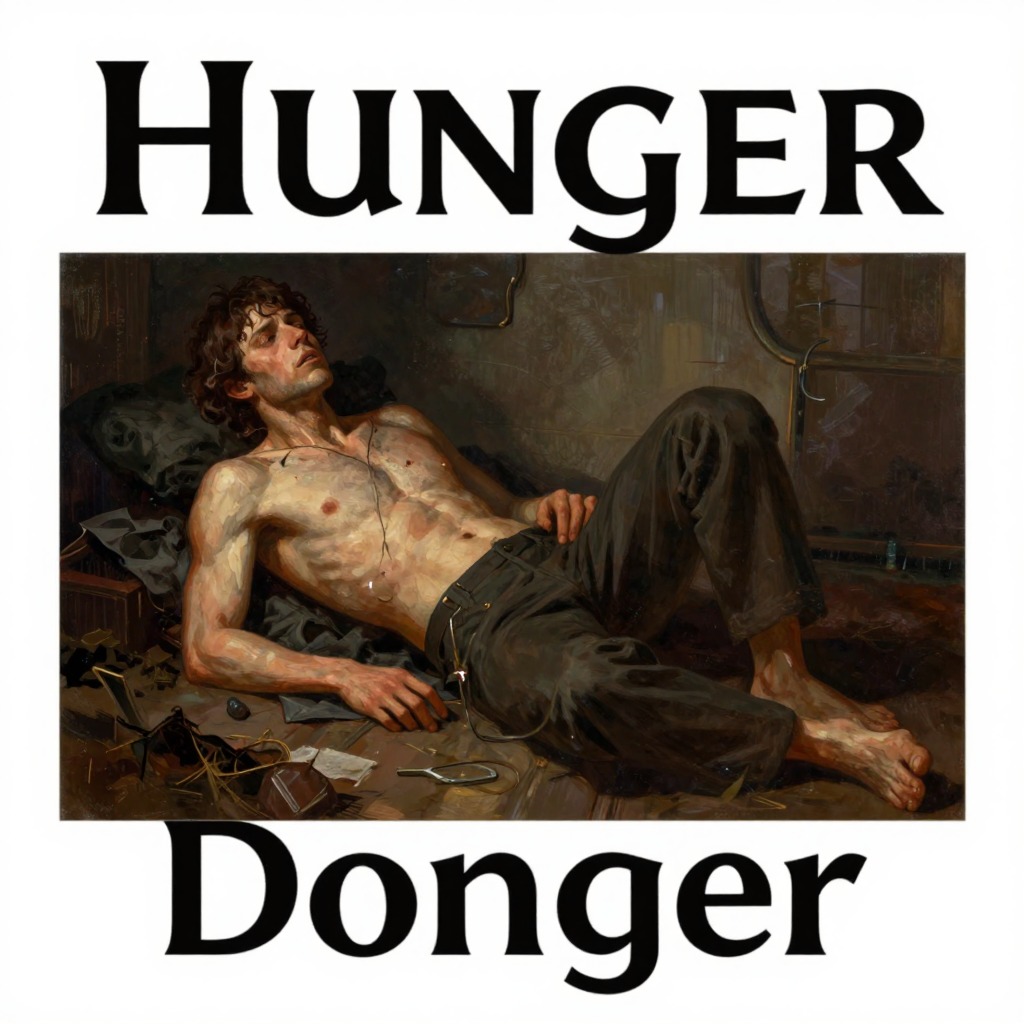
Hunger, the direct consequence of poverty, systematically destroys the protagonist's body and mind. He experiences vertigo, keeps his bed for days, and feels his brains "run quite gently out of my head," leaving a vacuum. His head grows light and far off, and his eyes stare too widely. He suffers from a gnawing in his chest, which he tries to stop by coughing or bending forward. His back and shoulders cause him the worst trouble. He examines his own body and cries over it: his shirt is stiff with sweat, his skin chafed, and a sore on his stomach will not heal. His hair falls out in masses, and he finds loose tufts on his pillow. His feet swell in his shoes, and he cannot move his toes. The psychological effects are equally devastating. He becomes nervous and irritable, subject to wild fantasies and hallucinations. He invents the word "Kuboa" in a feverish state and obsesses over its meaning. He experiences a "delirium of weakness" where he talks at random, yet is conscious of doing so. He is seized by a "madness" that he feels in his blood, and he fears being locked up. The poverty-induced hunger creates a cycle of physical collapse and mental fragmentation that makes sustained work or coherent thought nearly impossible.
Social Stigma and Isolation
Poverty marks the protagonist as an outcast, subject to the contempt and suspicion of others. A shop-boy looks at him contemptuously when he brings in a blanket to be wrapped. A young lady opens her door and says, "No, we have not got anything today," taking him for a beggar. A street girl, after searching his pockets and finding nothing, calls him a "dry cod." A servant-girl mocks him, asking if he has been to a dinner party at the palace, and laughs at his torn shoes, saying they are "as wide as a dog's house." Even a policeman calls him a "Juggins." The protagonist is acutely aware of this stigma: he feels shame when a lady looks at his knees, and he avoids acquaintances, slipping past them. He is rejected from the Fire Brigade on account of his sight, and a job application is dismissed because he dated his letter 1848 instead of the correct year. His poverty makes him a target for mockery and exclusion, reinforcing his isolation and despair. He is forced to beg for a bone for a dog from a butcher, and to accept a half-sovereign from the "Commandor" as an advance, which humiliates him. The social world of Christiania is a place where poverty is a visible, shameful mark that invites scorn and pity in equal measure.
Moral Struggle and Transgression
The protagonist's poverty constantly tests his moral boundaries, leading to a series of transgressions that he both commits and regrets. He steals five shillings from a shop-boy through a misunderstanding, then gives the money away to a cake-woman to cleanse his conscience. He attempts to pawn Hans Pauli's blanket, a borrowed item, but is unable to go through with it. He lies compulsively, inventing a false identity as a journalist for the Morgenbladet and claiming to be a book-keeper at Christensen's. He confesses his theft to the shop-boy, but does so in a way that is aggressive and self-justifying. He tears up his own manuscript in despair, and tramples on his hat. He even contemplates stealing a schoolgirl's savings or a poor widow's penny. These actions are not the result of a criminal nature but of a desperate need to survive. The protagonist is acutely aware of his own degradation, and he frequently weeps, curses God, and berates himself. His poverty forces him into a state where honor becomes a luxury he can no longer afford, yet he clings to the idea of it, creating a painful internal conflict between his principles and his needs.
The Cycle of Hope and Despair
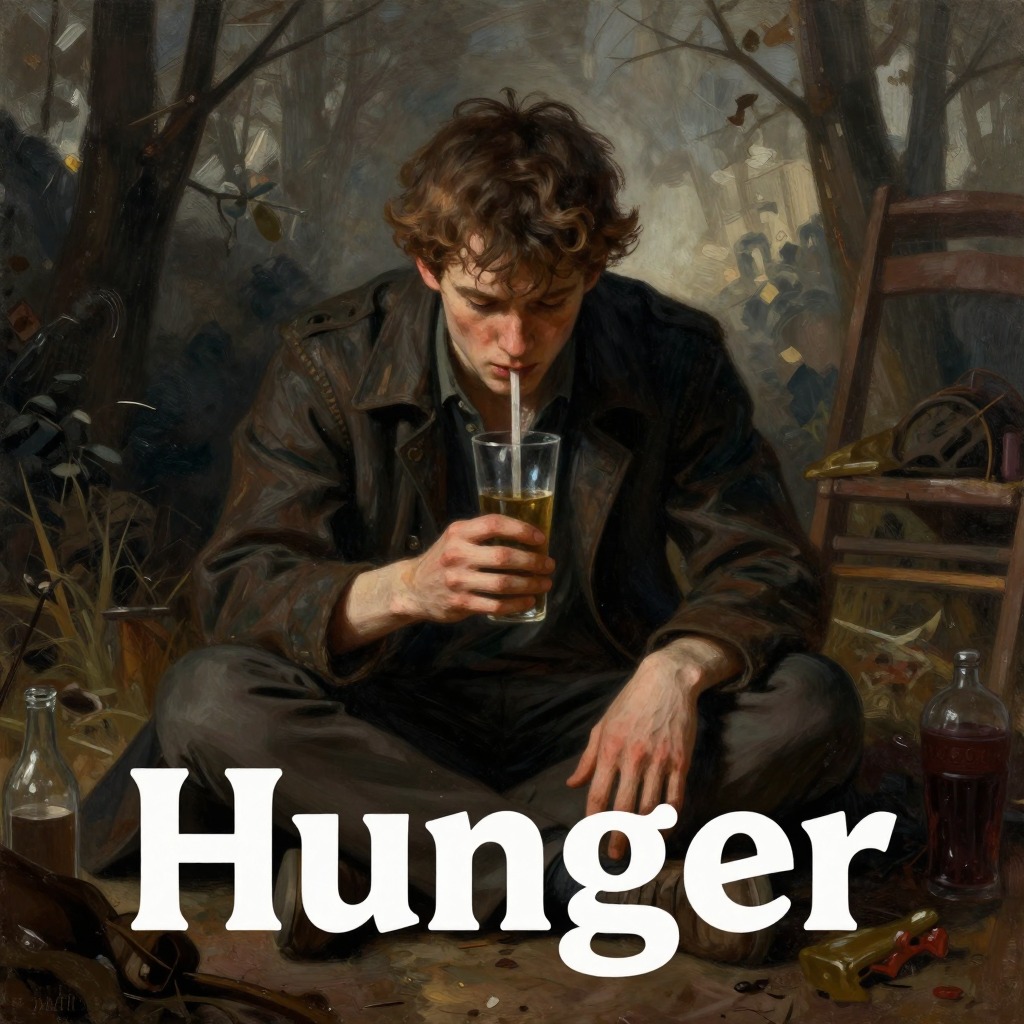
Poverty in Hunger is not a static condition but a cyclical one, marked by brief periods of relief followed by renewed deprivation. The protagonist receives ten shillings for a story, which lifts his spirits and allows him to pay for a room, but the money is soon exhausted. He then endures days without food, sleeping in the woods or in a police cell. He receives a half-sovereign from the "Commandor," which he immediately gives away. He is given a room in a lodging-house, but is eventually turned out when he cannot pay. Each small success—a published article, a charitable gift—is followed by a deeper fall. The cycle is punctuated by moments of intense hope, such as when he believes he has written a masterpiece, and crushing despair, when he realizes his work is worthless. This pattern creates a narrative rhythm of rising and falling, mirroring the protagonist's fluctuating physical and mental state. The novel's structure, divided into four parts, reflects this cyclical nature, with each part ending in a crisis that is temporarily resolved, only to begin again. The final departure on the ship Copégoro offers a potential escape, but it is an escape into an uncertain future, not a resolution of the poverty that has defined his life.
Thematic Significance
Poverty in Hunger is not merely a social or economic condition but a philosophical and existential state. It is the lens through which the protagonist confronts the fundamental questions of existence: the nature of God, the meaning of suffering, the limits of human endurance, and the value of honor. He rages against God, accusing Him of being a "bungler" and a "Gracious Monster on High." He questions why he, of all people, has been singled out for persecution. His poverty strips away all pretense and forces him to confront his own bare, animal existence. It is the engine of the novel's psychological intensity, driving the protagonist to the brink of madness and back. The novel suggests that poverty is not just a lack of money but a condition that permeates every aspect of a person's being, shaping their thoughts, actions, and relationships. It is a state of being that is both a curse and a kind of brutal education, revealing the depths of human resilience and the fragility of the self. The protagonist's journey is a testament to the power of poverty to both destroy and, paradoxically, to create a unique, if harrowing, form of consciousness.