VIP Section
HungerThe VIP Section, or "reserved section," of the Christiania guard-house represents a formalized hierarchy within the city's system for managing the homeless. It is a space where social status, even when fabricated, can temporarily shield a person from the harshest realities of destitution, yet it remains a fragile refuge, subject to the whims of institutional authority and the individual's own unraveling sanity.
Definition and Institutional Context
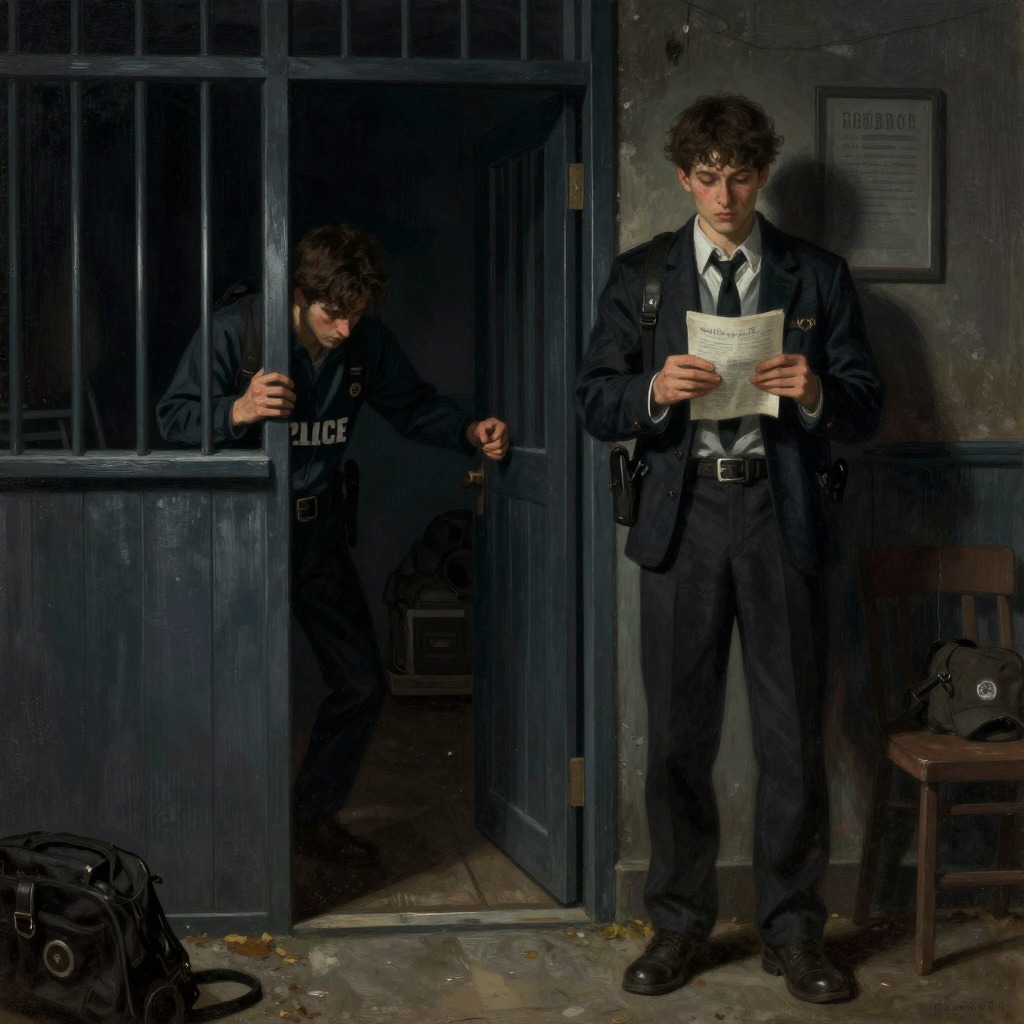
The VIP Section is a specific part of the guard-house, distinct from the general holding area for the homeless. When the protagonist, having lost his key and unable to enter his lodging, is directed to report himself as homeless, the officer on duty, after hearing the false name "Andreas Tangen" and the occupation "journalist" for the Morgenbladet, instructs a policeman to "show this gentleman up to the reserved section" . This designation is not a matter of official policy but a discretionary act by the guard, who responds to the protagonist's fabricated social standing. The guard's polite bow and the phrase "reserved section" immediately set the protagonist apart from the other homeless individuals, who are processed in a large room and given tickets for breakfast . The VIP Section is thus a space where a convincing performance of respectability can secure a private cell, a privilege denied to those who cannot or will not play the part.
Experience and Privileges
The cell itself is described as "bright" and having "a friendly air," a stark contrast to the protagonist's usual accommodations . He feels "comfortably and well sheltered" and listens with pleasure to the rain outside, wishing for nothing better . The cell is equipped with a gas jet that provides light for ten minutes before going out . The protagonist's contentment is so great that he amuses himself by acting the part of a Cabinet Minister, calling himself "Von Tangen" and clothing his speech in red-tape . This performance is a continuation of the lie that gained him entry, and it underscores the theatrical nature of the VIP Section's privileges. The cell's relative comfort, however, is a temporary reprieve, not a solution to his underlying condition.
Vulnerability and the Limits of Privilege
The VIP Section's protection is not absolute. The protagonist's night in the cell is marked by a terrifying descent into madness, triggered by the absolute darkness after the gas goes out . He experiences hallucinations, invents the word "Kuboa," and wrestles with the fear of insanity, ultimately springing out of bed and flinging himself against the door . The cell, which initially felt like a sanctuary, becomes a space of psychological torment. The next morning, the protagonist is released without incident, but the experience reveals that the VIP Section cannot shield him from the internal ravages of hunger and exhaustion. Furthermore, the privilege is contingent on maintaining the lie; when he later encounters a policeman who might recognize him, he is filled with fear . The VIP Section is a fragile construct, dependent on a performance that the protagonist is increasingly unable to sustain.
Significance and Thematic Resonance
The VIP Section functions as a microcosm of the novel's central themes: the arbitrary nature of social hierarchy, the performance of identity, and the failure of institutional systems to address genuine human need. The protagonist's brief stay in the reserved section is a darkly comic episode that highlights how a fabricated identity can unlock doors that genuine desperation cannot. Yet, the cell's inability to prevent his mental breakdown underscores the novel's argument that hunger and poverty are not merely material conditions but existential crises that no amount of institutional accommodation can resolve. The VIP Section is a temporary, illusory shelter, a stage on which the protagonist plays a role that ultimately cannot save him from himself. The rule that allows for such a space is a testament to the city's capacity for a kind of bureaucratic charity, but it is a charity that demands a performance of worthiness, a performance that the starving and desperate are often least able to give.