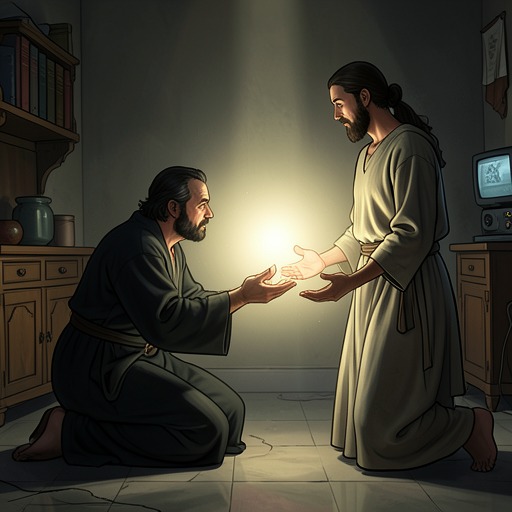
Passover
JudasPassover is the feast around which Shmuel Ash’s reconstruction of Judas’s role in Jesus’s final journey is organized. In Shmuel’s account, Judas believes that the crowded festival in Jerusalem will provide the stage for Jesus to reveal his divinity and inaugurate the kingdom of heaven; the crucifixion instead ends in Jesus’s death. The same calendar setting recurs in the account of Judas alone after the event, as the Sabbath and Passover begin around him and his faith gives way to grief and isolation.
The Feast as a Public Stage
In Shmuel’s reconstruction, Passover gives Judas a reason to urge Jesus to leave Galilee for Jerusalem. The feast will draw pilgrims from across the region, creating the immense gathering before which Judas expects Jesus to perform a miracle that will persuade the public and the wider world. Judas imagines Jesus being crucified in full view of Jerusalem and then descending alive from the cross. The expected outcome is not simply survival: the assembled people, from priests and ordinary residents to Roman authorities and religious groups, will recognize Jesus, and the kingdom of heaven will begin. Passover thus gives Judas’s plan its audience, timing, and promised political and religious consequence.
The timing also sharpens the contrast between Judas’s expectation and the account’s outcome. He wants the crucifixion to become a public revelation, but Jesus dies before the festival, and the anticipated recognition never comes. In this telling, Passover’s crowded setting magnifies the gap between a hoped-for universal transformation and the failure of the sign on which that hope depends.
Crucifixion and the Question of Payment
Judas’s role in arranging the crucifixion is connected directly to the approaching feast. Shmuel describes him as working through his influence among Pharisees and priests to bring Jesus to trial and arrange for him to be crucified alongside two minor criminals shortly before Passover. The Romans, Shmuel argues, had little interest in Jesus, whom they could regard as one among many itinerant prophets and miracle-workers; Judas therefore had to persuade others to act.
Shmuel also challenges the familiar account of the thirty pieces of silver. He suggests that the payment may have been invented by later enemies of Israel, or possibly by Judas himself as a way to complete the story. In his reasoning, the sum was worth the price of an ordinary enslaved person, an implausibly large reward for the arrest of a publicly known man who had made no effort to conceal his identity. The argument recasts the betrayal narrative: Judas’s defining action in Shmuel’s version is not a profitable transaction but the organization of a crucifixion intended to make Jesus’s identity unmistakable at Passover.
The Feast in the Retelling of Judas
Elsewhere in Shmuel’s manuscript, Passover fixes the scene of the crucifixion in a later retelling. He recalls the crowd calling on Jesus to save himself and descend from the cross, and imagines Judas also urging his teacher to come down before the people disperse. This version keeps the same central expectation alive at the moment when it is most threatened: Judas still believes that Jesus will descend and reveal himself. Yet the crowd’s departure makes the hoped-for public recognition feel increasingly urgent, not more certain.
Shmuel’s account of Judas’s fate also turns on the difference between the expected miracle and the death that follows. He asks why a man who had supposedly sold his teacher for money would then take his own life from grief, and observes that none of the other apostles died with Jesus. Judas, in this interpretation, is the one who cannot go on living after the Savior’s death. The Passover crucifixion therefore becomes central to Shmuel’s attempt to recover Judas from a tradition that condemns him: the man who arranged the event did so, in Shmuel’s account, because he believed Jesus would survive it and be recognized.
After the Festival’s Promise Fails
The narrative later places Judas alone in an empty tavern shortly before closing, as the Sabbath and Passover are about to begin. Food and wine have been set before him, but he does not eat or drink. His thoughts turn to a poor pregnant young woman with no one to protect her, and to the cries that he still associates with the crucifixion. The scene links the festival’s arrival to the immediate aftermath of the event: while Passover begins, the mercy and redemption Judas expected have not appeared, and he imagines the world as empty of compassion.
Judas then leaves the tavern and continues along the road. At the dead fig tree, he chooses a branch and ties the rope. The timing is significant to the shape of the narrative, not as a festive observance but as a stark counterpoint: Passover, which in his plan was to bring a public revelation and the beginning of a new kingdom, arrives instead in the shadow of Jesus’s death and Judas’s final act.
Historical and Interpretive Contexts
The feast also belongs to the larger history of how Jesus and Judas are remembered. Shmuel’s research considers Jewish and Christian accounts of Jesus, including a passage in Josephus that places Jesus’s crucifixion before a claimed appearance on the third day. The passage’s authenticity is disputed in the account: scholars such as Gustav Yom-Tov Eisenschloss regard its Christian language as evidence that it was later altered and inserted, while another version attributed to Agapius presents Josephus as describing what Jesus’s followers believed rather than affirming the resurrection as fact. Passover’s role in the novel thus sits within a broader inquiry into how later communities have narrated the events surrounding Jesus’s death.
Shmuel also emphasizes the silence surrounding Judas in Jewish writing about Christianity. Even Jewish authors who challenged Christian accounts of Jesus generally avoided discussing Judas, despite the central part he plays in the crucifixion story. That silence matters to Shmuel because his alternative account depends on reading the Passover event differently: Judas is not merely the betrayer whose payment explains his action, but the organizer of a public test founded on belief in Jesus. The feast becomes the point at which that interpretation is tested—and the point at which its promised revelation fails.