Natural hierarchy and might-makes-right
JustineNatural hierarchy and might-makes-right is the libertine doctrine that turns unequal power into a supposed natural entitlement: the strong may rule, exploit, or discard the weak, while gratitude, pity, mutual obligation, and legal restraint are dismissed as obstacles. Across the novel, this reasoning changes its vocabulary—from property and political economy to family authority, sexual domination, and social order—but its practical result remains the same: the powerful present their advantage as Nature’s law, and the vulnerable are told that resistance has no legitimate basis.
The Doctrine of Power as Right
In the argument over marriage, the Comte de Gernande claims that an obligation to make another person happy can exist only between people with comparable power to harm one another. Such a relationship, he says, would require a contract limiting each person’s use of force. Because husband and wife are not equally strong, he rejects the possibility of a binding mutual agreement: the weaker party, in his account, has no claim to kindness simply by virtue of the relationship.
The Comte extends this premise by treating pity as conditional and self-interested. A powerful person, he argues, need feel compassion only for someone whose sympathy might matter in return. Where superiority ensures permanent ascendancy, the strong have no reason to sacrifice their advantage. He likens a wife’s claim on her husband to a chicken’s claim on the person who eats it, reducing an intimate relationship to the use of a dependent possession.
From this foundation he draws an openly coercive conclusion: the weaker must submit, while the stronger may seek happiness through the fullest exercise of domination. He presents inequality between the sexes as evidence that Nature intends one sex to tyrannize the other, and insists that the greater the powerful person’s authority and the misery it imposes, the more fully that person supposedly answers Nature’s purpose. The argument does not merely excuse an individual act of cruelty; it recasts domination as an order that the victim has no standing to challenge.
Nature, Custom, and the Uses of Argument
Other libertine speeches deploy the same method beyond marriage. Monsieur du Harpin attempts to recruit Therese into stealing a wealthy neighbor’s gold box. He describes robbery as indifferent to morality and even useful because it restores a kind of balance to unequal property. He also appeals to the rarity of punishment and to historical societies that honored theft as proof of courage and skill. The lofty examples make a private scheme sound like a general principle, while the promised reward—an additional crown for two years—shows the material purpose beneath the theory.
The Comte de Bressac applies a related natural-philosophical argument when he tells Therese he has decided to kill his aunt and wants to use her hand in the crime. He claims that a person cannot truly annihilate life, only alter its forms: matter returns to Nature’s vast process in another shape. On that account, killing does not injure Nature, and the destruction of a human being has no special moral weight. His reasoning transforms a planned murder into an allegedly inconsequential change of form, attempting to neutralize Therese’s horror through abstraction.
At the Saint Mary-in-the-Wood Monastery, Rodin and Rombeau likewise give violence the language of useful knowledge. They discuss killing Rodin’s fifteen-year-old daughter for dissection, claiming that a young body would provide anatomical information unavailable by other means. Rodin argues that a single child may be sacrificed for the benefit of millions and denies that fatherhood should restrain him. He supports that denial with examples of ancient laws and customs that granted parents power over their children, including infanticide. The appeal to science and historical precedent gives the proposed crime the appearance of public necessity, even as the speakers treat a particular child as material for their research.
Clement’s defense of his tastes extends the doctrine from violent acts to desire itself. He argues that tastes, however criminal society may judge them, arise from the individual’s organization by Nature, and asks what right law or society has to demand that a person suppress them. He further questions whether anyone can remake himself. In this formulation, natural determination cancels moral accountability: because desire is presented as given, restraint appears as an unjust demand. The recurrent move is to make a claim about what is natural do the work of an argument about what is permissible.
Wealth, Dependence, and Ingratitude
Roland turns the hierarchy of strength into an account of wealth and social rank. When Therese protests that she saved him and appeals to gratitude, he denies that her rescue created any obligation. He recasts her act as a pleasure she chose for herself, then argues that a rich man should not owe anything to someone he calls inferior. Civilization may alter the means by which rank is established, he says, but it cannot remove Nature’s right to place strong beings above weak ones: gold, rather than physical force alone, makes the richest person the mightiest.
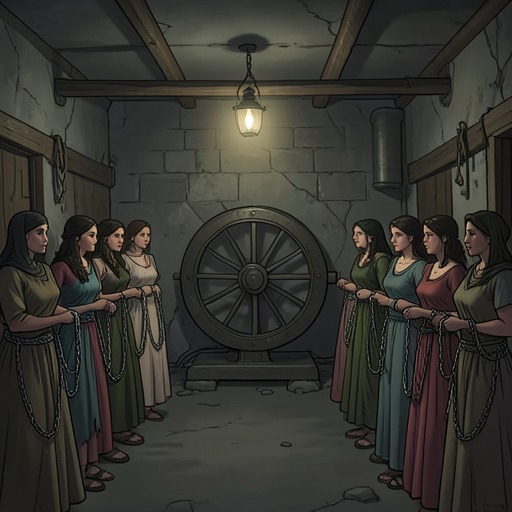
In Roland’s account, the person who receives help is humiliated by the debt, while the benefactor enjoys the superiority conferred by having helped. Ingratitude therefore becomes, for the proud, a virtue; gratitude belongs to the humble. The argument reverses the usual moral meaning of obligation. A service does not bind the powerful recipient; instead, the recipient claims that acknowledging the debt would injure his pride. This is not an abstract dispute for Therese: after refusing her plea, Roland has her seized, stripped, shackled, and put to work, making coercive authority the reality behind his theory.
Roland applies the same logic to poverty. He calls indigence part of the natural order and argues that relieving it would disrupt inequality, encourage idleness, and foster demands on the rich. He even proposes hanging seven or eight thousand beggars as a way of eliminating them, comparing poor people to vermin or parasitic plants that may be removed for the health of a body or garden. When Therese invokes religion, benevolence, and humanity, he identifies those principles as obstacles to his happiness and boasts that he has risen through ruining the poor, stealing from the rich, and sacrificing the weak. His language of social equilibrium thus protects privilege by treating relief as a threat and mass violence as a remedy.
Repetition, Contradiction, and Narrative Effect
These speeches are not isolated philosophical set pieces. Across the novel, different perpetrators recruit claims about Nature, law, science, history, or social order to make exploitation appear inevitable or beneficial. Du Harpin’s defense of theft borrows from political balance and ancient custom; Bressac’s defense of murder makes life a reversible material process; Rodin and Rombeau invoke research and parental authority; the Comte de Gernande turns inequality into a theory of marital rights; Clement treats desire as an inborn condition; and Roland makes wealth the modern measure of strength. Their different premises converge on the same permission: the person with power need not answer to the person who suffers its use.
The speeches also expose how claims of universal natural law are tailored to the speaker’s immediate advantage. The Comte’s doctrine licenses his domination of his wife; Roland’s makes his wealth and cruelty evidence of superiority; Du Harpin’s makes a planned theft sound socially useful. Each speaker treats the existing distribution of power as proof that the distribution is rightful. The doctrine therefore works less as a neutral explanation of the world than as an instrument that translates advantage into moral alibi.
The contrast with Therese’s responses gives the doctrine its narrative force. She rejects Du Harpin’s attempt to turn her into an accomplice, recoils from Bressac’s proposal to make her murder his aunt, and appeals to gratitude, pity, religion, and humanity when confronting the powerful. Such appeals do not persuade the men who control her circumstances. Instead, their repeated failure shows the gap between moral obligation and enforceable power: the libertines can make their reasoning consequential because they can act on it, while Therese’s ethical objections leave her exposed to their retaliation. The novel’s recurring irony is that the speakers describe domination as Nature’s impartial order even as they use that claim to defend intensely personal interests.