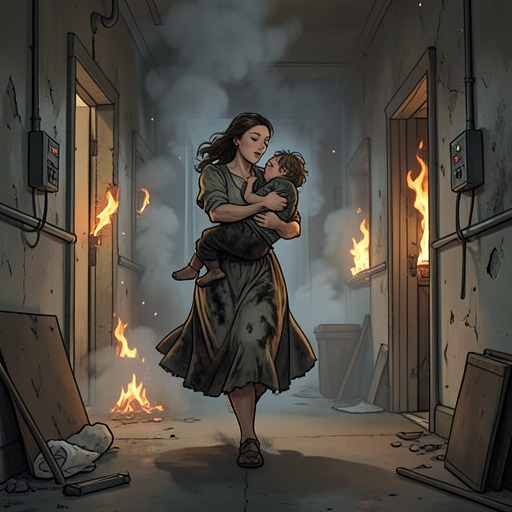
Roland's betrayal and enslavement of Therese
JustineRoland's betrayal and enslavement of Therese is a decisive reversal in Therese’s account: after she stops to aid a man who has been attacked, he offers her a place in his household, then reveals that he is the chief of a criminal operation and that she is to be held there against her will. The episode turns an act of charity into the means of capture, and gives Roland’s libertine argument about gratitude a brutal practical consequence.
Rescue and the promise of employment
Therese encounters Roland on the road near Vienne, where two riders have left him injured. Though she is herself destitute and has reason to fear involvement with strangers, she approaches him, helps him recover with spirits and wine, and tears one of her blouses to bandage his wounds. She has little left to spare, but gives up part of it to assist him. Roland responds with apparent gratitude and asks what he can do for her. Therese tells him of her misfortunes, trusting that someone whose life she has helped save will feel bound to help her in return.
Roland introduces himself as the owner of a mountain château and says that he needs someone to wait upon his beloved sister. He offers Therese the vacant position. For her, the proposal appears to answer an urgent need: work promises shelter and a way to live without accepting the criminal employment she has previously resisted. Roland’s account of his wealth and his explanation for traveling on foot reinforce the impression that he is a prosperous man with a household to offer, not the source of a new danger.
The journey into isolation
Therese and Roland set out together, initially traveling to an inn and then continuing by mule. They stop at Virieu before heading into the Dauphiné highlands. The farther they travel, the less reassuring the setting becomes. The route climbs for more than four leagues through difficult mountain country, away from settlements and ordinary roads, until they reach an isolated fortress above a precipice. Therese’s unease grows as the journey carries her deeper into a place from which escape appears increasingly difficult.
The last details of the journey sharpen the reversal. Roland dismisses the muleteer who has accompanied them, leaving Therese without even that limited outside connection. When she questions the character of the place, Roland confirms that its inhabitants are dishonest: he is taking her to serve the counterfeiters of whom he is chief. His offer of domestic work has been a deception, and the isolated château is not a safe household but the center of a criminal enterprise.
Forced labor and Roland’s doctrine
On entering the courtyard, Therese sees four women, nude and shackled, turning a wheel in a deep grotto. Roland identifies them as her companions and tells her that she too will be required to work there for ten hours a day. He sets out the ration she is to receive—six ounces of black bread and a plate of kidney beans—and declares that she will not regain her freedom. He threatens that those who die from overwork will be thrown into a nearby pit, where the remains of between sixty and eighty others already lie. Therese pleads with him to remember that she saved his life and that he seemed to offer happiness in return; her appeal makes explicit the gap between the employment she expected and the captivity he has arranged.
Roland rejects the idea that her help entitles her to repayment. He argues that Therese acted because she chose the pleasure of helping him, not because he asked her to, and therefore has no claim upon him. He extends the argument into a defense of ingratitude: to him, receiving a favor is humiliating because it places the recipient beneath the benefactor, while refusing repayment preserves the pride of the powerful. This reasoning recasts kindness as a self-contained pleasure and denies that it creates any obligation between people. At the château, the doctrine is not abstract. Roland’s wealth and force let him impose his interpretation on the woman who trusted him.
Capture and significance
After making this argument, Roland gives Therese no opportunity to answer. His servants seize her, strip her of her belongings, and shackle her beside the other women, putting her to work immediately after the exhausting journey. He then punishes and humiliates her, invoking the brand left by Rodin as part of his abuse and striking her as a warning about what will happen if she fails at the task. The incident makes the promised employment disappear entirely: Therese is treated not as a worker with an agreed position but as a captive whom Roland claims the right to use and control.
The episode repeats a pattern established by Therese’s earlier history. Orphaned and left with only a small share of her family’s lost inheritance, she has repeatedly had to seek work or assistance from people whose wealth gives them power over her choices. At Monsieur Dubourg’s house, her poverty exposed her to a predatory proposal; later, she learned that a man who had exploited her distress prospered financially. Roland’s offer follows the same material imbalance in a more openly organized form: he presents a position to someone with few alternatives, then converts dependence into imprisonment. The episode therefore connects Therese’s personal misfortune to a wider economy of exploitation, in which need supplies powerful men with people they can recruit, deceive, and dispose of.
Its narrative form intensifies that connection. Therese recounts the encounter as part of her testimony to Madame de Lorsange and Monsieur de Corville, listeners who have asked how she came to be accused and brought before them under guard. Her account of Roland’s deception belongs to the long sequence of reversals she discloses to them, giving the isolated mountain château a place in a larger history of repeated vulnerability. The contrast between her expectation of gratitude and Roland’s celebration of ingratitude is especially stark because she has just demonstrated care at personal cost. In this episode, that care is not rewarded; it becomes the opening through which a stronger man takes control.